Showing posts with label Lynn Varley. Show all posts

Monday, April 4, 2022

Frank Miller's DARK KNIGHT RETURNS: good or bad?


So, that's not a totally fair title, but I prefer it to my original click-bait idea: "Why do I accept Frank Millers' Fascistic Superman?" Anyway...

Batman: The Dark Knight Returns by Frank Miller, Klaus Janson, and Lynn Varley.
One of the best selling comics of all time.
One of the most influential comics of all time.
A classic from one of the all-time great creators in comics.
You may not read comics, but it's quite possible you have read Dark Knight. Along with Alan Moore's & Dave Gibbons's Watchmen, it ushered in a new era of superhero comics from which we have yet to disentangle ourselves, despite attempts to do just that by many creators, including Alan Moore himself. But! This is a post about Dark Knight, so let's get to it. 

Since the start of COVID, my buddies and I have been talking comics over Zoom, on a weekly basis. Our latest discussion was on Dark Knight, and it didn't go as I expected. Popular opinion would have you believe this work is unassailable, a pinnacle of comic book storytelling, the greatest Batman tale ever told, a superhero story for the ages. For the most part, you would get little argument from me ('greatest' might be a stretch, but it's in the discussion). So, when a couple of my friends revealed the clay feet upon which this classic piece of comic art stands, I was surprised. But they're smart dudes, so I was ready to hear them out . . . and then tell them why they were wrong! 

An aside: I feel like I should get my personal history with this book out there, because it is pertinent to the discussion as well as to my consideration of the book. I started collecting comics in 1984, when I was 12 years old. I grew up in a small town and did not discover comic book shops until 1988 or '89. In 1987, I found the Warner Books edition of Dark Knight Returns, in my local bookstore, Mr. Paperback's. I immediately bought it. Having read very few -- and possibly none at all -- Batman comics at that point, this was basically my introduction to the character. It made a lasting impression on me, and I have re-read it multiple times through the years. I know it well, and I thoroughly enjoy it. 

Aside #2: A brief summary of Dark Knight. Bruce Wayne is 55 years old. Batman has not been seen for a decade. Superheroes have been outlawed, and even saying their names on television is not allowed. The only one left is Superman, working covertly for the U.S. government. But, the animal inside cannot be contained, Batman returns to clean up Gotham, and Superman is sent in to stop him; it ends in a stalemate. Except . . . Bruce is good with chemicals, and he ingested a concoction that made him appear dead when he was merely in hibernation. Kal-El (Superman) attends the funeral, and his super-hearing picks up a heartbeat, just as he's about to leave. But he's willing to let Bruce wage his war, if he keeps it low-key. 

Two of my friends were critical of Dark Knight, one more than the other. Their main point of contention was the characterization of the two main heroes: Batman and Superman. Both of them felt that Miller wrote these characters completely wrong. Regarding Batman, they could never see him giving up on Gotham or going into retirement; it's not in Bruce Wayne's nature. He's obsessed about instilling fear into criminals in order to clean up his city and make sure nobody ever experiences the tragedy he did when his parents were shot dead in Crime Alley. Superman, to their minds, is written as a bootlicker who follows orders from a fascist authoritarian, in the form of the broadly satirical Ronald Reagan. The prime example of this comes after the nuclear fallout of the missile Superman barely diverted. Even with crime rampant in cities across America, Gotham -- previously the most dangerous city in America -- is now experiencing a substantial decrease in crime due to the Batman's actions. Despite that, Superman is sent into Gotham to put a stop to Batman. Because, the law. 

These points are valid. In all honesty, I'd never thought too deeply about the characterizations of Batman and Superman, or the other supporting characters, in this book. I just went along for the ride. That said, I agree completely that Batman and Superman are totally out of character in Dark Knight. But, I don't think that's a problem. And here's why: because I love being right

Or maybe there are better reasons. 

The most important thing to remember -- despite DC's desire to shoehorn this book into Batman's main continuity -- is that Batman: the Dark Knight Returns is an Elseworlds story, a tale from a parallel universe, where all the heroes' names are the same, but they are, to various degrees, slightly different. This is essential, I feel, to accepting and fully understanding Dark Knight.
(Allowing that all art is subjective, so you may understand it differently, and that's cool too, but wishy-washy statements don't make for compelling arguments. But I digress. Let's get back to our regularly scheduled program.)

In this Dark Knight continuity, Batman and Superman (as well as all the other notable characters) have aged beyond the perpetual 28 years they inhabit in the main comic books. Bruce Wayne is roughly 55, as Miller wished to make the character as old as his legend. Superman would also be around 55, though his Kryptonian physiology seems not to have dampened his powers. Jumping off from there, Miller wanted to craft a narrative that examined what a Bruce Wayne/Batman of 55 might be like. He wanted to look at how that would have affected him not only physically, but also emotionally. Sure, Bruce Wayne is a superhero, but age has a way of slowing you down, making you second guess your abilities, infusing doubt where it might not have resided before. It's an intriguing premise, and one that I appreciate seeing played out in Dark Knight

These characters have also experienced very real change in their lives, and they live with that hanging over them. Again, this is unlike the main comics in that, though there is the illusion of change and the hyperbole of earth-shattering events in those books, for the most part these incidents have very little impact on the characters. DC, as a publishing entity, needs to keep the status very much in quo so people will continue to buy their comics. There can be no real changes in these characters' lives; it's too much of a risk. Therefore, Batman, Superman, et al. plod along, ageless icons, experiencing titanic events, but never seeming to feel their repercussions. 

Miller wasn't interested in working within the status quo. He wanted to put these heroes under a microscope and poke at them, see how they might react to having experienced real tragedy, real change, real evolution. Jason Todd died ten years prior, a cataclysmic event from which Bruce Wayne found it nearly impossible to come back. For a decade he allowed Batman to remain dormant, so that no such personal tragedy might happen again. It can be assumed that, even if he were not directly responsible (and maybe he was), Bruce feels wholly responsible for the death of Jason, who took the mantle of Robin after Dick Grayson grew out of the name. This has weighed heavily upon him. 

Also in that time, superheroes have been outlawed. It seems a safe assumption that the timeline for this legislation parallels that of Bruce's tragedy -- ten years. As a result, Hal Jordan (Green Lantern) left Earth for the stars, Diana Prince (Wonder Woman) went back to her people, and Superman became the not-so-secret secret weapon of the U.S. government. Similar to the disbanding of the Justice Society when they refused to divulge their identities in the HUAC hearings, it can be assumed that heroes became suspect by regular civilians, that they were no longer trusted, and, thus, outlawed. Most of them retired, but Superman could not. His powers, and the responsibility instilled in him by Ma & Pa Kent -- who also taught him to respect authority, an important point -- meant he needed to find a way to continue helping humanity. So, he took the only path that he felt had been afforded him. He worked under guidance from the U.S. government, keeping a low profile but still doing good. 

Both of these heroes have gone through personal upheaval and been changed by that. This is why, I think, I am able to accept their characterizations, even if they are "off" from how they are regularly written. Superman has always been the rule follower, while Batman the rule breaker, and the idea that Superman would go along with the government if it meant he could contribute to bettering the world, even in some small way, works for me. Batman was responsible -- at least indirectly -- for the death of a teenager, Jason Todd. This would have a profound effect on Bruce Wayne, could cause him to turn in on himself and reevaluate his actions. Extrapolating from that, he might retire, give up on Gotham, and try to just live out the rest of his life in a way that wouldn't put another child in danger. 

Of course, in the end, Bruce Wayne returns to Batman. And, in my reading of those final pages, Superman, with a knowing wink to Carrie Kelly, the new Robin, learns that there may be another way to help this adoptive world of his. 

Ultimately, these characterizations were due to Frank Miller wanting a battle between Batman and Superman at the end of Dark Knight. He needed them to be on opposite sides of the fence, so that he could bring them to Crime Alley, along with Oliver Queen, and show readers that given enough money, ingenuity, and obstinacy, a human can defeat a superhuman in battle, even if that victory is fleeting. 

Monday, October 11, 2010

Batman: the Dark Knight Returns pt 3


It's been a few weeks. But after some technical glitches, I finally made it onto the Legion of Dudes to help them discuss book 3 of Frank Miller's seminal work - Batman: the Dark Knight Returns. The link to the podcast can be found here.

And below are the notes I had for the episode:


- The voice-over in these first four panels perfectly gets across the character of Superman and of Batman. Simple and effective use of language. Miller is very good at boiling down the essence of these legendary characters.
He also has yet to show Superman in panel, giving us his POV in these shots, letting the image build in reader’s minds, making him larger than life, similar to how he’s treated Batman in the book as well.
- PAGE 3: Again, Miller utilizes the voice-over to quickly give readers a rundown of where Batman is at this point in his career.
- PAGE 4: Nice shout-out to Corto Maltese, the series by Hugo Pratt
- PAGES 5-8: Miller balances things well in these pages, introducing Superman (who has also not been seen for some years, apparently) through the new stories, which continues the back and forth of perspectives (the “acid” newsstand operator and the conservative advertising agent) while moving the story forward and exhibiting the atmosphere of the city through the back and forth of the newscasters (the one reciting the Superman mantra while the other warning her off that).
*And the way Miller evokes Superman as a streak of light, makes one think of a heavenly being, one that’s above us all, our savior, which is how he is perceived – a perception that Bruce doesn’t buy into and believes is a danger.
- The Soviet/U.S. tensions over the Corto Maltese incident mirrored the real-life tensions in the world at the time.
- PAGE 10: What a SPLASH page. My favorite of the series.
- PAGE 13: Thanks to the age lines Miller has given Joker, and Miller’s art style, this is one #$%^ing creepy Joker.
- PAGE 14: Our first look at Clark Kent, but still no Superman.
*Miller’s costuming, the use of cowboy boots, adds to the link he wants to give between Superman and the United States.
*And again, his voice-over perfectly captures the feelings Bruce has toward Clark
- PAGE 15: Reagan’s quote: “We’ve got God on our side . . . or the next best thing, anyway,” is very much like the Watchmen line: “Superman exists, and he’s American,” which we discovered in the backmatter was a misquote. It should have been, “God exists, and he’s American.”
- PAGE 16: Very cool we find out what happened to the other heroes, though at the time I first read this, I had no idea who Diana or Hal were.
- PAGES 18-25: “It’s been twenty years since I had to fight cops.” Again, the voice-overs are concise but tell us so much.
In this fight with the cops, we see again that Batman is not the Batman we know. He is old. He can’t manage against such odds. He needs Robin. By having this new Robin, Miller has given himself a natural way to get Batman out of the jams he puts himself in. It works so well.
- PAGE 26: Finally, SUPERMAN
- PAGE 29: I love how Batman is doing the Sherlock Holmes thing – dressing up in costume to get the information he needs. Very cool, and not done nearly enough in his regular series.
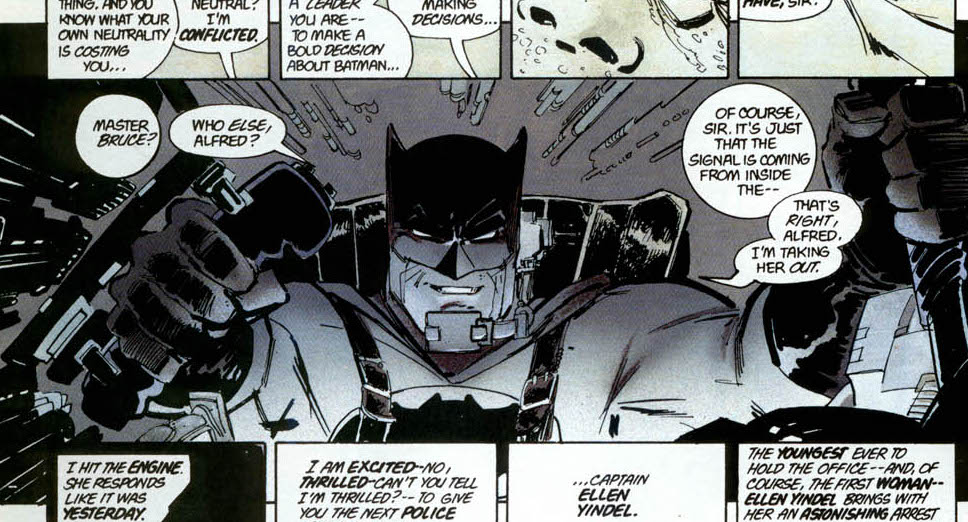
- PAGE 38: Another brilliant splash page. And the few lines on Batman’s face and the way he draws his teeth (all gritted) really shows that he’s old and having to work hard to keep doing what he is doing. Miller is complementing the story he created with his art, giving us a bigger, older Batman with his linework.
- THE FINAL BATMAN/JOKER BATTLE: It’s the little moments that make this fight shine:
o Joker’s dialogue: “Out of your mind –” & “This is too weird.” showcase that this is a different kind of fight for these two.
o Batman telling the boy to “watch his language”
- The Batman says it will all end tonight, implying he will kill Joker. In the end, he paralyzes the Joker, and the Joker finishes himself off, knowing that Batman will be pinned for his murder when he actually committed suicide. BUT:
- Did Batman not go through with it, or would he have if given the chance by the Joker? Did he lose his nerve?


Enjoy,
chris

Monday, August 23, 2010

Batman: the Dark Knight Returns pt 2


So, the Legion of Dudes released their second episode examining the Dark Knight Returns, analyzing - appropriately - the second issue of this landmark series. To listen to or download the episode check here.

and below, you'll find my notes for this same issue. I'll be guesting on the third episode and am really anxious to discuss this series with the Dudes. Hopefully, I won't clam up like I did my previous time I was on with these guys.

Enjoy,
chris

CHAPTER II

- ** the 16-panel grid Miller uses is similar to the 9-grid from Watchmen. It allows him to pace the story very specifically, gives him the opportunity to create splash pages that MEAN SOMETHING, plus using the 16-grid in this story gives it a claustrophobic feel, which fits perfectly to the type of story and to the thematic elements of Bruce Wayne’s journey in Dark Knight, in that one could interpret that he’s feeling claustrophobic from being only Bruce Wayne, unable to get “out of his box” and follow his natural instinct, which is to be Batman and take care of his city.
-
- Lynn Varley’s coloring showcases this is not a typical comic story. The opening page, is all grays as Jim Gordon thinks about the past, wades through it, seeing it in every corner of the city, but when the present interrupts, there’s a small burst of color from the visor of the Mutant gang member.
- Is this the first mention of Sarah Essen (though we might not have known that at the time)

- That opening page also makes for a nice contrast when we first see Carrie in the Robin costume. The red really pops because of this set up with the coloring.

- PAGE 3: “harmful influence on the children of Gotham,” which has been a cry from fans examining the Batman & Robin dynamic over the years.

- PAGE 8: “Should’ve gotten out of the way, Spot –”
Batman crashing through the wall – Miller is cementing the “legend” of Batman with this book. The way he was re-introduced in the first issue (glimpses) and the way he got Harvey at the end of that issue, and now his one-man war on crime and the way he does it, it’s all about creating a LEGEND.

- PAGE 10: I like how Chuck Brick, the politician has the exact same look in every panel, just like actual politicians

- PAGE 11: This interrogation scene, where the panels are black, that was brilliant. I remember being blown away by that when I first read it – punctuated by “the scream alone was worth it,” on the following page. Hard core Batman.

- PAGE 15: Miller’s storytelling is deft in many places, particularly in the two panels where the newscaster tells of the suicide of General Briggs. In that second panel we get the reason he sold the weapons to the Mutant Gang (in order to pay for a rare medical treatment for his wife, which had been denied by his insurance company), which is also a similar motivation used in Daredevil: Born Again, for the honest cop who helps frame Matt Murdock.

- The attack on the Mutant Gang
- Love the Batmobile
- Man, like Watchmen, I feel the pain from this fight, and I worried about how Batman was going to come out of this. Is this the first time we’ve seen him with a VERY REAL CHANCE OF DYING???

- PAGE 28: Again, Miller introduces a major hero character – Superman – without actually showing the reader. We get just a glimpse. But it’s well done, the way in which the fluttering American flag morphs into Superman’s S-shield, symbolizing that Superman IS America.

- I like all the vignettes of people inspired by Batman. They’re all distinct. I also appreciate the irony Miller infuses this section with when the one that is successful (the shop owner stopping a mugging by a mutant gang member) does not make the news, since it wasn’t violent enough (like the porn theater gunman and the former boxer dressing up in a batsuit)

- The second fight with the Mutant Gang Leader is where we again see the methodical Batman (his initial defeat being the impulsive Bruce Wayne from the opening of the story). The internal monologue shows us his planning, while again exhibiting his age in his assessment of the situation, allowing the audience to relate to Batman.

- AND, the manner in which Batman goes about setting up the fight – asking Gordon to release the Mutant Leader, so he could come right into his trap – is Miller once more cementing the “legendary” status of Batman

Sunday, August 8, 2010

Batman: the Dark Knight Returns pt 1


Over at the Legion of Dudes podcast, the dudes are stripping down Frank Miller's seminal work (along with Klaus Janson and Lynn Varley) of an aging Bruce Wayne and his return to crime fighting as Batman, after 10 years in retirement. They will be doing an issue by issue analysis/discussion of the book, which is something I am really looking forward to. The first part can be found here.

I've also begun re-reading this book again, and here are some of my scattered thoughts on the first issue.

- Other than some scattered issues (400, two parts of Year One, the Millennium crossover) this was probably my first Batman comic I ever read.

- The opening pages really set the scene – Lynn Varley’s muted colors, the claustrophobia of the 16-panel grid Miller uses, the smoke and haze he draws across Gotham, it all sets the mood, a feeling of things having moved on, things being bleak.
And Jim Gordon and Bruce Wayne both look old. The lines on their face; these guys have been through a lot.

- PAGE 7: “Arkham Home for the emotionally troubled,” not criminally insane

- PAGE 9: When Bruce Wayne comments that, “we must believe in Harvey Dent. We must believe that our private demons can be defeated . . .” he is talking about himself and about trying to keep his urge to be Batman at bay

- It’s ironic that Jason Todd’s death was the impetus for Batman’s retirement, when DKR was created before “A Death in the Family.”

- Is it significant that Harvey Dent’s psychiatrist has a “Hitler” mustache? (Dr. Wolper did release Harvey Dent/Two-Face back into the world)

- PAGE 15: In Miller’s recreation of the death of Thomas and Martha Wayne, The panels where Bruce’s father dies and the emotion on young Bruce’s face is perfect. Miller really captures the moment here, and the utilization of the 16-grid works very well in showing this moment without any dialogue.

- PAGE 20-25: The way Miller reintroduces Batman, having him come from the shadows, only showing pieces (a hand, a foot, a bit of cape) is brilliant. It enhances the myth that is Batman, his wish to instill fear in the hearts of the criminals. And then on page 26, that’s how to use a splash page. Miller built up the anticipation with the 16-grid on the previous six pages, using small panels to create a frenetic pace, and then BAM! The Batman is in our face on that big splash. Brilliant.
** Interesting that Batman uses the phrase that he’s “born again,” considering Miller’s seminal work for Marvel and these both were coming out at roughly the same time.

- The voice-over by Batman as he takes out the bank robbers, really makes him a totally new character. He’s a bad-ass, and Miller taps into that feeling in all of us of wanting to be able to balance things, to make things right. These robbers shouldn’t be getting away and shouldn’t have the opportunity to do it again. Batman takes care of them in a way the legal system can’t.
Miller also showcases Batman’s intelligence as he lets the final guy lose his cool, waits for him to come closer before acting. Methodical and smart.

- PAGE 32: both sides of the coin are scarred. A classic example of letting the art tell the story.

- PAGE 33: The resurgence of the common man’s will that Lana (Lang?) speaks of on television with Batman’s reappearance is compounded by Batman's reappearance giving resurgence to the Joker’s will to live as evidenced in these panels.

- PAGE 40: Even though Miller is making Batman larger than life (with his return despite being sixty), he also grounds him, makes him very human (the voice-over on this page where he shifts his legs to stop them cramping, or the pain crossing his back as he climbs “it used to be easier.” On the next page) and makes readers relate to him even more because of this. It pulls the audience in, great storytelling.

- PAGE 42, bottom panel: that image with the huge cape flowing as Batman aims the rifle is priceless, like the way Berni Wrightson drew Batman in Swamp Thing in the 70s.

- PAGE 43: the reason for the yellow symbol, brilliant.

- PAGE 44: Another fantastic splash page. Again, worthy of the moment. Only the second in these first 48 pages.

- At the end of this first chapter, Batman understands that Harvey is only a reflection of himself. But, the question is, what will Bruce Wayne do about this revelation?


The second installment from the Dudes should arrive in a couple of weeks, and each successive chapter probably two weeks thereafter. I'm looking forward to it.

chris

STAR WARS -- a modern trailer

 This came across my feed, and it's pretty stellar, even if it utilizes some special edition cuts.