Showing posts with label Frank Miller. Show all posts

Monday, April 4, 2022

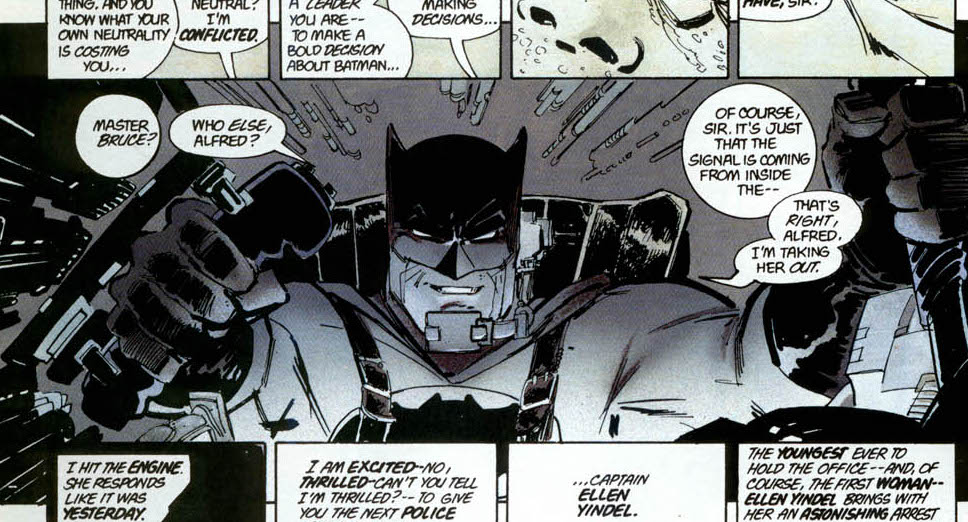
Frank Miller's DARK KNIGHT RETURNS: good or bad?


So, that's not a totally fair title, but I prefer it to my original click-bait idea: "Why do I accept Frank Millers' Fascistic Superman?" Anyway...

Batman: The Dark Knight Returns by Frank Miller, Klaus Janson, and Lynn Varley.
One of the best selling comics of all time.
One of the most influential comics of all time.
A classic from one of the all-time great creators in comics.
You may not read comics, but it's quite possible you have read Dark Knight. Along with Alan Moore's & Dave Gibbons's Watchmen, it ushered in a new era of superhero comics from which we have yet to disentangle ourselves, despite attempts to do just that by many creators, including Alan Moore himself. But! This is a post about Dark Knight, so let's get to it. 

Since the start of COVID, my buddies and I have been talking comics over Zoom, on a weekly basis. Our latest discussion was on Dark Knight, and it didn't go as I expected. Popular opinion would have you believe this work is unassailable, a pinnacle of comic book storytelling, the greatest Batman tale ever told, a superhero story for the ages. For the most part, you would get little argument from me ('greatest' might be a stretch, but it's in the discussion). So, when a couple of my friends revealed the clay feet upon which this classic piece of comic art stands, I was surprised. But they're smart dudes, so I was ready to hear them out . . . and then tell them why they were wrong! 

An aside: I feel like I should get my personal history with this book out there, because it is pertinent to the discussion as well as to my consideration of the book. I started collecting comics in 1984, when I was 12 years old. I grew up in a small town and did not discover comic book shops until 1988 or '89. In 1987, I found the Warner Books edition of Dark Knight Returns, in my local bookstore, Mr. Paperback's. I immediately bought it. Having read very few -- and possibly none at all -- Batman comics at that point, this was basically my introduction to the character. It made a lasting impression on me, and I have re-read it multiple times through the years. I know it well, and I thoroughly enjoy it. 

Aside #2: A brief summary of Dark Knight. Bruce Wayne is 55 years old. Batman has not been seen for a decade. Superheroes have been outlawed, and even saying their names on television is not allowed. The only one left is Superman, working covertly for the U.S. government. But, the animal inside cannot be contained, Batman returns to clean up Gotham, and Superman is sent in to stop him; it ends in a stalemate. Except . . . Bruce is good with chemicals, and he ingested a concoction that made him appear dead when he was merely in hibernation. Kal-El (Superman) attends the funeral, and his super-hearing picks up a heartbeat, just as he's about to leave. But he's willing to let Bruce wage his war, if he keeps it low-key. 

Two of my friends were critical of Dark Knight, one more than the other. Their main point of contention was the characterization of the two main heroes: Batman and Superman. Both of them felt that Miller wrote these characters completely wrong. Regarding Batman, they could never see him giving up on Gotham or going into retirement; it's not in Bruce Wayne's nature. He's obsessed about instilling fear into criminals in order to clean up his city and make sure nobody ever experiences the tragedy he did when his parents were shot dead in Crime Alley. Superman, to their minds, is written as a bootlicker who follows orders from a fascist authoritarian, in the form of the broadly satirical Ronald Reagan. The prime example of this comes after the nuclear fallout of the missile Superman barely diverted. Even with crime rampant in cities across America, Gotham -- previously the most dangerous city in America -- is now experiencing a substantial decrease in crime due to the Batman's actions. Despite that, Superman is sent into Gotham to put a stop to Batman. Because, the law. 

These points are valid. In all honesty, I'd never thought too deeply about the characterizations of Batman and Superman, or the other supporting characters, in this book. I just went along for the ride. That said, I agree completely that Batman and Superman are totally out of character in Dark Knight. But, I don't think that's a problem. And here's why: because I love being right

Or maybe there are better reasons. 

The most important thing to remember -- despite DC's desire to shoehorn this book into Batman's main continuity -- is that Batman: the Dark Knight Returns is an Elseworlds story, a tale from a parallel universe, where all the heroes' names are the same, but they are, to various degrees, slightly different. This is essential, I feel, to accepting and fully understanding Dark Knight.
(Allowing that all art is subjective, so you may understand it differently, and that's cool too, but wishy-washy statements don't make for compelling arguments. But I digress. Let's get back to our regularly scheduled program.)

In this Dark Knight continuity, Batman and Superman (as well as all the other notable characters) have aged beyond the perpetual 28 years they inhabit in the main comic books. Bruce Wayne is roughly 55, as Miller wished to make the character as old as his legend. Superman would also be around 55, though his Kryptonian physiology seems not to have dampened his powers. Jumping off from there, Miller wanted to craft a narrative that examined what a Bruce Wayne/Batman of 55 might be like. He wanted to look at how that would have affected him not only physically, but also emotionally. Sure, Bruce Wayne is a superhero, but age has a way of slowing you down, making you second guess your abilities, infusing doubt where it might not have resided before. It's an intriguing premise, and one that I appreciate seeing played out in Dark Knight

These characters have also experienced very real change in their lives, and they live with that hanging over them. Again, this is unlike the main comics in that, though there is the illusion of change and the hyperbole of earth-shattering events in those books, for the most part these incidents have very little impact on the characters. DC, as a publishing entity, needs to keep the status very much in quo so people will continue to buy their comics. There can be no real changes in these characters' lives; it's too much of a risk. Therefore, Batman, Superman, et al. plod along, ageless icons, experiencing titanic events, but never seeming to feel their repercussions. 

Miller wasn't interested in working within the status quo. He wanted to put these heroes under a microscope and poke at them, see how they might react to having experienced real tragedy, real change, real evolution. Jason Todd died ten years prior, a cataclysmic event from which Bruce Wayne found it nearly impossible to come back. For a decade he allowed Batman to remain dormant, so that no such personal tragedy might happen again. It can be assumed that, even if he were not directly responsible (and maybe he was), Bruce feels wholly responsible for the death of Jason, who took the mantle of Robin after Dick Grayson grew out of the name. This has weighed heavily upon him. 

Also in that time, superheroes have been outlawed. It seems a safe assumption that the timeline for this legislation parallels that of Bruce's tragedy -- ten years. As a result, Hal Jordan (Green Lantern) left Earth for the stars, Diana Prince (Wonder Woman) went back to her people, and Superman became the not-so-secret secret weapon of the U.S. government. Similar to the disbanding of the Justice Society when they refused to divulge their identities in the HUAC hearings, it can be assumed that heroes became suspect by regular civilians, that they were no longer trusted, and, thus, outlawed. Most of them retired, but Superman could not. His powers, and the responsibility instilled in him by Ma & Pa Kent -- who also taught him to respect authority, an important point -- meant he needed to find a way to continue helping humanity. So, he took the only path that he felt had been afforded him. He worked under guidance from the U.S. government, keeping a low profile but still doing good. 

Both of these heroes have gone through personal upheaval and been changed by that. This is why, I think, I am able to accept their characterizations, even if they are "off" from how they are regularly written. Superman has always been the rule follower, while Batman the rule breaker, and the idea that Superman would go along with the government if it meant he could contribute to bettering the world, even in some small way, works for me. Batman was responsible -- at least indirectly -- for the death of a teenager, Jason Todd. This would have a profound effect on Bruce Wayne, could cause him to turn in on himself and reevaluate his actions. Extrapolating from that, he might retire, give up on Gotham, and try to just live out the rest of his life in a way that wouldn't put another child in danger. 

Of course, in the end, Bruce Wayne returns to Batman. And, in my reading of those final pages, Superman, with a knowing wink to Carrie Kelly, the new Robin, learns that there may be another way to help this adoptive world of his. 

Ultimately, these characterizations were due to Frank Miller wanting a battle between Batman and Superman at the end of Dark Knight. He needed them to be on opposite sides of the fence, so that he could bring them to Crime Alley, along with Oliver Queen, and show readers that given enough money, ingenuity, and obstinacy, a human can defeat a superhuman in battle, even if that victory is fleeting. 

Thursday, April 29, 2021

Miller & Mazzucchelli: How Were They Allowed To Do That?


During an 18-month stretch in 1986-87, Frank Miller had a number of comic series published that many creators would be pleased to list as their career output, including Batman: The Dark Knight Returns, Daredevil: Love & War, and Elektra Assasin. Two of the storylines published in this period were done in collaboration with artist David Mazzucchelli, Daredevil: Born Again and Batman: Year One, both of which could be argued as the best superhero comic story every published. (Dark Knight is in that conversation too, but we're here to discuss Miller/Mazzucchelli). What these two artists achieved is impressive. What they were allowed to do with mainstream characters seems impossible. And the limited track record these two had, prior to 1986, makes it all the more improbable. 

Miller debuted as an artist for Marvel comics, in the late 1970s, doing fill-ins across a number of titles. He landed a regular art assignment on Daredevil, in 1979, and was promoted to full scripting duties, while still penciling the series, toward the end of the following year. Miller wrote 27 issues of Daredevil, garnering critical acclaim along with improved sales, for a title that was nearly cancelled before and during Miller's tenure. After this, Miller drew another half dozen or so comics, including Chris Claremont's Wolverine mini-series, until Ronin, the next project he wrote and drew, a six-issue series published as squarebound, 52-page books by DC Comics. And with that, Miller's writing résumé leading into this year-and-a-half burst of creativity was complete. 

Mazzucchelli, similarly, had a limited résumé leading into these two significant storylines -- Born Again and Year One. Mazzucchelli drew a half dozen individual issues across various Marvel titles like Star Wars, Marvel Fanfare, and X-Factor. Then in 1984, with issue #206, he became the regular artist on . . . Daredevil, roughly five years after Miller had done the same. From there, Mazzucchelli drew through issue #217 (missing #207) and then #220-226 (missing #224), or 15 total issues. At the point the Born Again storyline commenced, Mazzucchelli hadn't drawn the equivalent of two years worth of monthly comics. And yet -- in conjunction with works by the likes of Alan Moore and Art Spiegelman -- he and Miller were about to change the face of comics. 

The most important thing to remember about Born Again and Year One is the fact that these were not part of a more adult publishing arm from these Big 2 publishers, like Epic or Vertigo (still almost a decade away from inception), nor were they even outside mini-series. These two storylines took place within the regular titles of each character, Daredevil and Batman, respectively. One issue, you were reading a story from a different creative team (though Mazz was the regular artist on Daredevil at the time), the next, Miller & Mazzucchelli were bringing a whole new level of storytelling to your standard, monthly, four-color adventures: issues #227-233 of Daredevil and #404-407 of Batman. It had to be jarring for some regular readers. 

The first collaboration between Miller & Mazzucchelli was at Marvel, with Daredevil: Born Again, in 1986. Miller's initial run on the character, a few years previous, had made Daredevil a more edgy character, injecting him into the shadowy crime world of New York City, while also introducing a bit of fantasy in the form of the  ninja clan, The Hand, his blind martial arts mentor, Stick, and Matt Murdock's (Daredevil's civilian identity) former lover, Elektra, who had become a ninja assassin in the intervening years. Born Again expanded on that base in ways that would blow up the title, and mainstream comics, in a profound way. 

The opening scene of the first issue of this storyline -- again, importantly, nestled within the regular monthly series, with issue #227 -- has Karen Page, another of Matt's former lovers, giving up the secret that he is, in fact, Daredevil, for the price of a shot of heroin (unspoken at this juncture, but stated outright later in the story). We also learn that Karen has been involved in either soft or hardcore porn, as the dealer talking with her mentions he recognizes her from her flicks, that she's "big at the stag parties." At this point, in 1986, comics were still considered fodder for children, brightly garbed heroes beating up brightly garbed villains, with a return to the status quo at the end of every issue, only for the pattern to repeat the following month. These comics, particularly superhero comics distributed to newsstands and spinner racks, like Daredevil, were aimed at this demographic; they weren't yet made with adults in mind. So, for this story to begin with a character being described as popular at stag parties and selling our hero's secret for drugs was a big deal. Certainly, drugs had been used as story points before, most notably in Green Lantern/Green Arrow #85 and the anti-drug storyline from Amazing Spider-Man #96-98. These were important milestones in the history of comics publishing, but what resulted from Karen Page's revelation would add a whole new dimension to comic book storytelling.

It's the tone of this story, by Miller & Mazzucchelli, that really stands out for me. They don't treat Karen Page's addiction with anything approaching bombast or titillation. It feels like something from a hardboiled pulp novel by the likes of Raymond Chandler or Jim Thompson, authors whom Miller holds in high regard. It is this ground level, almost subdued (when taken in the context of typical superhero comic book fare) approach that elevates the story, as we follow Karen in her flight to New York hoping to find help from Matt. She hitches a ride with a skeevy character -- a pimp who wants to use Karen, to turn her out and make himself some scratch. He keeps his hold over her by offering up the heroin she needs, even as Karen desires to be free of this addiction. But combating a drug addiction is not an easy task. It requires daily vigilance even after you kick it. This truth, along with the shadow of guilt Karen feels and the torture she endures, resonates throughout her arc. 

Along with this new, adult approach to the character of Karen Page, Miller & Mazzucchelli also break down Matt Murdock, bringing him to a point as low as readers had ever seen him. Again, it is the tone of the storytelling that stands out -- no bombast or melodrama dripping with sentimentality, no overt machismo here. This feels real, genuine, a psychotic break we can believe, and it erupts into violence that is unhinged, unsettling, and unnerving. Matt believes everyone, including his former lover and his best friend, are turned against him. He sees devils everywhere he looks. When a collection of youths enter the subway car Matt is riding, intent on divesting the passengers of their valuables, and one of them points a gun in his face, Matt smiles, coldly, calmly . . . and then he reacts, taking out the armed thief, followed by his cronies, leaving them in a bloody mess on the subway car floor. As it stops, a police officer enters, gun drawn, and Matt proceeds to take him out as well. It's a bloody assault the likes of which would have been inconceivable for the lawyer-slash-hero, previously, and it accentuates the depths to which he has fallen. 

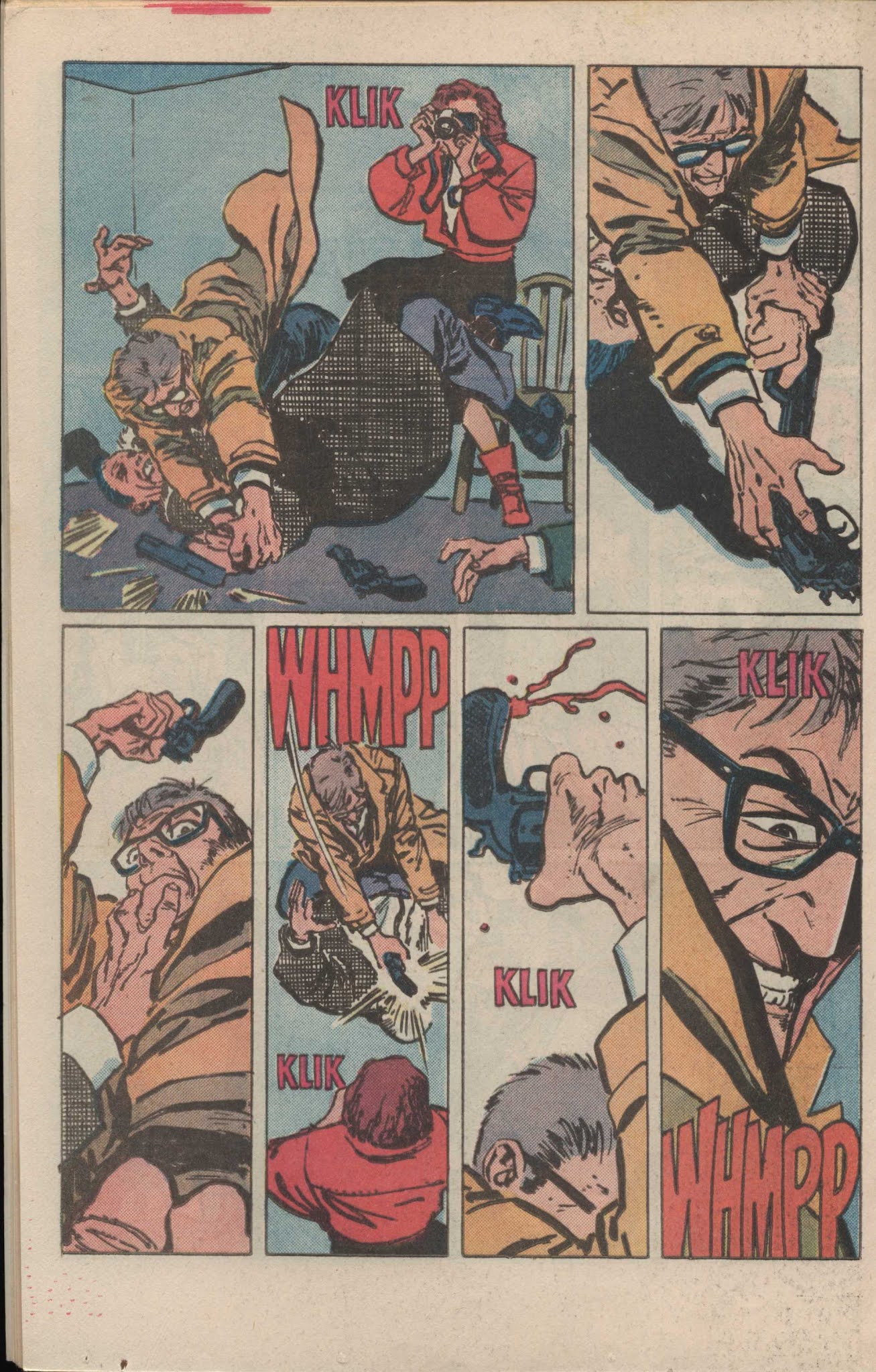
There is an even more disturbing scene of violence later in the story. Ben Urich, Daily Bugle reporter and friend of Matt Murdock, is investigating the Kingpin. He goes to the city jail with photographer Glorianna O'Breen, Matt's former, and Foggy's current, girlfriend, to question Nurse Lois, one of the Kingpin's assassins who's agreed to testify. Urich is accompanied by a fellow reporter, Blanders, and officer Hegerfors, who was assigned to Urich for protection. After the prison guard, Coogan, lets them into the cell, he locks the door. Blanders and Coogan reveal themselves to be on the Kingpin's payroll, as Blanders shoots Lois and Coogan fires on Hegerfors. Hegerfors manages to return fire, killing the prison guard, but Blanders isn't done. Everything happens quickly, Urich lunges for Blanders, knocking him down before retrieving Hegerfors's pistol and whipping Blanders with it, blood flying from the grip, even as Glori continues snapping photographs. Mazzucchelli is a beast in this scene. You can feel the tension, the desperation, the fear in Ben. It permeates every panel, with the angles chosen, the body language, the facial expressions. You know this is a life or death situation, and it stops your breath. It's brilliant. And haunting. 

A year later, Miller & Mazzucchelli helped usher in the "new" post-Crisis Batman, with the Year One storyline in Batman issues #404-407. Again, these two creators wanted to shake things up, to infuse more "realism" into what was possible with superheroes, while, in this case, retelling Batman's origin. They also widened their net to include the origin (at least as far as his days in Gotham City) of James Gordon, a detective in this storyline who would one day become Commissioner. And it is Gordon, as well as Selina Kyle, Catwoman, whom Miller & Mazzucchelli target, in order to add to the Bat-mythos, while also dragging the comic book medium forward. 


Gordon is young, but has a history in Chicago. His wife, Barbara, is pregnant with their first child, and he is hoping to restart his police career with this new posting in Gotham City. He soon learns that most of his colleagues are on the take and Commissioner Loeb is certainly corrupt (unsurprising for the cesspool that is Gotham). But Gordon is here to fight the good fight. He believes in what he does and believes he must hold to his principles. He takes out Detective Flass, a former green beret, after Flass and a half-dozen other cops roughed Gordon up to teach him a lesson. This, coupled with the good press Gordon receives for his police work, provides him with a bit of armor against retaliation by the Commissioner and his cronies. But it is still lonely, being one of the very few good cops in Gotham, and a romance blossoms between Gordon and fellow detective, Sarah Essen. Even as his pregnant wife suffers through a stifling summer in Gotham. This is one of the heroes of this story! And yet, it feels genuine, and it imbues Gordon with a humanity (though flawed) and a relatability that he may not have evoked previously. In the end, Essen requests a transfer and Gordon and his wife begin marriage counseling, but just the idea that these heroes can have clay feet feels exhilarating, and it adds a lot to this narrative, as well as to the possibilities for future narratives from these and other creators. 

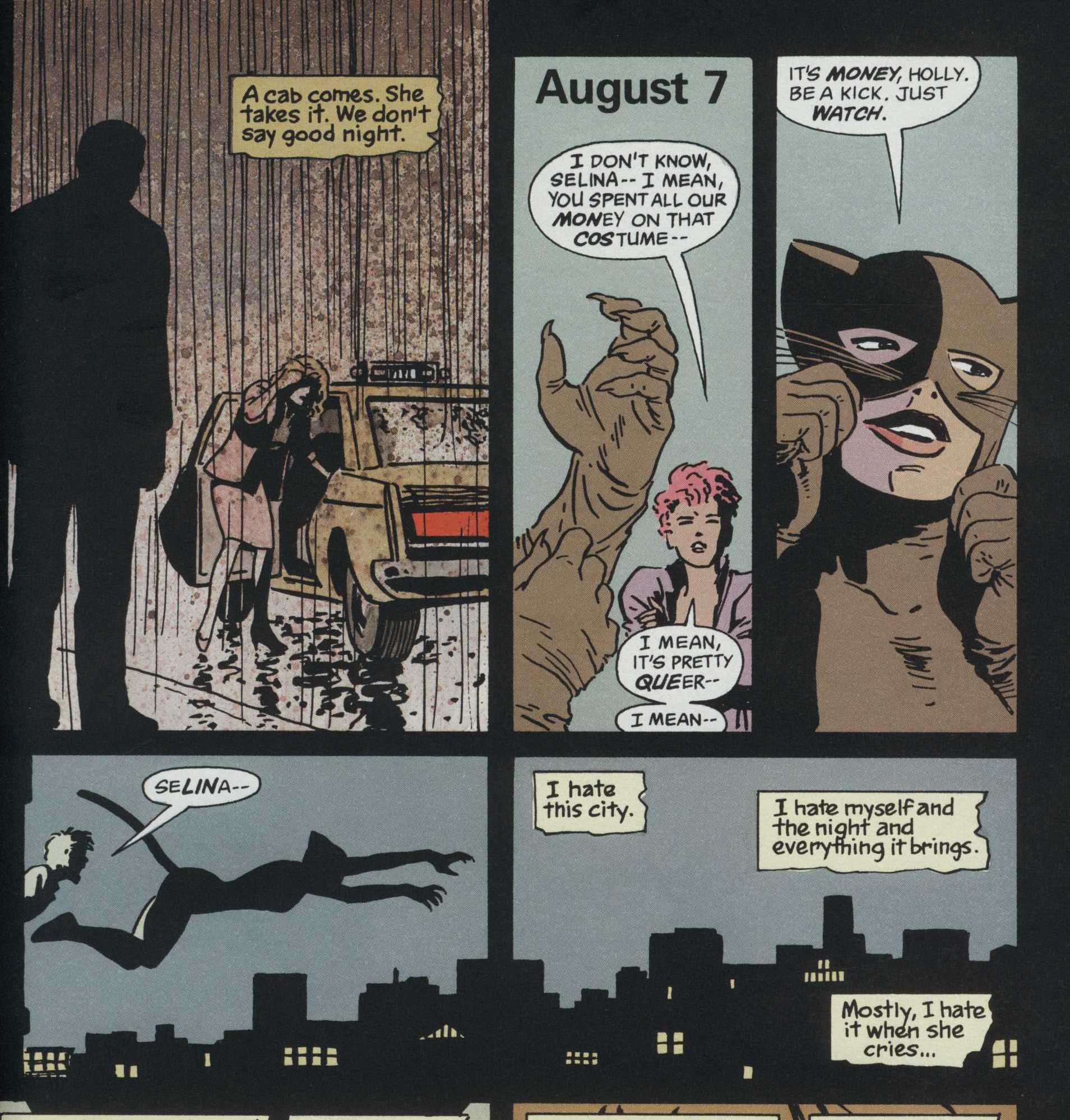
We also get a new Selina Kyle (Catwoman) in this retelling of Batman's origin. She is a prostitute, a dominatrix, who works in the ugly part of Gotham. Despite this, Selina comes across as a very strong character, one who seems to have chosen her profession rather than one who is being exploited. It's a fine distinction, but certainly one that comes across in this story. When Selina decides that she and Holly, the young girl who lives with her and is starting out as a street walker, are going to leave this life, she takes down the pimp who claims to own them. Then she buys a catsuit to become a burglar, and to make a splash like this new Batman. Yet, her exploits are either mistaken as that of the Batman or she is described as his sidekick. It's frustrating for her, and only makes her more determined to succeed at this new venture. Again, Miller & Mazzucchelli imbue a character with far more humanity than had been typically done in the past (and, sadly, is still too rarely achieved in our new present, 35 years after the publication of Year One). It's a relatively simple approach, but one that wasn't often attempted up to this point, for multiple reasons. 


As with Born Again, Miller & Mazzucchelli also bring a more nuanced, more real approach to the violence in this story. During Bruce Wayne's initial foray into the dark streets of Gotham, even before he's latched onto the idea of becoming a bat, he is seriously injured by a knife wound and has difficulty getting home. Bruce is not the supremely able and deadly combatant he will become; he's a neophyte going on bravado and overconfidence born of youth, and it almost ends in his death. There are more examples of this too throughout the series, of punches or kicks or bullets actually having impact, causing pain, and impairing the beneficiaries of the assault. This is no WWE wrestling match, this is real life (as real as superhero comics can get), and the consequences of violence can be substantial. 

Looking back from the vantage point of 2021, it is still surprising that Born Again and Year One got the green light for publication. These two stories took recognizable, mainstream superheroes and infused a groundedness and complexity of characterization that had rarely been done before. These heroes were being written for children, their battles couldn't be muddied by the grayness of reality. Drugs? Prostitution? Infidelity? Pornography? These weren't the subjects of kids' comics, and certainly weren't character traits one would associate with the good guys. And yet, Miller & Mazzucchelli, despite lacking a breadth of experience within the comic field, were allowed to take these characters and change things significantly. And it worked. Spectacularly. And we all should be thankful that the editorial regimes at these two, large publishers took a chance on these stories, because they are easily two of the very best superhero stories ever told in the comic book medium. 


-- chris


Friday, April 23, 2021

Batman: Year One -- Gordon & Essen

With the continued discussion of the post-Crisis DC Universe I'm having with three of my friends, we followed up Byrne's Man of Steel with Batman: Year One by Miller & Mazzucchelli. I want to look at one, very specific aspect of this series--the relationship between Detective James Gordon and Detective Sarah Essen. 

Miller & Mazzucchelli bring all their creative knowledge to the task of telling Batman's origin story, within the space of only four issues, none of them oversized. To achieve what they want, they heavily layer their storytelling, crafting full, intense scenes that take place over the course of just a couple of pages, or just a handful of panels. There's no fat on these bones, and that is true for one of the major character bits for James Gordon. 

Gordon is new to Gotham, trying to be a good cop in a corrupt agency, pressured by his superiors and his fellow officers, while dealing with the anxiety that comes from the impending birth of his first child, all in a cesspool of a city. He finds solace in the arms and lips of a fellow detective, Sarah Essen. 


Their blossoming relationship occurs over the course of only three scenes where they interact directly with one another. A grand total of maybe five pages, though there are another handful surrounding the personal interactions between the two. It's brief, very brief, and yet, it feels genuine, and it works. Miller & Mazzucchelli manage to infuse these scenes with the weight and the emotion and the humanity that allows us to believe that James Gordon could fall in love with this fellow detective, and that she could do the same, even with the reality of his marriage and his wife's pregnancy. It's masterful. And then, when we land on this page at the end of chapter 3, the devastating reality and the heavy guilt that Gordon is carrying with him just hits us in the gut. 

Miller & Mazzucchelli have a relatively small bibliography, within the mainstream, superhero comics medium. But, in the two stories they created together, this and Daredevil: Born Again, they may have crafted the best superhero stories the medium has ever seen. 

--chris

Friday, October 7, 2016

My Top 10 Comics [Storylines edition] -- # 6-10


So, I had a twitter discussion with Brad Gullickson (@MouthDork, co-host of the In the Mouth of Dorkness podcast: @ITMODcast) a few weeks back about “The Best Comics Ever” and how it’s always Watchmen and Dark Knight Returns at the top—kind of like Citizen Kane almost always topping the list of greatest films ever.  It’s hard to argue with not only the artistry and formalistic approach to both of these books but also the impact and influence these two books had, something that still hangs over the comic book landscape thirty years out.  It seems these two books, along with Art Spiegelman’s MAUS, are baked into the top 3 spots, all-time, for comic storytelling.  But do they need to be?  Might there be other works that have transcended the bounds of the field since then (or even prior to 1986)?  Possibly.  I think it would depend upon your criteria, since these lists are always subjective, in spite of any arguments to the contrary. 

Using this discussion as a jumping off point, I decided to come up with my personal top 10 comics.  Some of the guidelines I set for myself were to consider books other than those perennial top 3 (certainly, that introduced a bias against these books, but so be it; I doubt anyone’s going to forget about Watchmen & Dark Knight if I don’t list them here), to attempt not to repeat creators within these ten titles (otherwise, I could easily see Alan Moore flooding my list), and to weigh, heavily, how many times I have re-read these stories.  Also, for the most part, I worked to only include individual collections—whether an original graphic novel or a single storyline from a larger work—but you will notice I failed at that, in a couple of spots. 

So, without further equivocation, here’s the initial fistful of greatest comic stories I have read, numbers 6-10, in reverse order.  And, hey, feel free to disagree with me and drop a note in the comments with your own top 10.  I’d be interested to see what others feel are the best of the best.  Thanks.

#10:
Cerebus: Jaka’s Story, by Dave Sim & Gerhard.  


Dave Sim is one of the greatest cartoonists ever to work in the comic book medium, and it could even be argued he is the greatest to put ink to Strathmore.  The emotional depth of his best writing, along with the wit and intelligence also on display there, coupled with his facility in body language and facial expressions and layout with his drawings, are second to none.  Add in the emotive quality of his lettering, and you have a five-tool player, as they say in baseball.  The fact that he did this, primarily, in telling the story of an anthropomorphized barbarian aardvark and managed to tell some of the truest, most engaging comics ever published in the medium, and you get a sense of his ability.  Jaka’s Story, for me, is the one I most engaged with, and the one that tugged at my heart the strongest.  Thus, it comes in at number ten.

#9:
Saga of the Swamp Thing, vol. 1, by Alan Moore, Steve Bissette, John Totleben, Rick Veitch, et al.


Swamp Thing was the breakthrough book for Alan Moore, his first American comics work, back in 1984.  Paired with artists Steve Bissette, John Totleben, and Rick Veitch, along with a number of others, these creators managed to pull Alec Holland from the murky depths of D-list character to critical and commercial success.  The brilliance of these stories is not just in the writing, wherein Alan Moore reimagined the Swamp Thing’s reality without discounting any of the character’s history, but in the conjunction of art and story.  In all interviews I’ve read from this creative team, it sounds like a true collaboration, where Bissette & Totleben & Veitch were integral figures in plotting, offering ideas and images that Moore would weave into his scripts, and I think the final product bears out the benefits of this strong partnership.  Moore’s thoughtful approach to storytelling and his purple prose, coupled with the eerily moody artwork of these artistic giants, created a horror comic that not only made you feel uncomfortable, but also made you think.  And, to this day, it still holds up extremely well.

#8:
Daredevil: Born Again, by Frank Miller & David Mazzucchelli


My favorite superhero story of all time, period.  Miller was at the height of his artistic powers, in 1986, when these comics were published, and he got to work with a master of the medium in Mazzucchelli, who, in my opinion, delineated the most beautiful, “traditional-style” superhero art, ever, with this storyline.  A comic book that used symbolic imagery, sharp dialogue, clean artwork, and an adult sensibility to tell a tale that is Shakespearean in its scope, this was my introduction to the character of Daredevil, and even though there’s a lot of backstory that infuses the narrative with its emotional weight, I never felt lost or disconnected from the story or the characters, and the book has only rewarded my time with every re-read since then. 

 #7:
Vietnam Journal #1-16, by Don Lomax


Vietnam Journal was the first black and white comic I collected, and it is the best war comic I’ve ever read.  Lomax was a Vietnam veteran himself, and he infused his stories with a truth, however harsh it may have been, that sets this book apart from all other war books.  Following Scott “Journal” Niethammer, a journalist who volunteered to cover the Vietnam War, we learn a lot about the war, about how the grunts on the ground felt about it, and about the horror that war is.  This, like so many great comics, is not a standout series because of just the writing or just the art, it is a combination of truthful writing and a black and white art style that is able to reveal the ugliness of the circumstances and settings of the comic.  It does not glorify violence, nor does it gorify it.  Lomax manages to (and this is the best word, so I’ll use it again) reveal the Vietnam War in a way that kicks you right in the gut.  It’s an amazing book, and one you should seek out, as these 16 issues, along with later stories, have all been collected.

#6:
The Barefoot Serpent, by Scott Morse


The brilliance of Barefoot Serpent is not only in its format—a quick biography of Akira Kurosawa, done in full-color paintings, bookending a tale of a girl and her family on vacation in Hawaii, which is done in sepia tones—but in its subtlety of execution.  There are things in this short book, whether connections between the Kurosawa parts and the short fiction or hidden elements within either of these pieces singly, that will fly past you, on an initial read.  But, once you make those connections in subsequent readings, the thematic cohesiveness of this book will become apparent and make you appreciate it far more.  Again, it is the writing and the art, and the combination of both, that elevates this book beyond so much else available for your enjoyment.  Morse’s animation style is deceiving, putting forth a façade of whimsy and lightness that is undermined by the gravity of the tale he is weaving (a hallmark of almost all of Morse’s work), and it is this juxtaposition of whimsical art and heavy topics that makes the story resonate more strongly with its audience, even after you close the book. 

SPECIAL MENTION (or #11):
Cages by Dave McKean


I feel like this should definitely be on this list, but the truth is I have only read Cages the one time, many years ago, and never returned to it, due to its length and complexity rather than any shortcoming of its narrative.  Since it has been years, and actually closing in on two decades, since I read Cages, and my recollection of the story is lost, I didn’t feel I could properly include it in my top 10.  That said, my one memory of reading McKean’s Cages, other than how beautiful it is, was the fact that it was incredibly well written, something I was not expecting.  I was, and am, a fan of Neil Gaiman—he’s one of my favorite authors—and the only work I’d read of McKean’s had been with Gaiman (or Grant Morrison), but I distinctly remember thinking that Cages was at least as good as Sandman, my second-favorite long form comic series of all time, and that impressed me.  So, having added it here, as an addendum, I feel it’s near time to revisit this book and see if it will crack my top 10.  I’ve got a feeling it will, and I’ll let you know if that happens.  But, for now, I need to get to writing the next post, about my top 5 comics.  See you then.

-chris

Sunday, April 19, 2015

What It Is – week ending 19 April [2015]


With apologies to Dave the Thune (as well as Mike Baron & Steve Rude).


WRITING:
Every day.  1000 words.  That’s the goal.

At last check-in, two weeks ago, I’d completed the first draft of the novel.  Now I’m onto the pitch for my time travel “epic,” refining and rewriting it in anticipation of Oni’s open submission call next month.  I’ve got a solid premise, I believe, with an engaging four-issue arc that can work as a standalone story, but is also intended as the opening narrative of a much longer story, in the vein of Sandman and Queen & Country, two primary influences on this project. 

I don’t know exactly what Oni will be looking for, so I’m working up various items for inclusion, a synopsis of the opening story, a detailed issue-by-issue breakdown, character profiles, a final script for issue one (which I workshopped at Comics Experience, where I got some invaluable critiques that improved it immensely).  Some of these aspects, I already had written in a rough form and only need to revise, while others I am writing up for the first time.  The great thing about this is that I’ve discovered a lot about the story and been able to flesh it out more fully, so that when I do submit to Oni, I will have a far better understanding of where I am going with it, which, I hope, will improve the chances of getting picked up.  If I don’t, though, I may turn this into a novel at some point down the line. 


READING:
Finished up Jhumpa Lahiri’s The Namesake this week, and I had two thoughts: 1) what an amazing and beautifully written book, 2) why am I even trying to write? 

That second thought is one that occurs a lot, especially when I finish a book as stellar as this.  The connections Lahiri makes, her use of language and the perfect balance of detail and metaphor, and the facility with which she opens and closes a scene—all spectacular.  If you’re looking for a moving, engaging read, pick this up. 

I also re-read Elektra: Assassin this week.  I didn’t connect with this work the first time I read it and subsequently sold my trade collection of it.  But I recently picked up the individual issues on ebay and am I glad I did.  Miller’s writing, specifically his dialogue and captions with their halting cadence revealing the truth over the course of dozens of bits of text, is superb.  And the art by Bill Sienkiewicz is just damn beautiful.  I love his art, and he is just on the top of his game in this book.  Amazing stuff.  If you like over-violent, satirical stories and are a fan of comics, and you haven’t read this yet, do yourself a favor and seek it out.  Now. 


WATCHING:
Watched Live. Die. Repeat./Edge of Tomorrow/I Don’t Know What Title I am? this past week, and I really enjoyed it.  (Sure, there’s a theme running through most of these “updates” about how much I enjoyed reading/watching/hearing something, but that’s because I tend to be picky, and I also don’t want to spend much time on anything that I found less than enjoyable)  The conceit of time travel, as a story engine, is difficult to “get right,” or at least to utilize in a manner that doesn’t pull the audience right out of the story (fingers crossed with my comic pitch above).  But with this film, they did a great job of engaging viewers with the visuals and the drama of the situation, while offering a plausible explanation for the time travel (though, to be fair, it wasn’t so much time travel as a temporal loop, wherein Tom Cruise’s character repeated the same day, over and over, until that chain is broken).  I really enjoyed how we got to see Cruise’s character learn from each jump back to the same day, as he died again and again but retained his memories of those previous days, and the manner that the filmmakers revealed this worked well.  It kept me interested, provided the right amount of drama and intrigue, and offered questions that demanded answers.  And, as the guys at Travis Bickle on the Riviera stated, we got to see Tom Cruise become Tom Cruise.  His character arc was really interesting, something you don’t necessarily get in most action films.  Fun stuff. 


MISCELLANY:
Sox are in first place!  I’ll take that.  I’m not expecting much from the team this year, their pitching could use a shot in the arm (pun intended), but the offense should/could be exciting.  We’ll see  At least I’m not a Cubs fan (sorry, Dan)

The new Star Wars 7 trailer dropped.  And it is magnificent.  The initial teaser did nothing for me.  It didn’t feel like Star Wars, and after the prequels I felt too burned to give in to the dark side.  But this one kicked me right in my nostalgic, five-year-old self’s heart, and I am all in now.  That opening shot is what did it for me—seeing such familiar imagery, the desert, the X-Wing, and the Star Destroyer shown in such a wholly new context, that was exciting.  Add to that, the fact that the “soccer ball droid,” BB-8, is a practical effect, a puppet, and not a CGI effect, that cements it.  Abrams knows how to rummage through my memories and pluck just the right strings to make my heart sing, and he’s doing it again.  Can’t wait for this now.


SIGN OFF:
As always, check out my friends – Brad& Matt and Darren Smith (with Bryan Young on accompaniment, when he’s available)  and Don McMillan, as well as Dan’s foray into podcastdom, the Potato League Podcast, for their own weekly recaps on things comic-y and geeky, and we'll see what's what in seven.  

-chris


STAR WARS -- a modern trailer

 This came across my feed, and it's pretty stellar, even if it utilizes some special edition cuts.