Tuesday, November 20, 2012

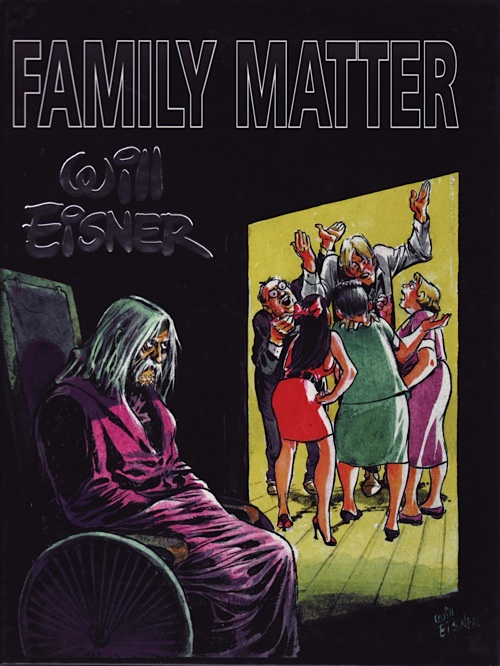
30 in 30: A Family Matter by Will Eisner


#13: A Family Matter
Storytellers: Will Eisner
Publisher: Kitchen Sink Press
Year Of Publication: 1998
Page Count (can be approximate or in # of issues format): 68 pages
WHAT I LEARNED ABOUT WRITING / STORYTELLING:
Eisner opens this book by introducing each of the main characters in short 2-3 page scenes, and with every one – with the exception of the final main character – he starts the scene with a full-page image of a building important to each character (a nice suburban house, the retail store where one characer works, the law office where another works), which also manages to convey pertinent information about the character.  It’s a clever use of the comics’ synthesis of words and pictures, and it is something I would like to use someday.
 
WHAT I LEARNED ABOUT ART / STORYTELLING:
Eisner’s visual storytelling is wonderful, and I am continually amazed at the fact that he rarely uses panel borders.  Many of his pages are done in a 6-panel grid, and despite the lack of borders, I never find the visuals to be confusing or cluttered.  His mastery of the visual lexicon of comics is amazing.
I also liked how he used thought balloons – instead of filling them with text, Eisner drew the flashbacks each character was thinking of while talking with their father or arguing with their siblings, and these flashbacks always added upon the conversation being had in the present, which really worked well.
 
RECOMMENDATION: B

NOTES / REVIEW / SYNOPSIS
To celebrate their father’s 90th birthday, all of his offspring come home to show their love – each of them trying to put on the best face about their lives in order to hopefully benefit from the estate of their father, who – having suffered a stroke – is not long for this world.  Through the course of the contentious and chaotic family gathering, we learn about the secrets harbored by all of the members through their visualized thoughts.  And, in the end, the truth about their mother’s death comes out, even as their father, who was wheeled into an adjoining room, dies in a similar fashion as his wife did.  It’s Eisner and he wrings as much drama from his characters as he can.  Not groundbreaking, but it’s Eisner, and it’s good.

Monday, November 12, 2012

30 in 30: Someplace Strange


#12: Someplace Strange
Storytellers: Ann Nocenti & John Bolton
Publisher: Epic Comics
Year Of Publication: 1988
Page Count (can be approximate or in # of issues format): 64 pages


WHAT I LEARNED ABOUT WRITING / STORYTELLING:
I really liked the use of thought balloons and captions in this.  In the opening of the story, the older brother chases his younger one to – we assume – beat him up for messing with his experiment, and the younger brother narrates the chase as if it were an adventure serial. It works to not only add characterization, but it also adds whimsy to the story. And toward the end, Nocenti utilizes the caption boxes to infuse a cinematic aspect to the story – one time directing readers to “start at the feet then raise your eyes slowly, stopping at the head…just like they do in movies,” when the hero is created in the dream world, and a few pages later a caption instructs readers to “quick, run to your stereo and put on ‘the charge of the light brigade,’ stand at attention, send shivers down your spine…and swell with emotion.”  It’s fun and appropriate for the type of story being told here.


WHAT I LEARNED ABOUT ART / STORYTELLING:
One – with an artist as talented as Bolton, having him switch styles depending upon the tenor of a scene works very well in a story that is mainly told in a dreamland.  He not only utilizes his photorealistic painting style, but also incorporates psychedelia, black and white parts, a less detailed “crayon” style, and others to great effect.
Two- utilize the whole page.  On many of the pages, Bolton would anthropomorphize the numbers at the bottom of the page to mirror actions within the main narrative, providing subtle emphasis for the main thrust of the narrative scenes.  It was fun and appropriate for this story.  


and a detail of the flying page number at the bottom:


RECOMMENDATION:  B

NOTES / REVIEW / SYNOPSIS
I don’t know how many years I’ve had this, probably since the 1990s.  Ever since Nocenti’s run on Daredevil with JRJr, I’ve been a fan of hers and picked this up because of that – having Bolton doing the art is just a nice extra.  And now that I’ve read it, I wonder why it took me so long.  This was really entertaining, and I expect I’ll re-read it someday.

Sunday, November 11, 2012

30 in 30: Garth Ennis's 303


#11: 303
Storytellers: Garth Ennis & Jacen Burrows
Publisher: Avatar Press
Year Of Publication: 2003
Page Count (can be approximate or in # of issues format): 144 pages


 WHAT I LEARNED ABOUT WRITING / STORYTELLING:
The narrative journey doesn’t have to be A to B to C to D.  You can cut out B and C, streamline the story, and make it better for that.  In 303, the transition between parts 1 and 2 of this story involve weeks of the Russian soldier who is the story’s protagonist cautiously making his way from Afghanistan to the United States without having to go through the security hassle of giving up his rifle, a Lee-Enfield 303 caliber rifle.  We discover some of the challenges met through the soldier’s voice-over captions, but Ennis doesn’t bother showing us that, because it wasn’t pertinent to the story at hand.  Plus, Ennis also did this to take a breath, look at the Russian in greater detail, and fill in some character background.
 
WHAT I LEARNED ABOUT ART / STORYTELLING:
Play to your strengths.  Jacen Burrows has a clean line and a very realistic style.  With such a style, when dealing with real-life horrors (as Garth Ennis likes to do), don’t be artsy, just be in the reader’s face. Blood, guts, ravaged bodies – just go for it with this kind of style, because it will work well in that context.
 
RECOMMENDATION: B

NOTES / REVIEW / SYNOPSIS This is a really good character piece that incorporates much of what Ennis likes to write about – soldiers and the death of the American dream.  Because of its economy of pages, I feel like Ennis manages to remain more focused and, as a result, this is probably my favorite work of his.

Saturday, November 10, 2012

30 in 30: the Barefoot Serpent by Scott Morse


#10: The Barefoot Serpent
Storytellers: Scott Morse
Publisher: Top Shelf
Year Of Publication: 2003
Page Count (can be approximate or in # of issues format): 128 pages

WHAT I LEARNED ABOUT WRITING / STORYTELLING:
This showed me a different way to look at a comic. The main comic narrative is in the middle of this book, relating the story of a young girl and her family visiting Hawaii to forget about the tragic event that has befallen them.  This story is in black and white with grey tones. Bookending this story is a brief biography of filmmaker Akira Kurosawa.  These pages are lush, vibrant paintings with text. Despite these two very different stories, told in very different manners, Morse manages to weave them together to produce a book that is elevated by the threads binding the two narratives. 

WHAT I LEARNED ABOUT ART / STORYTELLING:
Using a sublime approach to the dialogue with animation-style art, one can make serious and tragic experiences within a comic narrative resonate long after the end of the book.  This is something that Morse does in many of his works and that juxtaposition  of a “weighty” scene with the “fun” style that Morse uses really makes these scenes more emotional, in my opinion.


RECOMMENDATION: A


Friday, November 9, 2012

30 in 30: I Kill Giants


#9: I Kill Giants
Storytellers:  Joe Kelly & J. M. Ken Niimura
Publisher: Image
Year Of Publication: 2009
Page Count (can be approximate or in # of issues format): 184 pages

WHAT I LEARNED ABOUT WRITING / STORYTELLING:
When writing a strong emotional reaction from a character, it is far more affecting if you have set up a baseline previously to gauge this crescendo against.  For example, within the first half of I Kill Giants, we see the main character, Barbara bullied or reprimanded a few times.  In each instance, her reaction is to make a sarcastic remark and accept the consequences otherwise.  But, when the bully of the school crosses the line (grabbing at a purse Barbara always has with her, which has been shown to be special to her previously), Barbara loses it and reacts physically, laying a beating on the bully.  This was an incredibly affecting scene for me, made possible by the fact that he rreaction had been so different previously.  It was really well done and something to keep in mind when working on big emotional moments in my own writing.
 
WHAT I LEARNED ABOUT ART / STORYTELLING:
Speed lines can be a very effective tool when handled well.  I’m not a big manga reader but I have read all of Lone Wolf & Cub as well as Akira and Fist of the North Star, so I am familiar with manga and its tropes, and, for me, speed lines have rarely worked in these books.  I can’t say exactly why that is the case (I’m thinking they may have been overused, but I’d have to go back and look to see if that is the case).  But in I Kill Giants, Niimura – who worked in a manga style – utilizes speed lines sparingly to great effect.  


RECOMMENDATION: A+

NOTES / REVIEW / SYNOPSIS
This was a deeply moving and incredibly affecting story.  One of the best books I’ve read in a while.  Kelly & Niimura weave imaginary fantasies with harsh, and sometimes touching, reality to create a tale that feels genuine.  I don’t want to spoil it for anyone, but there is a secret in Barbara Thorson’s life that she is avoiding, as she tries to navigate the hardships of being a young girl who does not “fit in.”  Preferring to lose herself within the fantasies around her – manifested in her hardcore dungeon master style during D&D games with friends – she must eventually come face to face with the reality she has denied for too long.  And in that acceptance she discovers a truth about herself, and the rest of her family, she had not realized.  I cannot recommend this highly enough.  Brilliant, brilliant book.

STAR WARS -- a modern trailer

 This came across my feed, and it's pretty stellar, even if it utilizes some special edition cuts.