Showing posts with label Comics Experience. Show all posts

Sunday, November 9, 2014

What It Is - week ending 9 November [2014]


With apologies to Dave the Thune.


WRITING:
Every day.  1000 words.  That’s the goal.

Got back on track with the novel this week, which was nice.  I was afraid, after being away for a week, that it might be difficult to get into the swing of it (so many of the issues I have with writing stem from a need for routine and repetition, and putting aside a narrative for a few days can seriously hamper me, at least during that initial return to the work), but I was pleasantly surprised.  As with most scenes, I had a set idea of where things were going, but – though the overall story remained on course – the characters veered off-track just enough to surprise me and infuse the scene with a bit more drama and engagement for readers, I hope.  Regardless, it’s always fun to be writing, having the words move along the way I’d anticipated, and then, all of a sudden, have one character respond in a manner I had not considered – but it works, within the story and for the character.  Those moments are exhilarating.  Of course, then the question becomes, will it hold up when I start revisions.  Who knows?  But, for now, I’m really enjoying the story – so, that’s a big plus.  And I know, for sure, that this idea has legs and will fill out a novel nicely. 

Got a nice response to something I wrote a week back.  In the “What It Is” for the week ending 2November, I wrote a quick review of “Daddy” by Josh Simmons & James Romberger (published by Oily Comics).  Without warning, I received a pdf preview of Romberger’s next project, THE LATE CHILDAND OTHER ANIMALS, a graphic memoir written and colored by Marguerite Van Cook (Romberger’s partner), adapted and drawn by Romberger, and published by Fantagraphics the end of this month.  I haven’t found the time to read it yet, but I’m really looking forward to it.  Judging by his earlier work, including the aforementioned “Daddy” along with “Post York” and “7 Miles a Second,” I expect to enjoy the experience.  And, if you’re a fan of intelligent and engaging comics, seek out Romberger’s work and check out his site.  I don’t think you’ll be disappointed. 


READING:
Finished GONE GIRL this week.  I appreciated how well Gillian Flynn was able to examine her characters and convey this through her prose.  It was impressive.  And the plot twists were well played, putting her main characters into binds that seemed hopeless.  Then she would pull another rabbit out of her hat, up the tension while releasing them from one prison, only to push them into another, more devastating one.  Gone Girl was a totally engaging book, especially the first 85% of it.  With the final twists, I found the character motivations wanting – just a bit.  One might be able to explain it away as these outsized characters going “all in,” and be satisfied with that explanation, but there was something about the final motivations driving the two main characters toward the end of the book that didn’t sit right with me, as far as them being genuine human responses to what had gone before.  That said, it was a good thriller but not a book that will stay with me like Stoner or Age of Innocence. 

Read NIJIGAHARA HOLOGRAPH, by Inio Asano and published by Fantagraphics.  This was an amazing manga.  Similar in tone and structure to David Lynch’s films, I was blown away by it, so much so that I had to write about it.  Check that review out here.  


Continuing through Bakuman – I’m on volume 15 right now – and still loving it.  I also started reading the collection Batman: Strange Apparitions, which reprints the noteworthy Detective Comics run of Steven Englehart, Marshall Rogers, and Terry Austin (with the first two issues, before Rogers jumps in, from penciler Walt Simonson and inker Al Milgrom, who muddies Simonson’s beautifully delicate linework).  It’s some crazy, overwritten, but eminently enjoyable fun, with beautiful art from the Rogers/Austin team.  And, to be frank, looking at the image of the Joker on the back cover – though I don’t remember where I would have seen it (possibly in one of those “Greatest Stories” collections) the Rogers/Austin rendition is a seminal Joker for me.  Great work. 


MISCELLANY:
I’m a member of the Comics Experience Creators’ Workshop, an online resource for aspiring comic writers and artists to work on their stories and art, get feedback from professionals and other members, and to discuss craft in a safe environment.  Created by Andy Schmidt, it really is a great place, and there are a lot of books coming out from members – especially now that Comics Experience and IDW have initiated a publishing agreement.


But another member whom I’ve gotten to know fairly well on the boards, Don McMillan, has a new e-book out.  KIBBLES ‘N’ BOTS is about a Boston terrier puppy who believes she can become a superhero, after finding her owner’s comic books, and must battle bank robbing robots in this adventure.  But what of the true plans of the robots’ leader, Bad Boss?  It’s available for the Kindle, and at only $2.99, a bargain.  Can’t wait to check it out. 

SIGN OFF:
Another week down.  Thanksgiving is fast approaching, which means Christmas is right around the corner.  And that means I need to start thinking about letters from Santa – which is obviously a topic for another time.  As always, check out my friends - Brad & Matt and Don McMillan (see above) for their own weekly recaps on things comic-y and geeky, and we'll see what's what in seven.  

Ciao.


Wednesday, March 20, 2013

Unfashioned Creatures - a Frankenstein anthology

The next anthology where I will have a story published is the Frankenstein themed Unfashioned Creatures from Red Stylo Media.  There was an open call for submissions based upon the themes of Mary Shelley's novel (not the film adaptations).  This spurred me to finally read Frankenstein, after having it on my to-read list for too many years to count. The book was amazing, and I came away with a lot to work with.


The process for acceptance was rigorous and very worthwhile, having never gone through such a process before.  I had to query first, before I could pitch.  Then I had to send a one-page synopsis of my story idea for consideration, and once that was accepted, with notes from the editor, Enrica Jang, I got to work on scripting. 

My compatriots at the Comics Experience online workshop were invaluable in this regard, reading an initial draft that was not at all ready for an artist, at all.  From the great notes I received there, I got similarly insightful and helpful comments from Jang, who pinpointed trouble spots that I knew were there and offered suggestions that certainly elevated my contribution.  The script has gone through 5 drafts and is now ready to be sent to the artist, who is Gary Fitzgerald, someone I'm friends with on facebook and who has done some great work with Caryn A. Tate on her Red Plains comic, available at Topshelf's online anthology TS2.0, and with whom I've wanted to work for some time.

I'll be sharing those various iterations of my script through some upcoming process posts.  But, for now, I need to prepare for the CGS Super Show on April 6-7, where I'll be debuting a new chapbook and possibly printed editions of my Reading Watchmen analysis from the sister site.  More on that later.

chris

Saturday, March 16, 2013

Indie Comics Horror #1

I am fairly horrible at promotion and such, but with recent events I will be trying to get back on the horse with regard to that and to this blog - but I make no promises.

This past Fall, I had a story published in the inaugural issue of Indie Comics Horror from Aazurn Press.  It was an older story of mine, but I was very happy to be involved with this issues, especially since there were a number of other creators involved from Andy Schmidt's Comics Experience online workshop where I have learned a lot about writing, and about my own writing in particular.


The funding process for any Indie Comics title is interesting, in that Gary Scott Beatty splits the cost of printing and placing of ads in Diamond's Previews catalog between himself and the various creators, which allows him to actually get these books into comic shops.  And once Diamond's invoice and payment come through, that money is divided evenly among all those creators who pitched in on the printing costs.  It's an elegant way to get a foothold into the Previews catalog and get stories by aspiring creators into comic readers' hands, and it works very well.  Gary is up-front about the entire process, and I would highly recommend it to anybody seeking an opportunity to get your finished 8-page story.

The story I placed with Gary - and I should add here that it isn't just a matter of being able to pay for the printing costs, but your story has to be accepted as well; if there were no quality controls, it would be pointless to put the books out because, if the stories aren't good, nobody will buy them and you won't get future orders from comic retailers - was "Minister to the Undead" with art by Dan Lauer.  You can check that story out here. But if you'd like to get a hard copy, and also get a bunch of other great horror stories as well, you should seek out the issue, which will never be reprinted or distributed digitally, according to Gary.  Copies are available at Midtown Comics and Lone Star comics for less than cover price ($4.95 for 48 pages).  Check it out, I think you might like it.

Thanks,
chris

Thursday, November 22, 2012

30 in 30: RASL volumes 1-3


#18: RASL volume 1
Storytellers: Jeff Smith
Publisher: Cartoon Books
Year Of Publication: 2009
Page Count (can be approximate or in # of issues format):112 pages

WHAT I LEARNED ABOUT WRITING / STORYTELLING:
Jump right into the story.  This series opens with a man, bloodied and in tattered clothes, walking down a hillside in the desert.  Readers are immediately pulled into this story by asking where this guy came from, why he’s in such bad shape, and other similar questions.  Done well, as Smith does here, this can be a very effective way to open a story.
 
WHAT I LEARNED ABOUT ART / STORYTELLING:
In this science fiction narrative, Jeff Smith is creating a “lived in, run down” world.  With his clean style, he manages to convey the typical decay of the settings through well-placed marks – scattered dashes – that mar the pristine white spaces of the page and effectively convey this rough, genuine quality that was lauded in Star Wars.

 
RECOMMENDATION: A

NOTES / REVIEW / SYNOPSIS It’s Jeff Smith doing something completely different from Bone, but it’s still stellar cartooning.  RASL is a time travel story that incorporates the theories of Nikola Tesla, a love triangle, parallel worlds with parallel versions of many of the main characters, and a mystery about who is trying to capture Rasl and what they want him for.  Great stuff.


#19: RASL volume 2
Storytellers: Jeff Smith
Publisher: Cartoon Books
Year Of Publication: 2010
Page Count (can be approximate or in # of issues format): 112 pages

WHAT I LEARNED ABOUT WRITING / STORYTELLING:
In volume 1, Smith used the age-old action cliché of having the villain be a poor shot with a gun and I thought nothing of it, having seen this trope used myriad times in film, comics, and TV.  But in this volume, he turns that cliché on its head when the villain confronts our protagonist again and reveals to Rasl that he missed him on purpose.  By doing this, Smith puts that earlier scene into a far different context, opening up a number of question for the reader (why did he let him go before? Is he lying now?) while also opening up story possibilities for the writer.
 
WHAT I LEARNED ABOUT ART / STORYTELLING:
In a parallel world, Rasl meets an alternate version of his true love named Uma, and as they are getting to know each other, in a private viewing at the museum where Uma is curator, Rasl starts to daydream about his past with the alternate version of Uma and he tunes her out.  Smith conveys this by having Uma’s word balloons empty, and then he pulls in closer with successive panels, showing Rasl’s focus on her, until she leans down into the final panel of the page, where Smith has her face in close-up, and she asks if he’s even listening to her?  I thought this was a really novel and effective way to convey Rasl’s mental state through the visuals.
 
RECOMMENDATION: A

NOTES / REVIEW / SYNOPSIS Smith really knows how to tell a story.  As good as this is, I only hope that he will stick the ending.


#20: RASL volume 3
Storytellers: Jeff Smith
Publisher: Cartoon Books
Year Of Publication: 2011
Page Count (can be approximate or in # of issues format): 112 pages

WHAT I LEARNED ABOUT WRITING / STORYTELLING:
This is a science fiction story about parallel universes, but Smith utilizes real history and real science within the narrative – often through flashbacks – to help ground the story, and it works very well.  The big lesson is, if you’re going to tell a fantastic story try to base it within some semblance of reality to give readers something to “hold onto” and allow them to accept the out of this world elements.
 
WHAT I LEARNED ABOUT ART / STORYTELLING:
In this penultimate collection, things are starting to get out of Rasl’s control.  Time is becoming elastic, and his stress may be feeding into this.  Smith conveys this with an imaginative two-page spread with multiple images of the Uma drawn over an imaginative, abstract background.  This works really well for a number of reasons. 
One, up to this point much of the settings and much of the imagery has been relatively grounded.  Allowing for the conceit of time travel, little else “fantastical” has been seen in the story.
Two, Smith’s very clean art style has also helped to ground the story, so that when we get an abstract image such as this two-page spread, it makes a big impact.
Three, similar to how Moore & Gibbons used the page in Watchmen or Frank Miller used the page in Dark Knight Returns, this is the first time there’s been a two-page spread, and one of the few times where there are not multiple panels on a page.  By saving this large canvas for this important moment, Smith has not diluted the impact and manages to convey the import of this scene well.


RECOMMENDATION: A

NOTES / REVIEW / SYNOPSIS RASL came from a discussion Smith had with Terry More and Paul Pope a few years ago.  They all decided to do their science fiction stories.  From that also came Echo from Moore.  Now all I need to get is Battling Boy and that trifecta of creative, sci-fi, comic book goodness will be complete.

-chris


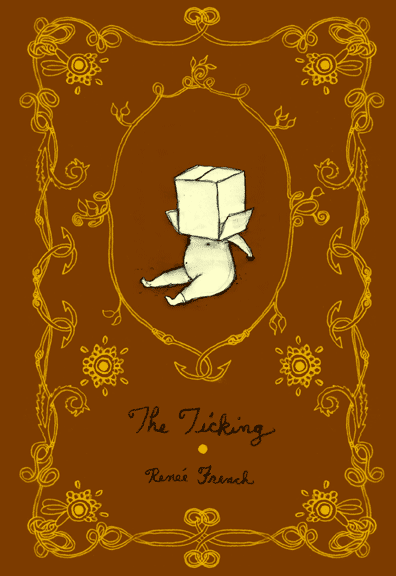
30 in 30: The Ticking by Renee French


#17: The Ticking
Storytellers: Renee French
Publisher: Top Shelf
Year Of Publication: 2005
Page Count (can be approximate or in # of issues format): 216 pages


WHAT I LEARNED ABOUT WRITING / STORYTELLING:
It’s the little moments – ones that could be most relatable – that can have the most impact in a story.  Early in this story, the son draws a picture of the scar on his father’s head, and he gives it to his dad. A few pages later, the boy sees that picture in the trash, and it was an incredibly affecting bit of storytelling.  French included moments like this throughout the book in a manner that seemed effortless. 
 
WHAT I LEARNED ABOUT ART / STORYTELLING:
French uses shadows very effectively to enhance the emotion of a sad scene, of which there were many in this book.  But she used this tool sparingly, which was smart, as it could lose its effectiveness if overused.  Maybe it’s an obvious tool, but it’s one to keep in mind.
 
RECOMMENDATION: A

NOTES / REVIEW / SYNOPSIS I had no idea what to expect with this or the other Renee French book I read for 30 in 30, but I now see why French is held in such high regard.  This story was told mostly through the pictures and the characters’ body language rather than through the dialogue, and I found it incredibly affecting.  I wish I hadn’t waited as long as I had to finally read some of her work, but I’m glad that I now have more work of hers to discover.


Wednesday, November 21, 2012

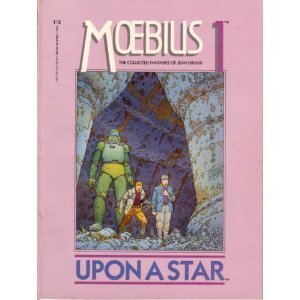
30 in 30: Moebius - Upon a Star


#16: Moebius 1: Upon a Star
Storytellers: Moebius (Jean Giraud)
Publisher: Epic Comics
Year Of Publication: 1987
Page Count (can be approximate or in # of issues format): 64 pages


WHAT I LEARNED ABOUT WRITING / STORYTELLING:
When writing alien dialects, one need not be constrained by utilizing our English alphabet.  You can use images instead of words – made up or otherwise – to show their language in the word balloons
 
WHAT I LEARNED ABOUT ART / STORYTELLING:
The coloring in this book really stood out for me.  The use of vivid colors was striking in this.  And the fact that Moebius used colors for common things (such as the sea or the characters’ skin tones) that did not match with our expectations (the sunsets were green, some human-like characters had orange skin) really sold the alien setting of these stories.


RECOMMENDATION: B

NOTES / REVIEW / SYNOPSIS This was the first of Epic’s line of Moebius collection from the 1980s and it includes a few short stories and one longer story, “Upon a Star,” that are all part of Moebius’s Aedena cycle.  They were enjoyable, and the art was amazing, but there was little ground-breaking in here, in my opinion. Still, these were very fun and beautiful science fiction stories that I would definitely recommend, if you’re able to find them at a decent price now.

STAR WARS -- a modern trailer

 This came across my feed, and it's pretty stellar, even if it utilizes some special edition cuts.