Friday, April 23, 2021

Batman: Year One -- Gordon & Essen

With the continued discussion of the post-Crisis DC Universe I'm having with three of my friends, we followed up Byrne's Man of Steel with Batman: Year One by Miller & Mazzucchelli. I want to look at one, very specific aspect of this series--the relationship between Detective James Gordon and Detective Sarah Essen. 

Miller & Mazzucchelli bring all their creative knowledge to the task of telling Batman's origin story, within the space of only four issues, none of them oversized. To achieve what they want, they heavily layer their storytelling, crafting full, intense scenes that take place over the course of just a couple of pages, or just a handful of panels. There's no fat on these bones, and that is true for one of the major character bits for James Gordon. 

Gordon is new to Gotham, trying to be a good cop in a corrupt agency, pressured by his superiors and his fellow officers, while dealing with the anxiety that comes from the impending birth of his first child, all in a cesspool of a city. He finds solace in the arms and lips of a fellow detective, Sarah Essen. 


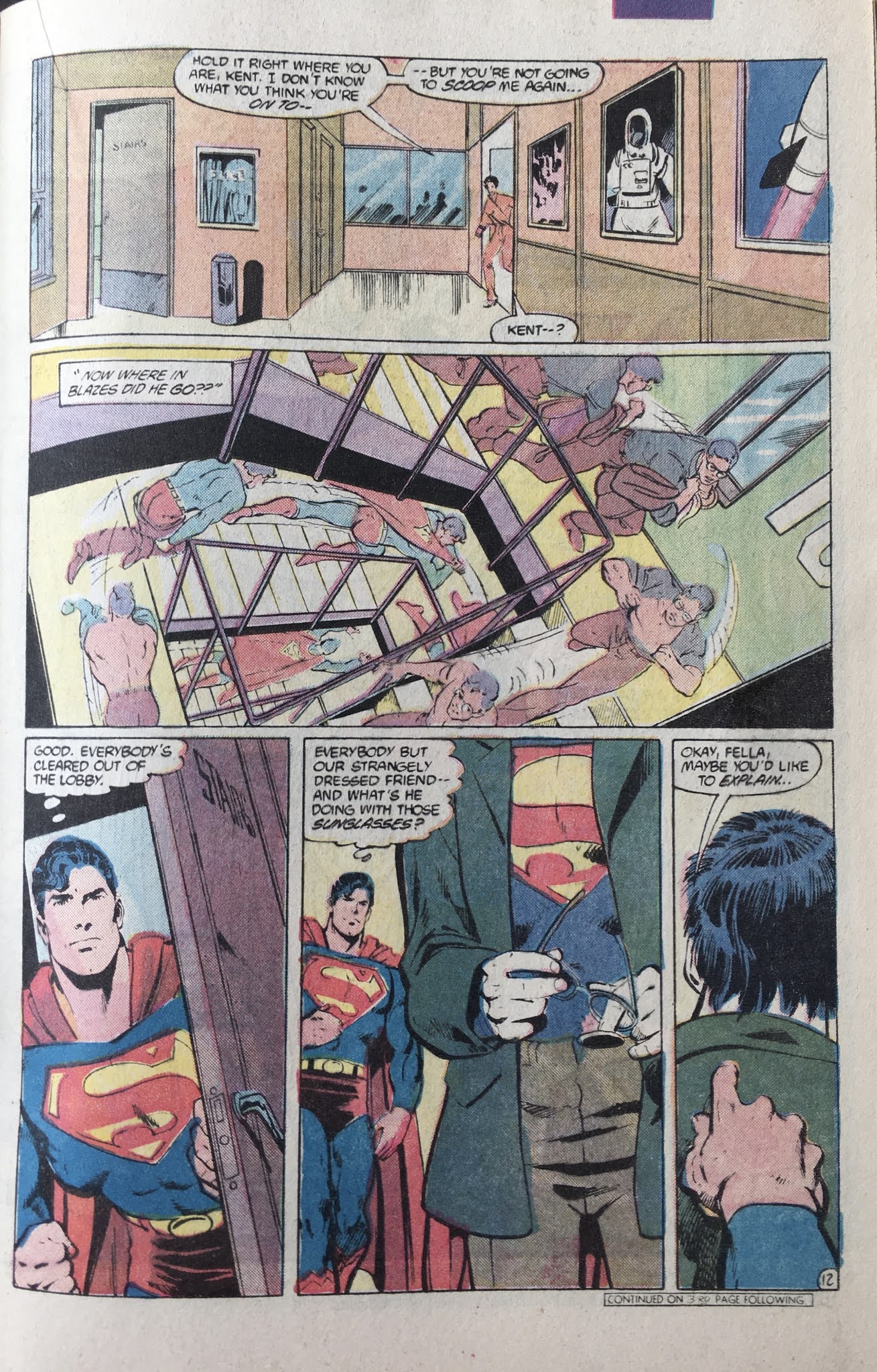
Their blossoming relationship occurs over the course of only three scenes where they interact directly with one another. A grand total of maybe five pages, though there are another handful surrounding the personal interactions between the two. It's brief, very brief, and yet, it feels genuine, and it works. Miller & Mazzucchelli manage to infuse these scenes with the weight and the emotion and the humanity that allows us to believe that James Gordon could fall in love with this fellow detective, and that she could do the same, even with the reality of his marriage and his wife's pregnancy. It's masterful. And then, when we land on this page at the end of chapter 3, the devastating reality and the heavy guilt that Gordon is carrying with him just hits us in the gut. 

Miller & Mazzucchelli have a relatively small bibliography, within the mainstream, superhero comics medium. But, in the two stories they created together, this and Daredevil: Born Again, they may have crafted the best superhero stories the medium has ever seen. 

--chris

Thursday, April 22, 2021

Post-Crisis DC: MAN OF STEEL by Byrne -- some rambly thoughts


Since January, every week three friends and I have been discussing Crisis on Infinite Earths and its crossovers, over Zoom. Having concluded that monumental task, we plan to move onto a discussion of the follow-up series, Legends, and its crossovers. But first, a palate cleanser with the DC trinity:  Superman, Batman, and Wonder Woman, and the various series that reintroduced these legendary characters to a new (and old) readership. First up, Superman: The Man of Steel by John Byrne, with Dick Giordano, Tom Ziuko, John Costanza, and edited by Andy Helfer. 


At the culmination of Crisis, there was now a single Superman on a single Earth in a single universe. DC Comics had achieved the goal of once again making him unique. Now they needed to ground Superman, make him more relatable, not so much the overpowering hero with little to challenge him. I mean, when you can use super-ventriloquism to speak with other heroes in space, what can't you do? So, DC poached John Byrne, one of the most popular creators working at the time, from Marvel, with the mandate to overhaul the Man of Steel. And that's just what Byrne did. 


The 6-issue series opens on Krypton, its people dying from a Green Death, radiation emanating from the interior of the planet and the destructive forces there that are threatening to destroy the planet, if Jor-El's calculations are to be believed. There is no doubt in Jor-El's mind; he's taken his and Lara's son, in order to send him to Earth, so that their boy might live. This is a sterile Krypton, a technologically advanced world eating itself, which, with the radiation known as the Green Death, also gives us a new, and logical, explanation of why Kryptonite (only green, now; no more red, gold, black, or whatever) would have such a detrimental effect on Superman. And very quickly, within the first few pages, we get the classic image of Kal-el's ship launching from the exploding Krypton, hurled toward Earth and his new life. From here, Byrne adds more familiar pieces to the Superman puzzle. 


We meet Lois Lane, a strong, intelligent, driven reporter. A cautious Batman who utilizes the city of Gotham, and his knowledge of it, to his advantage while having a contingency plan for all eventualities, including the arrival of Superman. Lex Luthor, a ruthless businessman who believes everyone and everything can be bought. A Bizarro formed in an experiment utilizing Superman's stolen DNA. And a Lana Lang who needed to discover who she was in order to deal with the burden--that of his secret identity--Clark laid on her, while still in high school. These are all characters we've most likely seen before, but they are all different in subtle and not so subtle ways. It's impressive the thought that Byrne put into these characters, of how to update them and make them relevant for a 1986 world. And it's the little things that stand out, like when Lois, at Clark's apartment, comments on how little weight he has on his dumbbells (not much more than she uses to workout), which makes sense, considering Superman would have no idea what amount of weight on a dumbbell would be too heavy or too light for a regular human. Or, there's the scene in Gotham City, when Superman first approaches Batman and snags his line, only to find that Batman has disappeared. Superman mutters to himself that he didn't think Batman had the power of invisibility, to which Batman--standing atop a nearby skyscraper--proclaims that invisibility is a relative concept, achieved sometimes through a knowledge of the terrain. It's these details that really shine in this series and help it to hold up today. 


One of the best things about Byrne's approach to Man of Steel, and Superman in general, was to model the character of Clark Kent/Superman after the characterization most people would have been familiar with at the time, Christopher Reeve's portrayal from the 1977 Richard Donner film, Superman. There are references laced throughout these six issues. Our introduction to Clark on Earth is in a football game where he's running for yet another touchdown, almost single-handedly defeating Smallville's opponent. This mirrors the frustration of young Clark Kent in the 1977 film where he is the waterboy/manager of the high school football team even though he knows that with his abilities he could run circles around any of the others on that field. We also get an almost direct homage with a flashback of Clark, as a toddler, lifting the family truck to get his ball from beneath it, mirroring the scene from the movie of young Clark catching and lifting the truck when the carjack shifts and tumbles away while Pa is changing the tire, just after they discovered him. 


But two of my very favorite scenes of Byrne channelling Christopher Reeve come when Superman saves a young woman from a would-be mugger and then turns to her and asks that she turn down her boombox, because "in a city [the] size [of Metropolis], consideration for others is the only thing that keeps life bearable," and when, in the opening of issue four, Lois arrives at Clark's apartment to pick him up for Luthor's gala and she sees the picture of Clark in his high school football uniform and is surprised by his physicality, and Clark tells her he still tries to keep in shape--the look on Clark's face is priceless and feels like it comes directly from Reeve and his characterization. For me, Christopher Reeve epitomized the character of Clark Kent/Superman and always will, so Byrne utilizing him as a template for this revitalized Man of Steel is more than welcome. 

"I still try to keep in shape..."

Ultimately, perhaps the most important aspect of Byrne's approach to Superman may be the fact that he focuses on Clark Kent as the main character, with Superman as the disguise. It's a subtle, but monumental, shift in what I feel was, and often times still is, the approach to the character of Superman. He's an alien, he has superpowers, the title of the comic is Superman, ergo Superman is the primary identity. But, for his formative years, until he turned eighteen, Clark Kent was raised by human parents, lived in a human world, was, for all intents and purposes, human, and his understanding of the world and his approach to life all stem from this, from the values instilled into Clark by Ma and Pa Kent. It is his humanity, his kindness, his desire to do good without expectation of reward that makes Superman the hero he is. There are plenty of other heroes with super strength, invulnerability, the power to fly, like Captain Marvel and J'onn J'onnz, the Martian Manhunter, but none of them are Superman. It's this goodness (and greatness) absent the ego that makes Superman stand out. So, focusing on Clark Kent as the prime identity, with Superman as the disguise, only makes sense, and it gets to the core of this character in a way that makes him far more interesting, in my opinion. 


After reading and discussing Byrne's Man of Steel mini-series, my friends and I agreed that this is a foundational text, as far as the character of Superman is concerned. It introduces this legendary character, known the world over, in a way that allows readers old and new to have a solid understanding of who Superman is and who Clark Kent is, while also revealing the world within which he lives, along with the major cast of characters surrounding him. Lois Lane is here. Perry White. The Daily Planet. Lex Luthor. Metropolis. All the trappings that inform Superman's life. There's also Smallville. Ma & Pa Kent. Lana Lang. His roots in the American midwest that form so much of the ethos of Superman. And there's Krypton. Jor-El. Lara. And Kryptonite. The origins that created a superhuman icon and also spurred a need for him to belong and to be part of a community, while also containing the seeds for his destruction (whether one sees that as the Kryptonite or the stark, soulless reality of his people). And, of course, there's Batman, Superman's counterpart in so many ways, the yin to his yang and the one hero who might be able to contain Superman, if he went rogue. It's all here and all laid out by Byrne in a clear and entertaining way that grounds Superman and lays the foundation for all the adventures to come. It's pretty great.


--chris

Saturday, February 27, 2021

Free Association: Highlander, Christopher Lambert, Tom Skerritt, Mark Hamill, Duran Duran, via CGS


In their latest episode, Comic Geek Speak did a retro movie review of one of my all-time favorite films --- Highlander! In fact, Highlander is my #3 film, all-time. I love it! And I enjoyed the episode, even if a majority of the geeks were less than enthused by its quirky attributes. 


Certainly, Highlander can be seen as a low-budget cult classic, but there's so much more to it, for me. The romance of the film, the settings, the over-the-top craziness (especially from The Kurgan, as played by a young Clancy Brown), and the questions they leave unanswered, particularly surrounding the origins of the immortals. It's all fantastic in my book! 


Highlander co-stars Sean Connery, who was only available on set for seven days, meaning they needed to get all of his scenes done swiftly. Despite that small window, they manage to imbue Connery's character of Ramirez with a breadth and depth that is impressive. It is also noteworthy--as noted on the movie posters--for music provided by Queen, a fact pointed out rather out of the ordinary by Adam Murdough on the CGS episode noted above. But it makes sense, in a way. Highlander was a new property, directed by Russell Mulcahy whose only other film credit was an Australian movie titled Razorback, and MTV (in 1986, when Highlander debuted) was in its ascendancy. Duran Duran noted in an interview that they could tell where MTV was readily available, in those early days of the channel, because sales of their albums were far higher in those areas than the rest of the United States. MTV basically made Duran Duran the superstar band they became. So, tapping into that ready-made audience enjoying music videos, by spotlighting Queen's involvement with Highlander, makes complete sense. And Russell Mulcahy would have been able to make that connection easily, since he started out directing music videos. 


Of course, Highlander stars Christopher Lambert as the titular Highlander, Connor MacLeod. His distant stare (a result of his myopia) and intriguing accent (brought about in this film as much from his French heritage as his then lack of English language skills) made him an engaging star, launching a successful action star turn for Lambert, which led me down the rabbit hole of seeking out his movies at the local movie rental store. From Fortress to Knight Moves to The Hunted, I saw them all for a short while, there in the 90s, and I still like to check in on Lambert's work, most recently watching him in the Criterion release of Claire Denis's White Material. Most of those action films were enjoyable shlock, with some memorable scenes, though I wonder how they would hold up today (Knight Moves is a film I would certainly like to revisit, as I appreciated the premise and felt it was a fairly competent thriller with some good acting on the part of Lambert, Diane Lane, and Tom Skerritt). 


Watching these films--and making note of Knight Moves--led me to a theory that Tom Skerritt is a terribly underrated actor who elevates just about any film he stars in (though he couldn't save Wild Orchid II). Knight Moves sparked that idea. From there, you look at Alien, Top Gun, A River Runs Through it -- all great movies, but Skerritt certainly brings a special something to his roles in these films and adds to what is being produced. Whenever Skerritt pops up on something, I'm excited. 


A second, parallel track I followed, with Lambert's low-budget science fiction and action thrillers in the 90s were similar films from another sci-fi hero, Mark Hamill. After Star Wars, Hamill seemed to fade away a bit. Sure, I watched the episode of Amazing Stories Hamill starred in (Amazing! pun intended), and I was excited when he played the Trickster in the 1990 series, the Flash (which, it should be noted, is my favorite superhero of all-time), but there wasn't much in theaters starring Hamill. For that, I needed to peruse the shelves at Blockbuster, seeking out Time Runner (a title with a "coincidentally" similar sound to a science fiction film starring Harrison Ford) and The Guyver, a live-action adaptation of a Japanese manga series. These films . . . were not that good, but I loved Hamill in both of them. The Guyver, especially, suffered from a dichotomous tonal juxtaposition, with Hamill playing his character hard-edged and straight, while his co-star Jimmie Walker played his part as if he were just reprising J.J. from Good Times. A bit of a mess. But still, I'm glad I saw them so I never have to again. 


Which brings me back to Highlander (I stated this was "free association" in the title). I love this film, unabashedly and unironically. Despite it not being "a hit," it managed to spawn four sequels (three of which starred Lambert), a television series (in which Lambert reprised his role for the initial episode), an animated series, and an anime film. I've seen some of these -- the second and third films are trash, the TV series is pretty fun, the animated series didn't intrigue me, and I never realized there was an anime -- but it's noteworthy that the advice that should have been taken (artistically, if not fiscally) was in the tagline for the first and best film:  "There can be only one."


Wednesday, January 27, 2021

CRISIS COUNSELING: Week 2 Reading Order


Here's the list of books we're reading for week 2 of our Crisis conversation. Including 3 issues of Crisis on Infinite Earths!! Read along with us, why don't you?


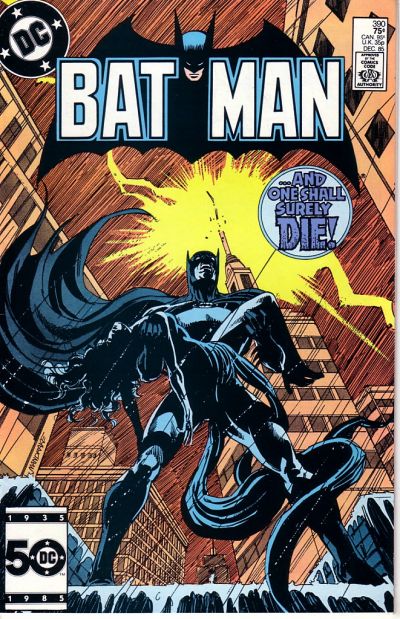
Batman #389


Detective Comics #556


Batman #390


Detective Comics #557


Batman #391


Detective Comics #558


Crisis on Infinite Earths #2


Crisis on Infinite Earths #3 


The Losers Special #1


Wonder Woman #327


Crisis on Infinite Earths #4

Monday, January 25, 2021

CRISIS COUNSELING: backmatter research for week 1


These are the research notes that line up with the Backmatter section of my week 1 notes for our discussion of Crisis on Infinite Earths. Check out that earlier post here, and you can check out the entire discussion of Crisis on Infinite Earths issue 1, plus crossovers, at youtube, here

And thanks.

CRISIS Research week 1


Pre-Publication:

1.  --- The first that fans and the public knew DC was planning CRISIS (not yet named as such) was a blurb in Dick Giordano’s initial “Meanwhile…” column in the Feb. 1983 cover-dated comics, released at the end of 1982. See Scanned images. 


2.  --- In a January 3, 1983 memo from Dick Giordano (executive editor for DC), Marv Wolfman, and Len Wein, all writers and editors were asked to cooperate by using The Monitor two times within their books over the coming year. As described: 

“The Monitor will be the pivotal villain of the series and we wish to have all our readers know who the character is—and to involve him completely throughout the DC Universe before the maxi-series appears.”  

The guidelines for these two appearances of The Monitor stated that, “for his first appearance…we will only hear the Monitor—not see him…His assistant, Lyla, will be the only on-panel character.” Drawings of the Monitor would be supplied within weeks of this memo so that for his second appearance, they could show him on panel. 

It is also noted that the two appearances are only a minimum. The Monitor could be used more than that, if creative teams wished, but it was important that he only observe and that they “refrain from ever having him appear IN action…He NEVER commits the crimes himself.” 


3.  --- In a memo a year later, on January 9, 1984, Giordano made it clear that “The need to include The Monitor in your plans is not optional but absolutely required for all designated titles.” Designated titles included most of the superhero titles. Examples of those exempt were war titles like Sgt. Rock, space titles like Omega Men, those that fell outside the DCU like Arak and Jemm and Thriller, and special books such as Super Powers, which was a toy tie-in, and DC Challenge. 


4.  --- In a memo to Giordano, Wolfman, and Wein, Roy Thomas pointed out that, judging by mail for the titles he edited, such as All-Star Squadron, the Monitor appearances in that first year were not exciting readers. Thomas stated he didn’t feel the concept of the Monitor was a bad one, but that “it’s bound to be wearying, all these cameos which have to get a bit repetitious.”


5.  --- In a memo from November 9, 1984, Marv Wolfman noted that “The entire CRISIS storyline takes place in about three weeks’ time.” But since they wanted the main line of books to crossover with CRISIS, the “participation time [was] actually from July to the first week in November [of 1985].”


6.  --- In an interview for Comics Interview #26, conducted by Patrick Daniel O’Neill, Marv Wolfman stated that the reason they decided to do CRISIS was the idea that the DC Universe was cluttered, that it made no sense. The ideas of “the multiple earths, the multiple Supermen, and the multiple everything” would drive new readers crazy. They wanted to “streamline the universe, get rid of the deadwood, get rid of the multiple universes.” It was believed this would make DC new-reader friendly and help avoid the confusion and contradictions in continuity that had cropped up through almost fifty years of publication of these characters. 

And the spark for this idea came from a letter printed in Green Lantern #143, noting a continuity mix-up from a two-part story in GL #136-37, wherein Marv Wolfman, who was writing GL at the time and answering letters during a changeover in editorship, stated that one day DC editorial would “probably straighten out what is in the DC universe, excluding that which isn’t in direct reference with Earth One, and what is outside.” And from there, Wolfman ruminated on this issue of confusing and contradictory continuity, with that idea germinating into what would become CRISIS. 


7.  --- In an interview for Pacesetter: the George Perez Magazine #7, Marv Wolfman stated that George Perez was his first choice to draw CRISIS, but he didn’t think he would want to do it. But when Perez heard Wolfman talking about it, he volunteered.  


Issue 1:


8.  --- Roy Thomas was the custodian of the golden age characters for DC, at the time CRISIS was conceived, and he was one of the most cooperative, as far as tying into the event through storylines for the titles he wrote—Infinity Inc. and All-Star Squadron—as well as general ideas outside of these titles. This was out of necessity, since he realized the story was going to be published, regardless, and if he assisted, maybe it would gain these titles a bit of a reprieve. He sent a number of lengthy, and thoughtful, memos to Wolfman, Wein, and Giordano, with this in mind. 

Because, ironically, Thomas would also be the one most impacted by CRISIS. One of the stated goals of the series was to streamline the DC Universe, to get rid of duplicate heroes, which would entail the demise, in some fashion, of many of the characters he edited, such as the original Flash, Green Lantern, Hawkman, etc. 


9.  --- It’s noteworthy that some of the most recognizable and, at the time, best-selling characters, such as Superman, Batman, Wonder Woman, and the New Teen Titans, are not front and center early in CRISIS. This was a conscious decision by Marv Wolfman and editorial so that the focus would be on the story and showcase the idea that this impending cataclysm affected the entirety of the DC Universe. Wolfman “wanted it to be obvious that the story was more important than any individual character.” 


10.  --- George Perez inked the figure of Alexander Luthor from Earth-3, the first few times, because he found it challenging to get across what he wanted for a look through just his pencils. 

He also inked Arion’s mystic symbol throughout, to avoid confusion with all the crossing lines, and to keep it consistent throughout the whole story. 


Crossovers

11.  ---An explanation of why some crossovers don’t have the CRISIS banner and others do --- In an interview with Comics Interview (#26, conducted by Patrick Daniel O’Neill), Marv Wolfman stated that they asked that “CRISIS crossovers be in all the comics,” and that “if it’s a minor crossover . . . ‘Do not blurb it as a CRISIS crossover.’ But “if it’s a major crossover, if it’s the root of [their] plot, ‘Blurb it.’” 

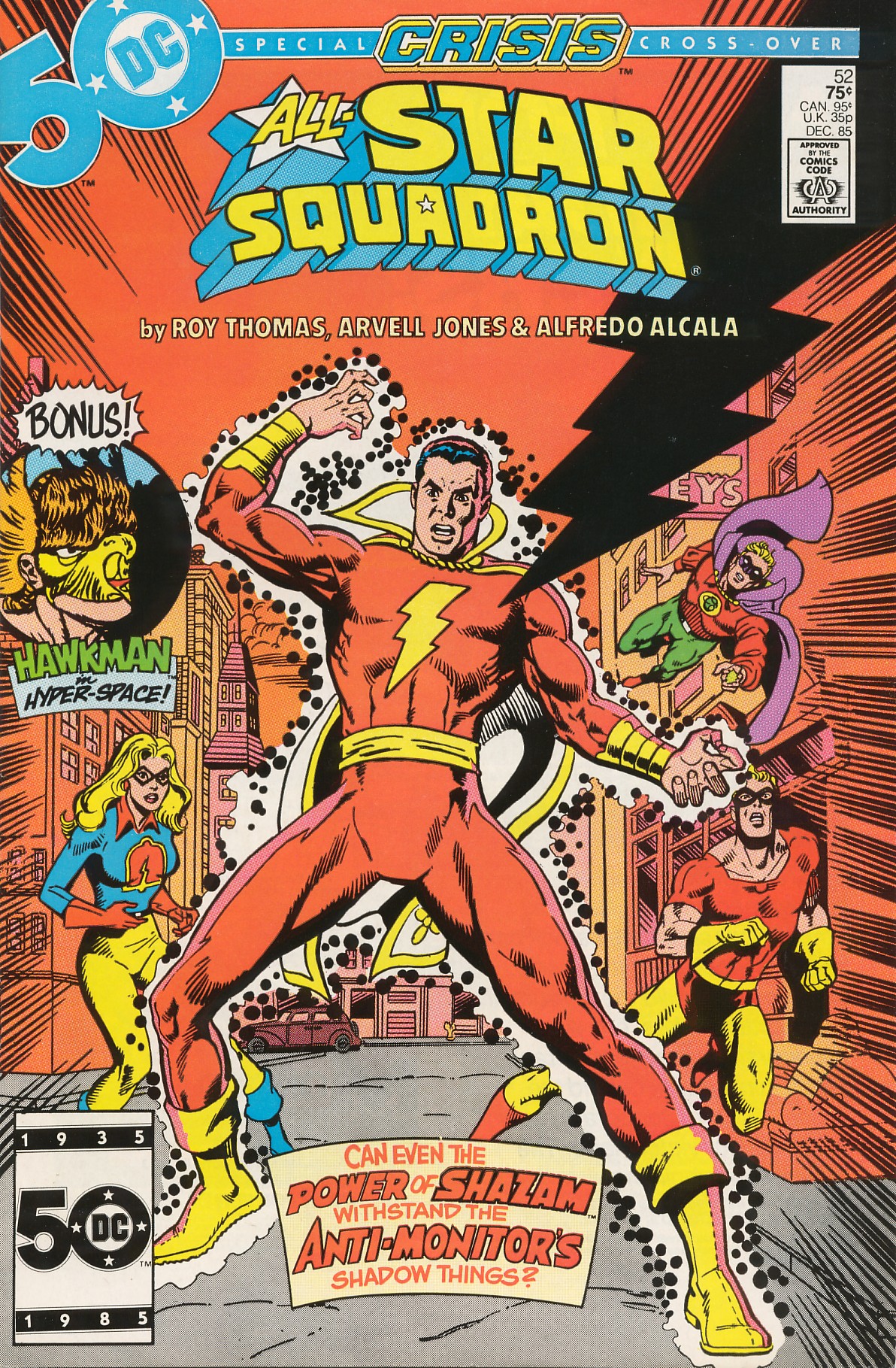
I’m not sure if these All-Star Squadron books should have had the banner.


CRISIS COUNSELING: raw notes for week 1


The first episode of our look at Crisis on Infinite Earths is now live on youtube, with an audiocast to follow. With that, I thought I would share my raw notes for the discussion, here. Hopefully you'll find it interesting. Thanks.


Notes for week 1 

Opening Argument:  thought --- balloons & Gerry Conway’s recent-ish dissection of these vs. first-person caption boxes  see thread here.

Introduction

I began collecting comics in 1984, with GI Joe #23.
Crisis was published later, but I didn’t read it until probably middle to late ‘86.
I remember going through the Mile High Comics catalog and next to Crisis #8, it stated the Flash died. Flash is my favorite character. I had to have it, and I bought the rest of the 12 issues.
From the start, I loved this series. Probably read it a couple dozen times, at least, and it still stands up. 


Crisis Cover Impact: Love it. Wraparound cover, with the heroes & villains tumbling through space as red lightning destroys a centipede of multiple Earths, while Pariah gnashes his teeth and Harbinger stands above it all, with the Monitor a shadow in the background. It’s engaging. And it’s PEREZ.


Synopsis

Chapter 1:  “The Summoning!”

We open with the birth of the multiverse. What should have been a single universe with a single Earth became many, and now that debt is being paid as a wall of anti-matter sweeps across dimensions, as one Earth dies, followed by Earth-3, home to the Crime Syndicate—including Ultraman, Super-Woman, and Power Ring—evil doppelgangers of heroes familiar to us, and the lone hero who stands against them, Alexander Luthor.

As the wall of Anti-Matter destroys Earth-3, Luthor and his wife, Lois Lane Luthor, secure their child in a vibrational rocket and send it across parallel dimensions to Earth-1, so that he might at least be saved, not unlike the way a baby Kal-El was launched from Krypton to become Earth’s Superman, the first superhero.

With every universal death, a mysterious, green-cloaked figure named Pariah is forced to bear witness, unable to intervene. We will learn more of him later.

Back on Earth-1, in the satellite of the Monitor, his assistant, Lyla, energizes to become Harbinger. Dividing into identical clones, she journeys to multiple Earths at multiple points in time to retrieve the heroes and villains the Monitor needs to defend the multiverse, including Dawnstar of the Legion of Super Heroes from the 30th Century and Arion of Atlantis, 45,000 years in the past.

Once her task is complete, Harbinger returns to the Monitor’s satellite and powers down. The collection of super-beings stand in awe of the structure, unsure of who it is that summoned them, and uncertain even of who many of the other heroes might be. There’s a Superman, but older and from Earth-2. And a Green Lantern, but he is new to the ring and African-American. Before they find any answers, the shadows attack, a horde of shadow demons, which seem impervious to physical contact, even at the strength levels of Superman. It is an impossible task, and the collective of super-beings appears on the brink of defeat, when a blinding light fills the satellite, and the shadows flee.

At which point, the Monitor reveals himself, telling the heroes and villains that he is the one who summoned them, “because their universes are about to die!”


QUESTIONS about this issue: 

1 -- Why are these heroes chosen? 

In-story -- the Monitor needs heroes and villains to work together AND these are the ones whose distinct powers are needed by Monitor to be successful.

Editorially -- Marv Wolfman wanted the focus on the story, wanted it known this affected the whole DC Universe and not just the Big Guns.

2 -- Why do these heroes trust Harbinger? 

3 -- On page 25, the Monitor mentions another Earth perished, taking 5 heroes he needed, do we know what Earth that might be and who the heroes are?


Matter/Anti-matter (what we liked "Matter" and didn't "Anti-Matter")

MATTER: Perez artwork, especially the introductory scene with Blue Beetle and that hero’s body language. Specifically, the modified somersault Beetle uses to kick one of the crooks in the face. Beetle is a doppelganger of Batman, but this move feels like something Batman wouldn’t necessarily use, and it allows him to stand out as a distinct character.
ALSO: Solovar’s quick back and forth with Dawnstar on page 29 -- “You’re an ape, but you can talk!” “And you’re a human with wings! Reality holds surprises for everyone!”

ANTI-MATTER: The overly melodramatic Pariah, both in body language and his utterances.


Who’s Who

  • Crime Syndicate, Earth-3, Alexander Luthor, Lois Lane Luthor, and the idea of multiple Earths
  • King Solovar and Gorilla City -- the apes’ mental powers, including telepathy, come from using 100% of their brains
  • Pariah (his origin is actually a big chunk of a later issue, maybe wait)
  • Monitor & Lyla (Harbinger)
  • Firebrand of Earth-2
  • Dawnstar, of the Legion of Super Heroes from the 30th Century
  • Blue Beetle (and the Charlton hero acquisition; Earth-4)
  • Psycho Pirate (Roger Hayden) 
  • Arion  trivia bit: Perez always inked Arion’s mystic symbol because it was complex and he wanted to keep it consistent throughout the series
  • Firestorm & Killer Frost
  • Psimon --- part of the Fearsome Five; powers came from Trigon
  • Dr. Polaris --- old-school Green Lantern villain, first appearance GL#12
  • Superman of Earth-2 
  • Green Lantern (John Stewart)
  • Geo-Force -- gained power through scientific experiment; retains power due to family lineage (Prince of Markovia)
  • Cyborg
  • Obsidian of Infinity Inc.


Backmatter (see this post for more detail on these bits of backmatter)

Pre-publication:

  1. First announcement of CRISIS in Meanwhile… column
  2. Memo from Jan. 1983 asking creative teams to use Monitor 2 times in their titles
  3. Memo from Jan. 1984 stating use of Monitor is not optional; it is required
  4. Roy Thomas memo pointing out mail is not positive re: the Monitor appearances
  5. Memo stating CRISIS storyline takes place over 3 weeks; crossovers from July-Nov.
  6. Comics Interview #26: reasoning for CRISIS, to streamline DC universe
  7. Pacesetter #7 interview: Wolfman stated Perez was first choice to draw & he volunteered

Issue 1

      8. Roy Thomas was most cooperative, as far as crossovers, sent many memos with ideas
      9. Most popular characters don’t show up early in CRISIS; this is why
     10. George Perez inked Alex Luthor & Arion’s mystical symbol, early on, for consistency

Re: Crossovers:

     11. how they decided what issues to have CRISIS banners and which should not
             a. All Star Squadron?????

The Fix (any band-aids in this issue that serve the overall goal of CRISIS):  

the destruction of Earth-3??  It did do away with a set of doppelgangers for DC’s big-name heroes.


The Death List: 

  • An unnamed Earth
  • Earth-3, the Crime Syndicate: Ultraman, Power Ring, Johnny Quick, Owlman, Super-Woman, and the lone hero: Alexander Luthor, and his wife Lois Lane Luthor


Crisis Rating [quarter bin, pull list, bag & board, slab]:  

Bag & Board. Perez art elevates any comic, for me. The stakes are set out right up front, and done economically, we get some nice interactions with the heroes being retrieved by Harbinger (I particularly enjoyed the Solovar and Beetle scenes), there’s action and mystery, Wolfman does a good job of introducing all these characters without the exposition dragging down the story -- it’s quite impressive -- and we end with a quick battle, a revelation, and a helluva cliffhanger: “Your universes are about to die!”


Ratings for crossovers: 

  • All-Star Squadron 50 --- quarter bin. It added nothing to what we saw in Crisis #1
  • All-Star Squadron 51 --- quarter bin. Again, added nothing, just a panel with Harbinger & Firebrand
  • All-Star Squadron 52 --- quarter bin. adds nothing, and seems to contradict Crisis #1, with the All Stars & Captain Marvel able to battle the Shadow Demons. But is it due to magic? Maybe we discover this later in the series.

**To be fair to Roy Thomas, these crossovers take place very early in the CRISIS. Add to that, All Star Squadron is set in 1942, while the bulk of CRISIS is in the present of 1985, and it would be challenging for him to tie into the overall event. That said, he got the banners, and he didn’t do too much with them.

  • Fury of Firestorm 41 --- pull list. It tied in strongly with CRISIS and added to the story, while also providing a good introduction to Firestorm and Psycho Pirate, along with a new status quo for Firestorm that could be a good jumping on point for new readers. But the story wasn’t captivating for me. 
  • Infinity Inc. 18 --- quarter bin. A page and a half showing Harbinger getting Obsidian. Added nothing and I didn’t care for the story. McFarlane is either trying to be inventive with his layouts or just too new, either way, it does not work.
  • Detective Comics 555 --- pull list. It was entertaining with solid Gene Colan art. A Red Skies issue that didn’t tie in but I liked the story. would pick up the next issue.
  • New Teen Titans v.2 #13 (pp.1-17)--- quarter bin. Added little and felt plodding, as a story, to me. 
  • Green Lantern v.2 #194 --- bag & board. It actually added some background with the Guardians, and set up Guy Gardner joining the heroes, gave readers a thorough background of the title, and was entertaining. would definitely pick up the next issue


Friday, January 22, 2021

CRISIS COUNSELING: episode 1, "The Summoning"

 “Worlds will live. Worlds will die. And the universe will never be the same.”

A wave of anti-matter is sweeping across dimensions, destroying Earths and eclipsing universes, while one being, the self-described Monitor, has a plan to stem the tide — if only there is time enough left. Summoning fifteen super-beings from across parallel Earths, the Monitor prepares to defend what remains of the positive matter universe as he quickly relates the gravity of the situation to those assembled.


Week one of a twelve-week examination of the granddaddy of all comic book crossovers, Crisis on Infinite Earths. Four friends and lifelong comic nerds – Ben, Chris, Dan, and Gibran – discuss, dissect, and debate this seminal storyline from 1985, crossovers and all.


Week one reading list:

  • Crisis on Infinite Earths #1
  • All-Star Squadron #50
  • All-Star Squadron #51
  • All-Star Squadron #52
  • Fury of Firestorm #41
  • Infinity Inc. #18
  • Detective Comics #555
  • New Teen Titans (v.2) #13 [pp. 1-17]
  • Green Lantern (v.2) #194

Tuesday, January 19, 2021

CRISIS COUNSELING: Week 1 Reading Order


I jumped the gun last week, but if all goes well, the new podcast discussing Crisis on Infinite Earths, with myself, Gibran Graham, Dan Fleming, and Ben Roberts, should be hitting tomorrow. Fingers crossed. We're taking 12 weeks to tackle this 12-issue series, crossovers and all, and here's the reading order for week 1. 

Crisis on Infinite Earths #1 


All-Star Squadron #50


All-Star Squadron #51


All-Star Squadron #52


Fury of Firestorm #41


Infinity Inc. #18


Detective Comics #555


New Teen Titans, vol. 2 #13 (pp. 1-17)


Green Lantern #194


Hope you check out the podcast when it hits, and why don't you read along with us as we explore a 36-year-old event series that continues to have repercussions for DC Comics, even today. 

Thanks,

chris

Monday, January 18, 2021

CRISIS COUNSELING: some personal background


Crisis on Infinite Earths may be the most consequential comic book event, ever. It's certainly the one that's had the most impact on me, as a reader and a fan. And it is, by far, my favorite of the event comics. Maybe that's because -- despite the fact that Marvel's Secret Wars came out the year before -- it's the first major company crossover. It was in the planning stages, and prematurely announced in Dick Giordano's "Meanwhile..." column, before Marvel's Jim Shooter conceived of his Secret War, and it can definitely lay claim to the fact that it had the most impact on its characters and titles, and, by extension, its fans. 


I didn't read Crisis when it was initially published in 1985. I lived in Calais, Maine, just about as far east as you can go in the United States, right on the border with Canada. Calais was a town of roughly 4,000. We had no comic book store -- heck, I'd never heard of comic book stores at this point -- but we had a bookstore that sold comics, which is where I got mine for the most part (you could also find them at the convenience store or the drugstore, as well as at a smaller bookstore in the strip mall across the river, in St. Stephen). I am certain that my local bookstore, Mr. Paperback, did not order Crisis. Because if I had seen that gorgeous George Perez artwork, I would have snatched it up without thinking, and been the happier for it. 

But I was a huge fan of the Flash (secret identity: Barry Allen). Still today, the Flash is my favorite superhero. It started with the Super Friends cartoons. When I started collecting comics in 1984, at age 12, the latest issue of his title was one of the first ones I bought at Mr. Paperback, number 336. Many more were added to the collection later. Many more. But, at some point in 1986 (by my best guess), I was poring through the latest Mile High Comics catalog, looking carefully at the notes next to the individual issues -- notes that would mark a significant character appearance or situation, as well as the names of popular creators who may have written or drawn said issues. As I perused the titles, I came across a note that stated: "Death of the Flash." 

What the what!?!
I had no idea Barry Allen had died. I needed to get this comic (it was issue #8 of Crisis on Infinite Earths). And since it was one chapter of a twelve-chapter series, I had to get them all. I can't remember which of the issues weren't available at that point -- I think #10 may have been one of them -- but I ordered all the back issues that were available and quickly managed to fill in the gaps. Then I read the story. 

Marv Wolfman & George Perez

I was blown away. No, I wasn't familiar with the vast majority of these characters, but I was intrigued. The story by Marv Wolfman propelled along at a blistering pace, and the art by Perez . . . what can I say, it was amazing. I immediately fell in love with his tight, detailed comic art, and he quickly became my favorite superhero artist. And Crisis became one of my all-time favorite stories. It's one that I re-read regularly, every year or two, and it never fails to entertain me. Wolfman & Perez were at the top of their game, when they wrote and drew Crisis, and the effects of this dimension and era-spanning tale were cataclysmic. 


And now, my buddies and I are doing a deep dive into Crisis, with all its crossovers. The first episode of our podcast should be hitting soon, and when it does, I'll let you know. Hope you'll join us for a look back at one of the most important superhero stories in comic history.


Thanks,

chris

Sunday, January 17, 2021

I . . . am your father.

 And yesterday's video consciously mirrored this scene from Rogue One. Which I loved, and which is probably my favorite Star Wars film after the original trilogy. 

Cue heavy breathing. 


Saturday, January 16, 2021

STAR WARS -- a modern trailer

 This came across my feed, and it's pretty stellar, even if it utilizes some special edition cuts.