Saturday, October 15, 2011

ESSEX COUNTY vol. 1 by Jeff Lemire

Wow! I read the first volume of Jeff Lemire’s Essex Country trilogy, “Tales from the Farm,” last night (the entire thing is available in one handy volume from Top Shelf) and was completely enthralled. Lemire’s deft storytelling belies his relative inexperience at the time he wrote and drew this. Seriously amazing work.


The story takes place in Essex County in southwestern Ontario, where Lemire himself grew up. In this first chapter of the trilogy, readers meet Lester, a young boy who enjoys comic books and dresses up in his own makeshift costume to battle invading aliens in the back fields of the farm where he lives. Though not immediately evident, it is his Uncle Ken with whom Lester lives on the farm, and their relationship is strained at best.


Lemire, thankfully, does not spoon-feed his audience, allowing the narrative to reveal itself at a measured pace while keeping readers engaged in the story. Soon enough, one discovers that Lester recently lost his mother to cancer and does not remember his father. This, as much as anything, explains the divide between the boy and his uncle. It’s heartbreaking and authentic, and Lemire’s choice of imagery and spare dialogue convey this emotional chasm masterfully.


Through the course of this first chapter, readers follow this new family of two through a year on the farm, slowly learning more of their history. Lester befriends a local celebrity – Jimmy Lebeuf, who played a single game in the NHL for the Toronto Maple Leafs, wherein he suffered a career-ending injury – and finds the companionship he needs, at this time in his young life. Lester is comfortable with Jimmy, who enjoys discussing comic books with the boy and even dresses up in his old hockey uniform to help Lester battle his alien invaders. It’s a touching friendship, one made more sympathetic when Lester’s uncle warns Jimmy off, hinting at something more than just familial responsibility.


Lemire paces this first volume of his Essex County trilogy so beautifully, teasing out information, allowing readers to make the connections between these characters. His deft use of silent and repeating panels – all utilized to provide narrative beats or accentuate an emotional tenor within the story – help create an engaging graphic novel that had me enthralled from page one. And, when this volume reaches its climax, it is presented in such an understated manner that it will resonate with readers long after the book is closed.


Lemire’s raw, almost scratchy, brushwork adds an emotional layer that elevates this story. His work exemplifies the difference – and, in my opinion, the superiority – of cartooning over photo-realism, the current trend in “mainstream” comics. Lemire’s stark, expressive inks pull readers into this story, enveloping them in the raw emotions he is sharing through these characters. It’s a wonderful melding of art with words, showcasing what is possible in comics.


I understand, fully, why Essex County has received such widespread accolades, and I eagerly look forward to the next volume sitting on my to-read stack. If you haven’t read this book before, you need to seek it out. Now.


chris

Friday, October 14, 2011

Cully Hamner's Blue Beetle

So,

I had a big post ready for today - just needed a little polish and some images. But, my day has been spent with the little man (Ian, my 4-year-old), so no writing got done. We ran some errands, played with my old Ewok village, and hit the kids' museum. And now, he's sitting looking through the Blue Beetle collection I wrote about yesterday. So, in honor of that, here are some interior pages from those first issues of the Jaime Reyes Beetle by Cully Hamner.


Thursday, October 13, 2011

PLAYING CATCH UP: BLUE BEETLE SHELLSHOCKED


I was introduced to Cully Hamner’s artwork with his professional debut on Green Lantern: Mosaic, longer ago than Hamner might like to admit (I kid). I remember finding his art to be raw and energetic but not as refined as I might have liked. Forgive me, I was young. But it stood out because it was different, and Hamner’s name was registered in the back of my mind.

Over the years, I’ve appreciated watching Hamner grow as an artist. His uncluttered linework exhibits a mastery of how to effectively tell a comic story. I loved his work with Greg Rucka on the Renee Montoya Question back-up feature they did in Detective Comics. So, when I noticed the Blue Beetle: Shellshocked collection in the UMaine library where I work, I took it out to see what this “new” Blue Beetle was like, before he became new again with the recent DC relaunch.

This book was great, and so much fun! I loved learning about Jaime Reyes and this new iteration of the Beetle. I enjoyed seeing him do his research into the legacy of the character, working to discover exactly what he might be in for. I appreciated the fact that this hero was Latino, and that the creators (Keith Giffen, John Rogers, Hamner, et al.) portrayed this reality without hammering away at the clichés that can quickly descend such a scenario into farce. It felt genuine, and I applaud the creators and DC Comics for trying to broaden the spectrum of heroes within “mainstream” comics with this character.

One of the best things about this opening collection is the fact that Jaime, along with readers, is learning about his new powers as the story progresses. He isn’t adept at fighting – clumsily attacking some “men in black” at the Mexican border – and he knows very little about the armor that covers him when he manifests his Beetle powers. This adds authenticity to Jaime’s story, and makes readers sympathetic to his cause, while also providing interesting story possibilities.

Jaime’s interaction with his family, as well as that of his friends, provides a nice counter-balance to his new heroic persona. A good student, who is also a good person, Jaime feels different from other characters. It’s not just because of his ethnic background. Jaime is a real teenager, without the burden of personal tragedy that seems to be grafted onto most contemporary heroes. There is also a big question in his recent history that, I assume, had ramifications down the line in this series, but it is only hinted at in this first volume, and I’d rather not spoil it for anyone who might want to go back and check this out, as I did. It really adds a new dimension to Jaime’s character very early in his story.

And the art in this book – provided by Hamner, Cynthia Martin, Duncan Rouleau, Kevin West, Phil Moy, and Jack Purcell – is really lovely. Clean lines, dynamic cartooning, and work inspired by manga all add up to an energetic and fun read. If you like expressive artwork that tells a story well, this is a book for you.

My hope is that the new iteration of Blue Beetle in the DCnU retains the fun aspect this first volume exhibits. But for now, I would highly recommend checking this, and any subsequent volumes, out. I know I will.

chris

Wednesday, October 12, 2011

FRACTURE OF THE UNIVERSAL BOY by Michael Zulli


I first heard about this book two years ago and have been anxiously awaiting its publication ever since. With such anticipation, it is easy to elevate the work to a level where expectations cannot possibly be fulfilled, no matter the artist.

Thankfully, Michael Zulli is no ordinary artist. Fracture of the Universal Boy is a beautiful, heart-rending, emotional, personal, and moving piece of work. It is obvious how much time Mr. Zulli has put into this book, and it is a book that will reward future readings.

I devoured my advanced copy (thank you Kickstarter campaign) a few weeks ago in a single sitting – the book is roughly 200 pages long – and was very happy to find my “official” copy on the doorstep just the other day. The amount of detail on these pages is well-served by the oversized dimensions of the book, and the complete package is truly a thing of beauty.

I am letting the story simmer in the back of my mind for now. But, at some point soon, I plan on re-reading the book and writing a longer piece on this book. I only hope that I am able to do the work justice.

But I will say that, if you see this book at your local comic shop or book store, pick it up. You will not be disappointed. Mr. Zulli worked ten years on this book, and the care and artistry evident within its pages exhibits that commitment. It is an amazing book that is deserving of your support.

chris

Friday, October 7, 2011

More Infantino/Janson Flash wonderment

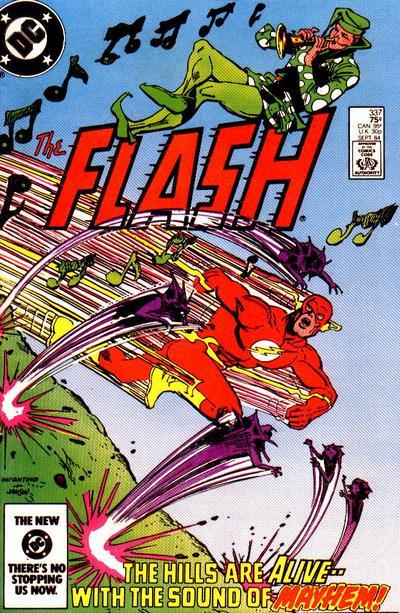
I mentioned in an earlier post that the combination of Carmine Infantino and Klaus Janson doing covers for the Barry Allen Flash series epitomizes my Flash. And this is the cover that cemented that for me.


Just amazing

chris

Tuesday, October 4, 2011

NEW TO ME: JLA Rock of Ages


JLA: Rock of Ages (collecting issues 10-15 of JLA) by Grant Morrison, Howard Porter, et al.


JLA: Rock of Ages feels like a true Grant Morrison comic – the first time in his tenure on the book that he appears to have let loose with his narrative creativity (though his wild ideas have been evident from a very early stage). “Rock of Ages” is a time-hopping story in which members of the League fall into a dystopian future that “could occur” if they don’t return and stop their colleagues from defeating Lex Luthor and his Injustice League, who are attempting a corporate takeover of the Justice League. The narrative wraps in on itself, twisting and turning until it’s difficult to discern which way is up, with the Worlogog (or Philosophers’ Stone) at the heart of the narrative – its design a visual metaphor for the mind-warping narrative Morrison creates with these six issues.

It is also fitting that, although a retread of the theme utilized in the two-issue story involving the Key, the heroes who fall into the future – Green Lantern, Aquaman, and Flash – must make their way back to stop their friends from defeating Luthor so that the dystopian future in which Darkseid has created a new Apokolips on Earth does not come to pass. This inversion of the typical superhero story mirrors the narrative framework Morrison uses for “Rock of Ages.”

Not to belabor the point, but the story does suffer – again – from the cluttered and sometimes confusing artwork of Howard Porter and John Dell. It really is a travesty, in my opinion, that Morrison’s inventive stories are hampered by such muddled, hackneyed art. There are panels and pages where it is difficult to tell what is going on, but thankfully, the words and the ideas peppered throughout the narrative kept me involved and enthusiastic.


And, once again, Morrison shines with the inventiveness of his ideas, which he always injects into the narrative in an understated fashion, adding to the wonder I take away from it. They are found in bits of dialogue or off-handed scenes that always come across as obvious once stated, but are ideas that feel brand new. These moments, more than anything else for me, are the moments that elevate this book and make it so enjoyable. Some of those moments of brilliance are:

  • J’onn J’onnz shrinking “the rational, analytical left hemisphere of [his] brain and enlarg[ing] the irrational right hemisphere” in order to “see the world as the joker sees it…” when he and Superman are stuck in a holographic maze created by the Joker’s consciousness.
  • Batman realizing Luthor is attempting a hostile takeover of the JLA and noting that Lex doesn’t understand he’s going up against someone with as much experience in the boardroom as he who plays the game of “corporate takeovers” better than Luthor – Bruce Wayne.
  • The Atom realizing (because Ray Palmer is a scientist) that, if Darkseid can see through his forceshield, that means light is getting through, and then shrinking himself down small enough to follow the light inside. Simple, elegant, and it makes one think.
  • Orion, in this alternate future, affirming his heritage as a warrior born of Darkseid and destroying the universe with the Genesis box in order to save it – thus, exhibiting the heritage of his upbringing by Highfather. Only Orion, a product of these two diametrically opposed fathers, could achieve such a feat.
  • Luthor using Jemm, Son of Saturn to try and block the telepathic abilities of J’onn J’onnz. (Man, I loved the lush artwork of Gene Colan on that series)

And of course, there are many more hidden gems within this volume of JLA. Very few writers are able to achieve this level of intelligence in “mainstream” comics, particularly within the superhero medium. I look forward to what Morrison does next.

chris

Saturday, October 1, 2011

THIS is my Flash!

I don't think they ever did any interior pages together - which is a shame - but when Klaus Janson came aboard to ink Carmine Infantino's Flash covers with issue 335 of the original Barry Allen series, those images just spoke to me.


Something about the delicate lines of Janson's inks (it looks like he must have used a small pen nib, though I don't know for certain) over Infantino's smooth pencils just made the Flash pop on these covers. Flash was "my" superhero and the blending of these two fantastic artists made an indelible mark on me as a kid.

chris

Thursday, September 29, 2011

FROM THE LONGBOXES: Flash #334

Just a quick post here. I've been re-reading my issues of the Flash that comprise the storyline "The Trial of the Flash" and some of the opening pages by Cary Bates and Carmine Infantino have been wonderful. Often steeped in exposition to get new readers up to speed, it has yet to fall into the dead, weighty prose of Chris Claremont that so turns me off to his X-Men run.


This opener from the latest issue I read - #334 - is a prime example of why I am having so much fun re-reading these comics. It doesn't necessarily utilize it for catching readers up, but it does have a purpose in this issue's story. And I just love it.

So. Much. Fun.

-chris

Tuesday, September 27, 2011

THE NEW DC (1984): Blue Devil

House ads back in 1984, with Crisis on Infinite Earths just around the corner, were proclaiming "The New DC. There's no stopping us now."

I wonder: Does the DCnU have anything as fun as this on their publishing schedule?


From what I've heard and read - no - but I wish they did.

Ah, well. There's always back issue bins.

-chris

Monday, September 26, 2011

COMIC BOOK MEMORIES: Pat Broderick

One of the stalwarts of the eighties comic scene was Pat Broderick. As an artist, he wasn't flashy, but he was always good and could provide solid superhero work that was distinct. His characters were bulky and square-jawed, and they felt powerful. He worked on a lot of books I enjoyed, and I wonder where he is now. the last time I saw his work was in the late-lamented Harlan Ellison's Dream Corridor, where Ellison was able to choose those writers and artists whom he most revered and had always wanted to work with. Broderick was one of those artists, and he did a stellar job on the story assigned him.

Here are a couple of titles he worked on, back in the day. So good.


Sunday, September 25, 2011

Apples & Oranges: FRIDAY NIGHT LIGHTS vs. LOST


Netflix streaming has been good to me. I missed the LOST bandwagon, but once the finale aired, I thought it was time to get on board and see what all the fuss was about. And man, is that show good. I burned through the first season fairly quickly, then took a break, and followed up with a slower viewing of the second season. I’m now on the third season, but took a months-long hiatus after the seventh or eighth episode.

A couple weeks back, I decided to return to the island and see what was going on with Sawyer, Jack, “Freckles,” and the others. I watched a couple of episodes, then stopped. Because I noticed Friday Night Lights was now available for streaming, and I decided to sample an episode.

And I was hooked. This show easily outshines LOST, in my mind. Which is high praise, because I find LOST to be a compelling and entertaining show. But it’s missing a key ingredient.

LOST has a great ensemble cast, and I really appreciate the diversity of the characters. I applaud J.J. Abrams, Damon Lindelof, et al. for providing a “global” view with their cast. And these characters are, for the most part, more than just ciphers. They feel and act like real, complex people. And though they are relatable characters, that empathy with the viewers is more in the abstract, I think, than in the reality of the viewerships’ experiences, which isn’t a bad thing, because the over-arching mystery is the glue that holds the series together. The mystery is the focal point, and the characters are the pawns used to get across that “truth” of the show.

On the other hand, Friday Night Lights is a television show ostensibly about football. And yet the football – whether practice or games – is rarely evident within any given episode. The football is the foundation of the series, but it is not the focal point.

In Friday Night Lights, as well, there is a diverse (though not as global due to the nature of the setting) and believable cast of characters. These people are people we viewers know and have interacted with most of our lives. The relationship between Coach Taylor and his wife is refreshingly frank and true and nuanced in a manner not often seen on television – two people committed to each other, who love one another, but who also argue in the course of their relationship while still being supportive. And the relationships between the teenagers, as well as the other parents, is all very well handled and takes me back to the trying times of high school when the fate of one’s future depended upon whether one wore the right brand-name to school.

Friday Night Lights is an engrossing, entertaining, and thought-provoking show that has eclipsed LOST – for now – in my viewing queue. And I think the reason for that is because they put the characters first while LOST, as a consequence of the type of show it is, puts the mystery first. They’re both extremely well done, enjoyable shows. But the fact that the human element is elevated ever so slightly in Friday Night Lights means I’ll be putting that at the top of my queue until I reach the end.

chris

Saturday, September 24, 2011

WRONG PLACE, WRONG TIME? Jeff Lemire’s Sweet Tooth


There’s no doubting that Jeff Lemire is a talented cartoonist and skilled storyteller. I have yet to read his Essex County trilogy – though I plan on remedying that fact soon enough – but I have read some short stories of his, as well as a preview of Essex County, and I have definitely been impressed. So, it was no surprise when Lemire leveraged the success of Essex County in order to place two projects with Vertigo Comics. I was very excited.

I have yet to read The Nobody, but I picked up the first two trades of his ongoing series, Sweet Tooth. I read the first collection and was impressed with the world-building he was doing. Dystopian future – check. Weird hybrids that might unlock the secret to a plague ravaging humanity – check. An over-arching mystery – check. Duplicitous characters who are more than one-dimensional ciphers – check. This book seemed ripe for my tastes.

But, to be honest, it just didn’t grab me. I started the second collection, but once I hit the halfway point (issue 8 of the overall series), I just stopped. The premise is good, the characters are fleshed out nicely – for what little time I spent with them – and the mystery is certainly a good foundation for the book. But ultimately, I didn’t care about the characters. I was not invested in them, and that made it difficult for me to continue reading.

Part of my problem is that, in reading Sweet Tooth, the book feels like stuff I’ve read before (of course Jepperd’s wife was going to be pregnant just as the plague was coming down on humanity) and the glacial pacing – which is the norm in comics now, I know – just sapped what enthusiasm I had for the book. I am curious if I might have appreciated this more if I’d read it in single issues. Would that month-long wait have added to the experience? I don’t know. But I do think reading this in a collected edition – where I could quickly move on to the next chapter – hampered my personal reading experience. I know I had the same reaction when I read the “Winter Soldier” arc of Ed Brubaker’s Captain America run. The decompression of the storytelling made it far less enjoyable for me, as well.

Which is not to say this is a bad comic. Not in the least. Lemire’s talent is in full effect within these pages. His expressive artistry is a wonder to behold. And some of the layouts are inspired – in particular, the moment when Jepperd kills Jacob, the pimp, with the butt of his rifle. That is a classic example of allowing readers to fill in the blanks and elevate the horror of the scene (the exact opposite of what was seen in the new Catwoman from DC comics, but I digress). The one aspect where Lemire’s expressive linework does not serve him well is in the action scenes. There’s no weight to his figures when they fight, no feeling of impact between them. But those scenes are few and far between, and it does not detract too much from the overall story. Add the coloring of Jose Villarrubia, which is stunning, and this is a top-notch book.

Ultimately, this just isn’t the book for me. Or maybe it’s not the book for – at this time. I’ve had similar experiences. When I was attending a monthly graphic novel discussion group at my local Borders (no longer open, obviously), one of the books chosen was Warren Ellis’s Transmetropolitan: Year of the Bastard. I remember having little good to say about that book. It just didn’t speak to me at the time. But now, years later, Transmetropolitan is one of my all-time favorite series, and one that I have read multiple times.

So, maybe I’ll return to Sweet Tooth at some point down the line and rediscover it the way I did TransMet. But, for now, I’ll move on to something else.

chris

Friday, September 23, 2011

COMIC BOOK MEMORIES: Paris Cullins on New Gods

Over on Twitter, Peter Rios has been tweeting about comics by playing off the creators/characters for the DCnU and pointing people toward other work by these creators (like Paul Jenkins on DC comics Presents? Check out his Inhumans with Jae Lee) or other iterations of these characters (like Captain Atom? did you know he was created by Steve Ditko?). It's been fun and has brought up a lot of memories from when I was first reading comics in the 1980s.

For example, Paris Cullins drawing the New Gods.


I was all over that book because of the art. And with Mark Evanier co-writing it had to be faithful to Kirby's legacy. Now I need to find those books again and see how they stand up. Good memories.

chris

Thursday, September 22, 2011

NPR's 3-minute fiction

NPR's Weekend All Things Considered is holding the 7th round of their 3-minute fiction writing contest. Each round has been judged by a published author, who provides a prompt for writers - both professional and amateur - to create a short (only 600 words) story around that can be read in 3 minutes. Thus, the 600 word limit.

For this round, one character must arrive in town while one character leaves. The deadline is this Saturday, and I think I finally have my piece finished. It was a great challenge to try and create a complete story from that prompt and keep it to 600 words. Not sure how successful I was, but we'll see. If nothing else, it was fun and really had me working to be as concise as possible.

Once the winners have been announced, I will throw my story up here. But for now - fingers crossed.

Saturday, September 17, 2011

INTRODUCING MYSELF TO MARK MILLAR – part 3

Wolverine: Old Man Logan by Mark Millar, Steve McNiven, et al.


I’ve read a lot about Mark Millar, but not much by the man. I decided to rectify that and read his 12-part story with JRJr, Wolverine: Enemy of the State. And I hated it. I’ve written about why I loathe that story already here at Warrior27, but basically, I found the characterization to be bland, the main conceit of the plot to be boring, and I felt that Millar – by trying to “push the envelope” and having Wolverine and Elektra pile up the dead bodies without any repercussions because they had been brainwashed – completely sapped the narrative of dramatic tension. There were some bright spots – very few – but, overall, it felt lifeless and ineffective, despite the stellar art from John Romita, jr.


So, my expectations were not high for this third Millar Wolverine book. And, I have to say, I was incredibly surprised. I thoroughly enjoyed Old Man Logan – could not put it down. This is what I want from my comics (and from my fiction, in general). I want it to engage me and keep me turning pages. I need to care about the characters and feel like there is a very real conflict at hand, despite the fantastical trappings to which I am typically drawn, as a reader. And that’s exactly what this book gave me.

It is some years in the future. All the heroes have died out or gone underground, and America is now ruled by the villains – the country dissected into various fiefdoms: Hulkland, The Kingdom of the Kingpin, Doom’s Lair, and the President’s Quarters. Wolverine is living in California, now Hulkland, with his family. They pay rent to the Hulk, who sends his gamma-irradiated offspring to collect. But this month, Logan (as he answers to now) is short. So the Hulk children beat Logan, taunting him to pull his claws (which he has vowed never to do again). They leave, warning Logan to have double the rent next month, or they will kill his family.


Hawkeye, now blind and a known drug-runner, shows up to recruit Wolverine for a cross-country trip that will pay well. Logan corrects Hawkeye on his name and agrees, realizing the money earned can save his family, but tells Hawkeye he won’t be fighting. Through the course of the story, we learn about this new world – a world where the skeleton of Hank Pym (in his Goliath form) stretches across the landscape now known as Pym Falls – and we discover what happened to the heroes, and what happened to turn Logan into a pacifist. And finally, we reach New Babylon, the capital of this burnt-out world, where Hawkeye was contracted to bring his contraband. It is for the President, who does reside in the White House, and who is better known as the Red Skull. He lords over his trophies in one of the many rooms of the White House, trophies like Iron Man’s armor, Cyclops’s & Thor’s helmets, pieces of the Visions, Dr. Strange’s cloak, and bits of the Silver Surfer’s board, among many other relics of the fallen heroes’ memories. And then, the real action begins.


Millar deftly handles the few narrative threads of this story quite well, teasing things out nicely to keep readers interested without revealing too much all at once. The inventiveness of the futuristic characters he introduces, along with the novel manner in which he explains Wolverine’s descent into self-loathing pacifism (which sounds like a terrible oxymoron), is all well done. Millar smartly pulls back the throttle for this tale, providing some “eyes-wide” gore when the story warrants, but offering a lot of quiet moments that allow the action to stand out, something sorely lacking in Millar’s “Enemy of the State.”

Millar also made me care about this incarnation of Wolverine. He is a very different character – beaten-down and defeated and unwilling to fight. Now a pacifist who only wishes to take care of his wife and children, this is the Wolverine I appreciated in the original Miller/Claremont mini-series – a person of honor working to keep his animalistic rage in check, who had to work to be a hero. That characterization has been completely lost in the last twenty years, in my opnion, but Millar manages to bring that back with this futuristic version of Wolverine. We see his berserker side in a daydream that opens the book, where he imagines ripping into the young Hulks, before the narrative brings us back to “reality.” Logan does not let loose on them, allowing these three behemoths to pummel him into the dust, and it sets the tone for the rest of the story. I was engaged with this character, which made me care about his road trip with Hawkeye. And when it all finally goes to hell, I’m completely in Logan’s corner.


Setting this story in a dystopian future was a smart move and added a lot to the narrative. This is a future where most of the heroes are dead, and those still around are either in hiding, retired, or about to face extermination. Anything can happen because Old Man Logan falls outside the regular Marvel continuity. And that means characters can, and will, die. This simple aspect of the setting imbues the narrative with a dramatic tension that is missing in most mainstream comics today. And Millar takes full advantage of this while also circumventing reader expectations of what is required of a Wolverine story. With every obstacle he and Hawkeye encounter, one expects the claws to come out, but they don’t. Not until Logan is pushed too far. And, at that point, all that anticipation can be released by the audience with a collective exhale.


I should say something about the art. Steve McNiven is a good artist. I can see that. But his photorealistic style is just something that does not appeal to me. That said, I found McNiven’s art in this book to be less “photoshopped” than I see from many of his contemporaries, and I thought, despite some over-rendering, that his storytelling was clear and appealing. He managed to pump up the action when it called for it, but he also set the stage nicely in the quiet scenes. So, overall, I’d say McNiven did a good job, and, more importantly, I think his art fit this story almost perfectly.

Overall, I was really impressed with Wolverine: Old Man Logan, and am very glad I read it. Will I read it again? Probably not. There are too many other good stories out there I haven’t gotten to yet, and this book, though enjoyable, is not one that I can see rewarding multiple reads. But at least I found a Mark Millar book I really enjoyed.


So, time to move on to something else. What that is, I don’t know yet? But I’ll write about it here when I do find out.

-chris

STAR WARS -- a modern trailer

 This came across my feed, and it's pretty stellar, even if it utilizes some special edition cuts.