Sunday, August 28, 2016
Saturday, August 27, 2016
OUR EXPANDING UNIVERSE, by Alex Robinson
The latest book by Alex Robinson, OUR EXPANDING UNIVERSE,
published by Top Shelf Productions, is Robinson’s best book yet. [or, put more honestly, my favorite of his
books] Revolving around three
buddies—Billy, Scotty, and Brownie—in their mid to late thirties, it’s a book
about growing up, and about being a grown-up, that I found relatable in a way I
hadn’t with Robinson’s earlier works.
Not that I didn’t appreciate Box Office Poison or Tricked,
but the subject matter, as much as anything, in Our Expanding Universe
just hit a nerve that elevated the book for me.
The drama for Expanding
Universe comes from the various familial entanglements of the three
men—Scotty is married to Ritu, with one child and a second on the way; Billy is
married, and he and his wife Marcy are just beginning to try to get pregnant;
and Brownie is divorced, currently single, and ever the voice of authority,
expounding upon marriage, child-rearing, and every other subject, regardless of
his personal experience—and their efforts to hang out with one another, as if
nothing has changed in their lives. The trio
gets together to play box ball (or 4-square), go to Funcle’s novelty shop, and
grab a beer and talk about old times (the underlying sentiment being these were
also the “good times,” especially as far as Brownie’s concerned). It’s a quiet existence, with our characters
comfortably settled into their lives.
It’s real life, one might say.
The couples also get together for dinner at one another’s
places, allowing readers to learn who Marcy and Ritu are. The book may be about the dudes, but Robinson
doesn’t forget about the women in the story, because they are essential to the
lives of these men. And these women
become the lynchpin for a major turning point in the narrative, when Marcy
happens across Scotty, in a café, having coffee with a woman from the school
where the two work. The philosophical
conundrums that branch off this single scene—Marcy detecting a sexual vibe
between Scotty and his co-worker, the ethical considerations of sharing this
with Ritu, for both Billy & Marcy, along with the possibility of Scotty
being innocent of any infidelity—propel the narrative forward through the rest
of the book. And—without giving anything
away—though some could find the ending to be unsatisfying, as things are not
neatly tied up with a bow, I felt it was a very real, very honest, very human
place for the story, and the friendships, to end up.
Robinson’s writing in Our Expanding Universe is as
good as it’s ever been. His dialogue is
natural and genuine, sounding a lot like conversations I’ve had, or overheard,
while getting to the important (and not so important) philosophical questions
that plague all of us. It’s engaging,
while also entertaining. And the plot
points develop effortlessly, following not only from what goes before, but also
from character, with nothing feeling forced.
Robinson keeps his readers, and his characters, in the moment, allowing
things to progress at a pace that keeps the audience wanting to turn the page
without ever feeling lost.
Our Expanding Universe also benefits from being a
shorter book with a smaller cast of characters than Tricked or BoP.
This book feels more accomplished, never wandering in its narrative,
remaining focused and on point throughout the book. Though I enjoyed his earlier works, it feels
as if Robinson managed, with Expanding
Universe, to cut all the chaff that, in my opinion, bogged down parts of these
longer works. It’s impressive how
concise the book is, while also packing in a lot of great story.
Alex Robinson’s art, like his writing, is also spot on with
this latest book. He has always been a
rock-steady artist, simplistic (but not simple) figure work clearly relating
the story he is telling. But with this
book, his art is not only accomplished, but he also injects some new approaches
(or, at least, some approaches I don’t remember seeing previously) into his
storytelling that work incredibly well.
In one scene, after Scotty’s second child has been born, he is feeling claustrophobic
and a bit overwhelmed and needs to get out of the hospital room. When Billy arrives with Marcy, Scotty and the
guys head into the hall and make for the stairwell leading to a side exit, and
once outside, with the sun looking down on Scotty as he takes a deep breath,
Robinson forgoes his traditional inking and, instead of outlining the figure, fills
in the body with hatching and uses the negative space to create the figure. It’s a perfect example of form following
function and enhancing the storytelling, in the process. In another section, Robinson plays not only
with the art but with his writing, as Marcy and Ritu get together with a bunch
of their female friends. In this scene,
the images are snapshots of the party, while the dialogue is typed out, outside
of the panels, like a film script. This
approach allows the women, seven in all, to carry on their various
conversations, over one another, without the panels getting jumbled with word
balloons or the audience becoming confused about who is speaking. It was masterfully done, and something that,
though non-traditional, worked very well and never pulled me out of the
story.
If you’ve enjoyed Alex Robinson’s books before, then you owe
it to yourself to check out this latest work (though, if you are a fan you
probably already have). If you’ve never
checked out Robinson’s work, seek this book out. It’s a smart story, well told and
entertaining, which will make you think.
And I don’t think we can ask much more than that of Robinson, or any
creator.
-chris
Friday, August 12, 2016
On Writing --- Making Narrative Connections (or, do I have any idea what I’m doing?)
I write. I’ve had a few short stories published. One of these was chosen for the “Best
American Mystery Stories 2015,” meaning it was deemed one of the 50 best
mystery/crime stories published in 2014.
Not bad; I’m very happy with that.
But, when it comes to writing, do I really know what the hell I’m
doing? Or at least think I know what I’m
doing? Quick answer: no.
Certainly, I’ve learned a lot these
past few years, since taking my writing seriously, and I know I’m a better
writer, but does that mean I know what I’m doing? Does that mean I can sit down and craft a
story that will elicit the emotion and demand the engagement of readers, in the
way that Hemingway could? Hell, no. When I sit down to write, I don’t have a clue
how to achieve the ends I’m seeking. I
still feel like I’m rowing upstream without a paddle (and that, maybe, I’m like
Wile E. Coyote and going up this stream even without a boat).
That said, I suppose it would be
disingenuous to state that I’m wholly lacking in ability. It’s just that I’m winging it, laying down
bricks without knowing if the cement I’m using is the right consistency. Which I don’t think is a bad thing. There are no rules—though there are plenty of
people willing to share their writing rules with you—and that’s where the
dynamism and excitement in a piece of prose can come from. It’s also what brings about this trepidation
and uncertainty I feel. But, I’d guess
many writers—even successful, working authors—would relate to this. So, let’s run with it.
I recently started draft one of a
new novel, which is probably where all this unease comes from. At this point, I still don’t know how to
write a novel and don’t even have a good approach for the writing of one. There are novelists who do a detailed
outline, and though they allow for some leeway within the parameters of this
framework, they adhere pretty strictly to it, so that they can be certain all
the pieces of this puzzle fit. (I am a
planner, and this use of an outline is something that appeals to me, but I’ve
yet to make it work for something as long as a novel) There are other novelists who prefer to make
it up as they go along. They may have a
general sense of where they are heading, with a few guideposts set out in the
wilderness they must reach, but all the interstitial stuff is unplanned. This approach affords these writers the
opportunity to be surprised by their characters and to remain enthused about
the work, which can be important when you give over months, or years, to a
single endeavor. There is also the added
expectation that, if the author is able to be surprised in the writing of the
novel, then readers will also be surprised.
(Though I’d prefer to have my map laid out before me, this is,
generally, what I’ve found myself doing, when writing longer works)
So, damn wordy preamble aside,
let’s get to the meat of this piece…
This new novel is a crime story
about friends, with rough childhoods, who grew up together, and all that
history, along with some of their poor choices in the present, come around to
bite them in a major way. I know a
handful of highlights within this narrative, and I have a fairly strong sense
of the main characters, but as far as a chapter by chapter basis—or even a scene by scene basis—I don’t know what’s
coming next. And working without a net
scares me. Will I be able to write something worthwhile and engaging if I don’t
even know what’s coming next and how I’m supposed to get to the “big scene?” Who knows?
But…
I do feel like I’m getting better
with this. My progress as a writer has
been a series of incremental steps, little things I’ve come to understand, come
to realize about the craft and about how I approach writing, that have proven,
to me, that maybe I am cut out for this.
It’s a long game, and I need to be in it for that long haul or I’ll
never make anything of it. One of the
major things I’ve become comfortable with is knowing my first draft will be
crap. I just spit it out onto the page, knowing
that I can fix all the bad stuff with revising.
That, as Greg Rucka has said, is where the real writing, the real work,
happens. This is good; it’s freed me up
to just let the first draft roll across my keyboard and be what it is, the
framework I was seeking from an outline, that can be tweaked and refined and improved.
I don’t think it’s a coincidence
that, concomitant my comfort with a horrific first draft has come my increasing
comfort with the idea of having no net.
Which does not mean I just dive into a new story without any type of a
plan. For this new novel, I had a general
idea of where the story was going and what I wanted to do with it. I also wrote a lot about the main characters,
long backstories that, for me, have been invaluable, because the childhood
experiences of these characters dictate the choices they’ve made as adults, and
the paths they will end up going down through this narrative. Without these backstories in place, I wouldn’t
have been able to start writing this book.
Even with that, though, there is
still a discovery process with the characters—not just finding their voices,
but also, still, finding out who they are.
Not until I actually started writing the first chapters did I realize
there was still more to learn about these people. It sounds odd, almost foolish, but I’ve heard
this from many writers, and the characters do take on a life of their own, once
the writing commences. It’s kind of
magical, but it can also stop the writing dead, because you end up with
characters you don’t know or scenarios you don’t believe you can write yourself
out of. One of the things I did, when I
found myself stuck only a few thousand words into the novel, was to write a
short story with two of the main characters, set in the past. This seems to have unlocked everything, and
has allowed me to forge ahead with the book.
Finally (sorry, jumping around
here, but it’s how my mind works, and this post—though ostensibly for public
consumption—is really about me working through ideas and practices and
approaches to writing, for my own self), one of the best bits of advice I’ve
found, in recent years, comes from Joe Hill.
He wrote on his blog, I believe, that he only writes one scene a
day. That scene could take up only six
lines or it could take six pages (or ten, or more). No matter what the length, he focuses on
completing that one scene. I’ve taken
that to heart, moving away from a word-count goal, and it has been
helpful.
Even when I’m working on a short
story (hundreds of which Harlan Ellison wrote overnight, or during the few
hours he sat in a bookstore window), this is an approach I take. It extends the time needed for me to complete
a short story, but I think it also makes the final product better. With only a scene to write each day, I can allow
myself time for other aspects of my life—like work, spending time with my
family, reading—but it also means I have all the rest of that time for my
subconscious to work on the next scene (or even to rework older scenes). It affords me the opportunity to make
connections that, I hope, will be enriching to those reading it.
The most recent example of this
comes with this crime novel I’m writing:
First, there were decisions made
prior to writing ---
- One character, KERRY, grew up rich, and, at the
point we start the novel, she has recently launched a campaign for State
Senator.
- Another character, DETECTIVE DESJARDINS, will
have a story arc dealing with her crumbling marriage.
Next, we had the introduction of the Detective. In order to give it some movement, some drama, some verisimilitude, I had Detective Desjardins’s superior, Lt. Glass, call her in to his office to talk about her recent trouble clearing cases and the change in her demeanor (all brought on by her knowledge—unknown to anyone else—of her husband’s infidelity Ăźone of the first connections made in the writing).
Now, Detective Desjardins will become important later when she investigates the murder of a couple of the main characters—one of whom is the aforementioned Kerry—but I wanted to intertwine these characters even before that. So, I had the Detective following up on a robbery report from Kerry and her husband, from a few weeks prior. Detective Desjardins does not believe some of what is in that report, and, being upset by her marriage issues, decides to confront Kerry’s husband, who made the report, about these problems. This gets two of my main characters together earlier than they might have and also lays groundwork for the main plot of the novel (this robbery report came up as I was writing, but the link to the main plot came to me after finish writing for the day Ăźsecond connection made).
Finally, while finishing up the current chapter, I was thinking ahead to subsequent ones. I knew what the next chapter would include, but wanted to consider the one after that. And, while listening to a podcast or reading or something other than focusing on the novel, it came to me. With the silver spoon mentality of Kerry, and the quid pro quo that can exist between civic entities and state legislators, it only made sense she would go to the police Lieutenant and complain about Detective Desjardins harassing her husband Ăźthird connection made in the writing. It’s a natural, and it provides the antagonism (between the detective and the Lt.) that helps infuse a scene with its dramatic tension and engage the readership.
I don’t think I would have been
able to make those narrative connections a few years back. I’m certain I would not have made those
connections without having the time between scenes to ponder what comes
next. And, if I’d had a set outline in
place that did not include these series of events, I don’t know that I would
have been able to find these connections and have them in the final narrative. It’s strange.
I’ve always been a planner. But
maybe I need to embrace writing without a net—which it appears, from setting
this down, I am working toward—and accept that it’s the best way for me to
write.
Sounds good.
-chris
Wednesday, August 10, 2016
What Comic Runs Can You Read Again and Again?
With the
rise of digital comics and the ubiquity of comic collections, today really is a
golden age for comic readers. There is
very little we cannot find—online, at a store, or through our library—to read and
enjoy, from the early works of Jack Kirby and Will Eisner to the most recent
collections from Kate Beaton or Ed Brubaker & Sean Phillips or Colleen
Doran. There’s a plethora of comic
stories out there, and more are coming out every week.
But with
this wealth of comics, it can be tough to keep up with the newest books, even
if one tries to narrow it down to just a handful of titles from specific. Even with all the new books coming out, there
are still those standout series in your longboxes, or on your shelves, that
will call you back for a re-read and a reassessment. These are the comics that touched you
somehow—maybe it was your introduction to a particular artist or character, or
just a great concept that was extremely well executed. Often tinged with a strong dose of nostalgia,
they’re the books that still give you that tingle in the pit of your stomach
that takes you back to a time that feels more vibrant. Like visiting an old friend you haven’t seen
for a long time, these series make you feel warm and comfortable, and bring a
smile to your face every time. Here are
three of mine…
G.I. Joe (Larry Hama, et al., published
by Marvel Comics)—
This was the
first comic book I collected and will always be an important title because of
that. I started with issue 23 of the
series—“Cobra Commander Captured at last!”—and it was all engines ahead, after
that one. I collected up through #140
(featuring the Transformers, by that time) and backtracked to gather all the
previous issues, either through reprints or the digests available at my local
bookstore, and these comics rarely disappointed.
The battle
of good vs. evil and the cool costumes—and ninjas! Natch—were what initially
drew me in, but it was the writing that kept me hooked. Hama crafted some great characters, and their
interpersonal relationships, along with the political intrigue inherent in the concept
of Cobra and its battle against this covert and “superheroic” military unit,
was exciting and engaging. Though soap
operatic, to a great degree, there was something more complex and more adult at
work in Hama’s storytelling. Sure,
scenarios may have been outlandish and overblown, but it never felt like he was
writing down to his audience. There was
a definite line between good and evil, in the comic, but many of the characters’
personal morality skewed toward a hazier shade of gray, which infused the
stories with something missing in most of my other comics. And, most important for me, though each issue
contains the requisite exposition to bring newer readers up to speed, Hama was
able to deftly weave this into the dialogue in a manner that rarely felt forced
and, at the very least, was lyrical, which kept the exposition from stifling one’s
appreciation of the reading experience.
Finally, it
should be noted that there were a stellar number of artists who worked on this series. There was the legendary Herb Trimpe, Ron
Wagner and Rod Whigham (two of my favorites on the title), Marshall Rogers, Tony
Salmons, Mark Bright, Geof Isherwood, and even art from Hama himself, along
with memorable covers by the likes of Michael Golden and Mike Zeck. G.I. Joe has a great pedigree, and it’s
a comic that, today, still holds up and excites the kid in me, when I sit down
to read it.
Sandman (Neil Gaiman, et al., published
by DC/Vertigo comics)—
This was the
series for me, when it was originally published, and it is what helped
make Neil Gaiman one of my favorite writers.
The Sandman was unlike almost any other series I was reading, at
the time (I had yet to compile a full collection of Alan Moore’s Swamp Thing),
and it hit me at just the right age. I
was in high school when the first issue was published, and was entering my
senior year when I discovered the series, with issue #8, “The Sound of Her
Wings.” Gaiman’s concoction of horror
and magic, ancient myth and a literary sensibility, spoke right to me. And as the series progressed, the realization
that he was overlaying all of these various stories with a single narrative
that would see the main protagonist evolve, in as extreme a way as possible for
the embodiment of Dream, only added to my appreciation of this series. It’s a masterpiece, in my opinion, and one
that rewards subsequent readings with new insights.
Sandman
hit at a time when the comic book publishers were just beginning to look at
collected editions as a viable publishing avenue. When this became the expectation—that the
single issues would be collected into a lasting volume—something occurred with
the serialization of many comic books—writers (or the editors), would plan
storylines to be six issues long, allowing for a standard length collection that
could be priced appropriately and sit alongside all the other six-issue
collections on the shelves. Thankfully, Sandman
came before this—and I might argue that Gaiman would not have fallen into that
trap, but who can say?—and the storylines within the comic spread across
however many issues were needed to tell the story properly, whether it be five
issues or seven or thirteen. These were
often interspersed with a series of single-issue stories, vignettes that felt
like a nice respite between arcs but, in many cases, were later revealed as
integral pieces of the overall narrative.
Yeah, I love this comic.
And, again,
like Hama above, Gaiman was afforded the opportunity to work with a wonderful complement
of amazing artists, including Charles Vess, Colleen Doran, Mike Dringenberg,
Sam Kieth, Kelley Jones, Jill Thompson, Marc Hempel, and many others. These comics are not just wonderful stories,
but they are also a feast for the eyes.
Some of the most beautiful comic art can be found in these volumes,
especially the final one, “The Wake,” which includes art from Michael Zulli,
Jon J. Muth, and the aforementioned Vess.
And don’t forget the covers by the inimitable Dave McKean. Just, seriously, beautiful, wonderful,
amazing stuff. Seek it out if you haven’t
already.
Suicide Squad (John Ostrander,
Kim Yale, Luke McDonnell, et al., published by DC Comics)—
The mid-80s
is my “Golden Age” of comics. It’s the
point when I was still relatively new to comics and collecting, and all the
series I read, at the time, just had an immense impact on me. Primarily, I was a DC guy, with titles like
the Flash, Justice League, Superman, Batman, Green
Lantern, and such occupying much of my interest, though I did have
occasional forays across the way, to Marvel, with the likes of Avengers and
Captain American and Silver Surfer (ah, Ron Lim, you did the
Surfer right). But the book at the top
of the pile, every month, was Suicide Squad.
This was a
comic that was unlike all the other superhero books I was reading. A collection of villains, and psychologically
suspect heroes, tasked by the government with the dirty jobs that the pristine
heroes could not be expected to do (assassinations, prisoner escapes, covert
ops in foreign lands). If they were
successful, and survived, their sentences would be commuted. But…there was always the chance they could die
on the mission, and that threat was very real.
With the likes of Captain Boomerang, Bronze Tiger, Rick Flagg,
Enchantress, Gypsy, Vixen, Deadshot, and Amanda Waller, “The Wall,” along with
a fantastic supporting cast, this was a book that surprised and engaged month
in and month out. There was real pathos
and melodrama, thanks to Ostrander and Yale, and it was wonderfully illustrated
by the likes of McDonnell, Karl Kesel, Geof Isherwood, John K. Snyder III, and
others. And, like Hama with G.I. Joe,
Ostrander & Yale managed to layer in the exposition without weighing down
the narrative with it, a task far harder than it looks. I love this book, and if you were
disappointed with the movie (or even if you enjoyed it) you should seek out
these original stories, because they are some great, exciting, and fun
comics.
Now, what are yours?
-chris
Wednesday, August 3, 2016
Love & Rockets, by Los Bros Hernandez
Spurred by the recent Previews episode from CGS, here are some thoughts on one of my all-time favorite comic series: Love & Rockets.
Los Bros Hernandez--Jaime, Gilbert, along with Mario, at
times--have crafted some of the most poignant, affecting, brilliant, and
beautiful comics over their thirty-plus year careers. I didn't finally read
L&R until the first giant omnibus came out, roughly ten years ago,
collecting (to that point) Gilbert's Palomar stories. They. Are. Awesome. And,
I would argue, the best way to introduce yourself to L&R. More soap
operatic, telling the stories of myriad characters in the small, Mexican town
of Palomar, Gilbert's early work in this series is more assured than his
brother, Jaime's, whose earliest issues suffer a bit from strange anachronisms
and a tendency to be wordy with his dialogue.
Which isn't to say the early Locas stories from Jaime are
not enjoyable. He quickly finds his footing and launches into one of the most
real friendships in all of comics, and, it could be argued, one of the best in
all of literature. Hopey and Maggie fall in and out of love, struggle through
hardships together, and apart, while continually moving forward, seeking
answers about life and what it all means. (and if that sounds like hyperbole,
there certainly is a pinch of that included, but, for the most part, I'd argue
my description stands up)
The real strength of this series comes from its longevity.
Jaime and Gilbert have taken each of their collections of characters and
allowed them to grow old, to have families, to lose friends and loved ones,
discover new friends, have adventures, feel pain and sorrow, and love and joy,
and experience lives that feel genuine, feel real, feel lived in. And their age
has not diluted their storytelling abilities on bit. One of the most heartfelt
and heartbreaking moments came a few years ago, in Jaime's
"Browntown," which was built on the stories that had come before. It
was an amazing piece of comic storytelling and comic art, that could not have
been done without the accumulation of stories, over the prior decades, that
came before. It was an exclamation point, driven into readers' (or, at least,
my own) heart(s), and it's one of those handful of comics stories that has
stuck with me, since I read it.
But it's not just their storytelling. Jaime & Gilbert
are two of the best cartoonists working today, and two of the best ever, in my
opinion. Their ability to evoke emotion and replicate body language utilizing
an economy of line is beyond impressive. This, to me, is some of the most
beautiful artwork I've seen in comics. Really incredible.
Now, I know it can be daunting to start a book that has this
much history (see: Cerebus). But Fantagraphics has a page that can help you
find where to start reading, here.
And the collections they've done for Gilbert & Jaime's
work are great--a good size, with a healthy collection of stories, at a good
price. Well worth picking up, here. Or on Amazon or at In Stock Trades. Or, if
you want, see if your local library can request them for you through their
Interlibrary Loan department, which allows libraries to borrow items from other
libraries, across the country.
These are, seriously, some of the best comics ever made. Do
yourself the favor of seeking them out and reading them. Now.
-chris
Monday, June 27, 2016
COMIC BOOK ANNIVERSARY ISSUES --- The Incredible Hulk 300
Comic book publishers love their big, round numbers. 100 issues, 200, 300, 800—these are
milestones worthy of celebration, most often marked by oversized issues with
major story developments for our beloved characters, while sometimes including
bonus material, such as extra short stories or pinups from noteworthy creators
in the field. My favorite anniversary
issue, as well as one of my favorite comic books, period, is Superman 400,
which I wrote about for W27’s 400th post. But the first anniversary issue I ever
picked up was The Incredible Hulk 300.
And it was awesome.
As far as anniversary issues go, this Hulk comic is a
benchmark. It is the culmination of a
multi-part story arc from creators Bill Mantlo and Sal Buscema that dynamically
changes the status quo for Bruce Banner and his alter-ego, the Hulk, in a
super-sized climactic issue that has tons of guest stars. And this comic is packed with action and
drama—if overwrought, at times, in the classic Marvel tradition TM—from
cover to cover. I chose well, when I
picked this off the stands, and, in achieving its secondary objective, this
story spurred me to start picking up the Incredible Hulk series on a regular
basis.
Being the final part of a major storyline, one might assume
this would be a difficult issue to read, lacking the context provided in
previous chapters. But in recently
re-reading Hulk 300, I never found myself lost, and could easily see how a neophyte-me
would also have been able to follow the story with ease. It’s obvious, from page one, that the Hulk is
on a rampage—exposition from bystanders gives a fuller context: that the Hulk
had recently come to be seen as a hero, that his beastly nature had been curbed
by an ability to retain Banner’s knowledge while in Hulk form, and that,
somehow, he’s now reverted to the mindless beast he’d often been—and that the other
heroes must stop him, lest the Hulk devastate New York and its citizens.
Mantlo & Buscema also provide ample introductions for
all the heroes who come together to battle the Hulk, with clear visuals and
[sometimes overly] detailed descriptions of their powers. It is a master class in how to write a comic
book that is welcoming to both long-time fans and brand new readers—if still in
that classic, overwritten manner. That
said, Bill Mantlo is a deft enough wordsmith that—not unlike Larry Hama’s
writing for G.I. Joe in this same time period—it does not bog down the momentum
of the story. Mantlo’s hyperbole is purple
and lush, but it manages to toe that fine line, rarely falling into what feels
like parody. He’s not quite on a level
with Alan Moore, whose purple prose contemporaneously dripped off the ink-soaked
pages of Swamp Thing, but his lexicon and turns of phrase are engaging and
entertaining, adding to the overall feel of the story. It’s impressive.
The art in this issue is pretty great too. Sal Buscema, a legend in the business, known
for his work on a myriad of titles, is not a favorite artist of mine. Certainly, his storytelling is clear and his
ability to hit deadlines laudable, but Buscema’s art lacked the dynamism and
distinctness that his older brother, John’s, art has in spades—at least, to my
eye. But with this comic, the solid base
Sal Buscema provides with his pencils is brought to vivid, dynamic life with
the inking of Gerry Talaoc. Where
Buscema’s solo work is epitomized by his utilization of heavy blacks for the shading
and definition of his characters, Talaoc feathers the heroes in this comic with
hatching that imbues the figures with more three-dimensionality and a better
realized musculature. With few
exceptions [Todd McFarlane being one of them; yeah, McFarlane], the Hulk has
never looked better, or more menacing, to my eye.
Getting back to the actual story—the climax, one of the most
difficult things to do in storytelling, is completely satisfying. After S.H.I.E.L.D. and Thor and the Avengers
and Power Man & Iron Fist have failed to stop the rampaging Hulk, Dr.
Strange conjures a spell to send the Hulk off to another dimension, where he can
no longer threaten Earth. New York City
is saved, but the guilt of failing to help their old comrade weighs heavily on
the heads of these heroes. In the end,
nobody won, except for the readers. This
issue was a celebration of the Hulk’s long publishing history that also marked
a new direction for the character, a near-perfect anniversary issue. And, it was a damn fun comic to read.
-chris
Thursday, June 23, 2016
THIS is my Superman --- [art edition]
I have long held that Superman need not be overly muscled,
in his depictions in comics and film, and would argue that it is more
“realistic” for him to be lean and agile rather than a Mr. Universe type. Superman’s power comes not from a
hypertrophied physique but from the energy imbued within his cells by Earth’s
yellow sun. Not that he wouldn’t be
muscular, but it isn’t necessary for the character as conceived, and it is more
interesting, visually, if Superman circumvents the typical body type of male
superheroes in comics.
Certainly, there have been a number of artists to draw this
icon of the four-color world, and they all brought their own personal style and
sensibilities to the character, resulting in varied body types for the Man of
Steel. But the most iconic
visualizations of Superman—by Curt Swan & Jose Luis Garcia-Lopez in the
comics and Christopher Reeve in film—have tended toward this leaner body
type. Which may be why I prefer the
leaner Superman as a template.
That being said [written], “my” Superman would definitely
have to be Jon Bogdanove’s version.
Feeling like an updating of Wayne Boring’s Superman, Bogdanove’s was
BIG, with huge muscles. And yet, it
never felt as if he overwhelmed the panel or the scene, at least not in a bad
way. Bogdanove’s Superman was powerful,
epitomized by Bog’s particular delineation of Kal-El, and it made for some
dynamic imagery.
During Bogdanove’s lengthy run on Superman: The Man of
Steel, which coincided with Bog doing some of the product art for ancillary
Superman merchandising—notable for the fact that Jose Luis Garcia-Lopez was
pretty much the only artist providing DC Comics merchandising art for decades—he
made his home in Maine, on Monhegan Island.
This afforded me a number of opportunities to meet Bogdanove, and his
enthusiasm for the character was obvious.
(Bog named his son Kal-El) And
that enthusiasm was infused into the character and the comic, while Bogdanove drew
it.
Bogdanove’s Superman is a statue, cut from marble, come to [printed]
life. Bog’s Superman is solid, an
irresistible force and an immovable object, all at once. Ultimately, it’s his use of shadow and the
thick lines for hatching—which help to define his Superman as a three-dimensional
hero on a two-dimensional plane—that has always stood out for me (shout out to
Dennis Janke, Bog’s longtime inker on Superman) and which still remains burned
on my memory as the epitome of the Man of Steel.
-chris
Tuesday, May 24, 2016
THIS is my Spider-Man --- [art edition]
Years back, Peter Rios (if my memory’s to be believed)
started a thread, at the old CGS forums, asking people to share the
comic artist who best epitomized any given character, for them. Neal Adams might be your Batman artist (or
possibly Berni Wrightson), Kirby (or John Byrne) your FF artist, Jerry Ordway
(or Curt Swan) your Superman artist, Marie Severin (or Herb Trimpe) your Hulk
artist. It was a great thread that
really got to the heart of why we, as comic fans, love and collect these
stories—sometimes to an obsessive fault.
The conjunction of personal taste in art and affection for a particular
character engenders a very specific attachment for us readers, which can lead
to interesting and illuminating conversations.
(So, please feel free to share your own in the comments and kickstart
this dialogue)
Spider-Man is an iconic character, some might even say he’s
the lynchpin of the Marvel Universe—or, at least, the standard-bearer for decades,
leading up to the recent invasion of Hollywood by so many of Marvel’s spandex
class. Spidey was the one most visible
in other media—with cartoons, a live-action television series, costumes and
party favors and toys, and a musical—as well as, it could be argued, the one
most accessible to nascent comic book fans.
And through the years, Spidey’s had a horde of great artists delineate
his adventures—John Romita, Sr. & Jr., Todd McFarlane, Mark Bright, Gil
Kane—but for me, it’ll always be Ditko!
Ditko co-created Spider-Man, drew the book for the first few
years, bringing to life such classic characters as J. Jonah Jameson, Betty
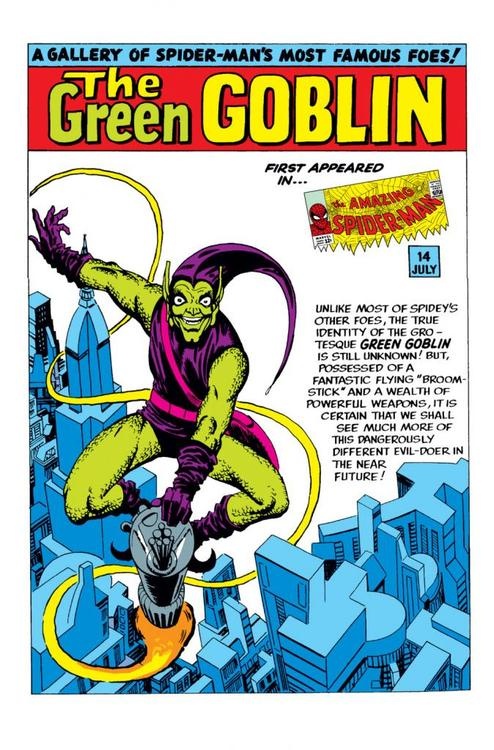
Brant, the Vulture, Electro, Kraven the Hunter, and the Green Goblin. He’s the artist who defined Spidey, for
decades to come. And he is, hands down,
the best artist ever to draw the webslinger.
Sure, it may seem a copout to go with the creator, but
Ditko’s Spidey perfectly epitomizes the character, to my mind. My introduction to Spidey was through
Ditko—not the comics, but the original animated series from 1967. Spider-Man, along with the other characters,
were strongly modeled on Ditko’s style.
Images of him swinging through New York, coming directly at you through
the television screen, are right out of those comics. And, though incredibly amateurish, those
cartoons were a ton of fun, at the age I discovered them.
When I finally got an opportunity to read some of those
early Spider-Man tales, my mind did not change.
Ditko’s work in those few dozen issues is stellar. His fluid, easy line and facility with body
language really elevate those comics.
All his characters look real, rather than the idealized HEROES™ we’ve come to expect
from the “photo-realism” made popular, in recent years. Peter Parker looks like a teenager. Aunt May is an old woman. J. Jonah Jameson is a loudmouthed
buffoon. Ditko’s work allows readers to
better relate to these people, affording them an opportunity to become more
invested in the stories and the drama, and become fans for life.
Ditko is also able to infuse these characters with power and
strength, when it suits the story.
Possibly the most famous sequence in all of Spidey’s publishing history
can be found in issue #33, the final chapter of the 3-part “If This Be My
Destiny” storyline. Doc Ock has stolen a
rare isotope that may be the only thing that can save Aunt May’s life. Peter, as Spider-Man, is trapped beneath tons
of heavy machinery. Through force of
will and thoughts of his family—his Uncle Ben, whom he let down, and his Aunt
May, whom he must save—Peter is able to push himself off the floor and throw
the pile of iron from his back. It’s one
of the most powerful scenes in Spider-Man history (or comic history, for that
matter), achieved through the deft artistry of Ditko.
Ditko is a master craftsman, still creating new comics
today, and one of the giants in the history of the comic book medium. And his work on Spider-Man illuminates that
fact, greatly. If you’ve never checked
out these early stories, you definitely should.
And if you find the writing a bit grating, as I do, then just look at
the pictures. Because Ditko drew the
best damn Spider-Man.
-chris
Subscribe to:
Posts (Atom)
STAR WARS -- a modern trailer
This came across my feed, and it's pretty stellar, even if it utilizes some special edition cuts.
-
James Owen’s Starchild series was one of those books that would rise to the top of my “to-read” pile when it was being published regularly ...
-
A quick (re)introduction. In 1987, I walked into my local bookstore and found a collection of comics -- "Saga of the Swamp Thing...
-
A brief (re)introduction. Two friends of mine, Brad & Lisa Gullickson, hosts of the Comic Book Couples Counseling podcast, are doing a...