Showing posts with label nonfiction. Show all posts

Friday, December 30, 2022

Books I've Read: AFTER THE IVORY TOWER FALLS by Will Bunch


Haven't been writing lately, which has allowed me more time for reading. But I find, often, that when I look back at the books I've read, though I may heartily recommend a title, I have trouble recollecting anything as to its contents. All that's left is the feeling that it was good or insightful or worthwhile, which isn't nothing, but it's less than I'd like. So, I'm trying something new -- both to possibly kickstart the writing habit . . . again, and maybe to afford my aging brain the opportunity to hold more of what I've read within its gray matter. Thus, the first in what I hope will be a series of posts relating what I've read and what I thought of it. I plan these to be more off the cuff than finely tuned pieces of writing, preferring to "work out on the page" what I thought of the book rather than making this into homework. The ideas offered may come across as half-formed or half-baked, and I apologize if this puts you off, but this is more for me than you--spontaneous, unformed, following whatever thread is sparked in my brain as I'm writing. If you gain something from this, that's great and thanks for reading, if you don't, I am sorry, but what'reyagonnado?


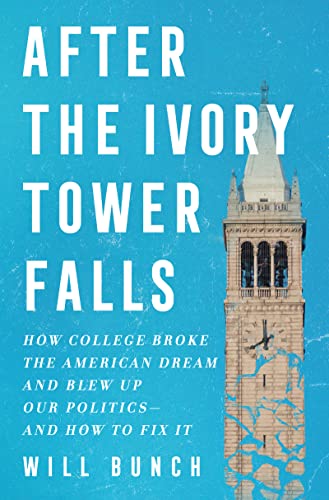
For this inaugural edition we have the latest nonfiction book I've read: AFTER THE IVORY TOWER FALLS, HOW COLLEGE BROKE THE AMERICAN DREAM AND BLEW UP OUR POLITICS--AND HOW TO FIX IT, by Will Bunch. 


Prior to WWII, college in America was a haven for the well-off, the top 5% of our society being afforded the opportunity of postsecondary education, while the rest of the country found themselves relegated to the fields or factories to make ends meet. But, after America helped to defeat Nazism, there was a question of what to do for the returning veterans, and one idea was the G.I. Bill, allowing veterans the opportunity to attend college that hadn't been possible before (with the caveat that this meant white veterans, in the main). Many college presidents felt these working class men would soften the learning at their venerated institutions, but they were proven wrong. 


The American Dream had found another pipeline, as college became a stepping stone for many working class whites to better their status in society, while also engaging their minds and working toward the civic good of all. It was a time when America came to understand education as a public good, something to be aspired to and lauded. In the decades that followed public universities flourished, women were also afforded the chance to seek higher education, and the government assisted, with Pell Grants being a primary tool for allowing those with lesser financial means to afford the cost. But this was a time when tuition was not as exorbitant, in relation to household incomes across the spectrum of fiscal wherewithal. It was a time of great opportunity and aspiration. 


But during the upheaval of the 1960s and 70s things began to turn. Those on the conservative right of American politics (Republicans, say it, Republicans) turned away from the idea of education as a public good. In governors' mansion and state legislatures across the country they slashed funding for public colleges. This drop in funding, along with the privatization of universities, banks, and other financial institutions, meant there was a rise in tuitions for public universities. Pell Grants and other government programs meant to assist people with the cost of college did not keep up, and many times were also slashed or at least became stagnated under Republican fists. 


The cost of college soared out of reach of many, and continues to do so, but these people also held true to the idea that a college diploma was the only way for later generations to improve their status within society. And this improvement is still true, to a point. During recent recessions, the unemployment rates of those without a diploma have often been double that of people who've earned a college degree. But what about the cost behind that degree? Those people are burdened, now, with debt spreading into the tens of thousands or even hundreds of thousands of dollars, even when they attend state universities, and it is a debt crisis that is untenable. 


With the rising cost of college, the divide between the haves and have-nots has also increased, and this has spilled over into our political ideologies. Republicans, thanks in no small part to hateful rhetoric from talk-show personalities like Rush Limbaugh, believe that college is nothing more than an indoctrination society for politically correct ideas of equality, respect, and representation for minorities. Democrats see this thinking as ill-informed and downright wrong, and they see college as the grand answer to all of society's ills. They're both wrong (though conservatives are more wrong). 


The real problem is, truly, the rising debt spiral for those attending college. It burdens those who choose to follow the traditional path to a better life, while it shuts out so many more who would benefit if given the opportunity, and, maybe even more dastardly, it labels those who do not attend college (a four-year institution, as I've been using the term 'college' throughout) as lacking in merit. Which is completely wrong. Education -- post-secondary education, including not just four-year universities but also trade schools, internships, community colleges, and other, similar programs -- must be seen as a common good, once more. We are failing our young people, at the point when they are most vulnerable: "You're 18 now, better figure out, fast, what you're gonna do with you entire life, and get right to it!" We need to do better. 


Where do the politicians get it wrong? 
As noted above, Republicans feel that colleges have become incubators for indoctrinating their children into 'politically correct' thinking. This is false. 
Democrats focus only on four-year institutions, with their proposals of canceling student debt or making public colleges tuition-free, failing to consider the cohort for whom a four-year degree program is not the answer. 


An idea put forth by Bunch, an idea that has been percolating for decades, is the idea of a mandatory year of service for 18-year-olds. Where the collective battle against Nazism brought us together as a country, maybe it would be a good idea to have something on that scale that could allow all of our young people to have a common touchstone. With the diminishing rolls of people at church or joining civic organizations, there is a need for something to connect us. This solitude that is enveloping our society is helping to foment the divisions we see in our politics. We don't talk to one another any more. We don't meet up at the Lions Club. We don't talk during the tea service after church. We don't bridge the divide that is tearing our country apart. A year of service, where one would be in a collective that consisted of people from across the political spectrum of America might be the first step in healing this wound. And it would give young people an opportunity to earn a living, learn some skills, and consider what they might want to do next, without having to dive into the deep end of the pool where loan sharks and bone-crushing debt awaited them. 


And we need to also, as a country and through the federal government, make education beyond high school a priority once again. We need to fund it, to push it, to make it a reality for everyone. But, that does not mean just four-year universities. We need to broaden our idea of post-secondary education. Include internships, trade schools, and other institutions and programs, as noted earlier in this spiel, so that we provide opportunities that match up with everyone's needs. And, one more time, FUND IT. 


It's an idea. 

Tuesday, February 12, 2019

Nonfiction read in 2018 (BLTN; better later than never)

It's been interesting for me, in just these recent handful of years, to find myself more engaged and excited about reading nonfiction, which was not the case for most of my life.  I had a prejudice against nonfiction -- it was too much like homework, its prose couldn't possibly be magical like the fantasy novels I read, it would probably put me to sleep.  That has definitely changed.  I couldn't pinpoint when or why, but I do remember the first nonfiction book I read that was as dramatic -- every page laced with propulsive, elegant prose -- as any novel I'd ever read.  That book was David Simon's "Homicide: A Year on the Killing Streets."


This past year I read 11 nonfiction books, one down from last year (surprisingly).  Sadly, though the subjects covered were wide, my breadth of authors was not as diverse as I would have liked:

COMPANERO by Jorge Castaneda
EUREKA by Edgar Allan Poe
HOME IS THE HUNTER by Hans Carlson
IN OTHER WORDS by Jhumpa Lahiri
LOST CONNECTIONS: UNCOVERING THE REAL CAUSES OF DEPRESSION by Johann Hari
PROPHETS OF THE HOOD by Imani Perry
SLEEPLESS NIGHTS IN THE PROCRUSTEAN BED by Harlan Ellison
STRANGE JUSTICE by Jane Mayer & Jill Abramson
THE COMPLETE ART OF WAR by Sun Tzu
THE STRANGER IN THE WOODS by Michael Finkel
THE TURQUOISE LEDGE by Leslie Marmon Silko


Only four of the nonfiction books were written by women, though each woman, or pair of women in the case of "Strange Justice," came from a different background:  one of Indian descent, one African-American, one pair was white, and one Native American.  Each of these authors offered a distinct perspective on the world that was new to me, which I found exhilarating as well as enlightening.  One thing that has come from reading more nonfiction, and trying reach farther afield with regard to the authors I read, has been the new eyes through which I can view the world and view humanity.  Sure, that can sound trite or cliched or overly simplistic, but it does not make it any less true.  Every one of these four books written by the above female authors stayed with me, long after I finished them.


With "Strange Justice," Jane Mayer & Jill Abramson wrote about the Clarence Thomas hearings, doing the reporting contemporaneously, as well as in the time shortly after, laying out the evidence that was not shared with the public, revealing the multiple other women willing to testify alongside Anita Hill, who were not offered that opportunity, all contemporaneously to the divisive hearings. 


Leslie Marmon Silko's "The Turquoise Ledge" was a memoir, wherein you not only learned about her writing, but also her art, and her spirituality.  It was a wonderful story about an important Native American author and the harmonious way in which she approaches living in the American southwest, with snakes, scorpions, and drought, among other hardships.


Imani Perry wrote about rap, dissecting and examining it in a way that was not only academic but also very real.  She made it relatable for everyone, delving deeper into the societal realities that helped birth this American artform, while also discussing the problematic aspects of rap.


Jhumpa Lahiri's "In Other Words" was magnificent.  She is an author whose work I have come to quickly revere, in recent years.  In this memoir, she wrote of diving headfirst into learning Italian -- of moving to Italy, bringing her family along, of speaking and writing only in Italian -- revealing her uncompromising will and intellect, through a dual-language book, wherein she wrote the Italian manuscript and then had someone else translate it.  Even in a second language, her prose sings with a beauty that few can match.  Possibly my favorite book I read last year.


Among the other nonfiction books, there were many enjoyable and engaging reads, but few as memorable as the four above.  One such book would be Harlan Ellison's "Sleepless Nights..."  Noted for his short fiction, and more likely for his television work, Ellison was a noted essayist, winning the Silver PEN award for journalism in 1982.  The essays in this work cover a wide range of topics and the electricity of Ellison's prose is always a guarantee for one to be entertained and engaged.

Others of Note:


"Companero" was an interesting look at the life of Che Guevara.  I only knew the broadest, simplest strokes about Guevara's life.  This book certainly filled in the life of this revolutionary.  I think it's fair to say that Guevara was an idealist, who worked hard for what he believed in.  But he was more complicated than that, eventually coming to believe, to a certain extent, the myths surrounding him, while failing many of those who loved him most because of his human failings, most prominently revealed in this book his appeal for beautiful women and the resultant infidelity that came of this.  This was a well done and even-handed book about an important figure in 20th-century world politics.


"Home is the Hunter" was a fabulously propulsive book looking at the James Bay Cree of northern Quebec, looking at their legacy and the manner in which their culture has been changed by modernity and the need for energy, in the form of a series of large dams for a giant hydroelectric project beginning in 1971, for the whole world and the compromises that come from the schism between cultural and governmental needs.  Living in Maine, I found this to be a fascinating book that revealed a reality I was unaware of, previously.  Hans Carlson's facility with language, as well as his open-minded approach to reporting on this topic, helped make this a memorable book.


"Stranger in the Woods" told the story of a man, Christopher Knight, who hid out in the woods of Maine for more than a quarter century, with nobody being the wiser.  Living alone, he braved Maine winters with nothing but his wits and what he could procure, doing so in as little an intrusive manner as possible.  It's an extraordinary story that many believed, and still believe, to be not wholly accurate.  How could a human, in this modern age, live for almost 27 years without contact with another human being, and survive?  It can't be done.  Except it was.  Though it manages to tell Knight's story in a comprehensive manner, this book breezes along at a breakneck clip, pulling you from chapter to chapter, until you reach the end, wondering how you managed to get through it so quickly.  A great read!


All right.  We haven't quite reached the middle of February, and I'm two-thirds of the way through my reading recap of 2018.  Next, all the rest of the books I read.


-chris

Tuesday, February 5, 2019

Audre Lorde's ZAMI: A New Spelling of My Name

While a young child, Audre Lorde didn't like the way the "y" at the end of her first name fell below the line on the paper, so she changed how she spelled her name.  Unsurprisingly, Lorde grew to be a strong, intelligent woman who fought for what was right and refused to be pigeon-holed or disrespected.


Zami: A New Spelling of My Name is an amazing book.  A memoir covering Lorde's early childhood up through her early to mid-20s.  Her facility with language pulls you in, as a reader, to 1930s, 40s, and 50s New York (with a quick aside to Mexico), filling your senses with her words, allowing you to picture the place that birthed her.


Self-described as a "black, lesbian, mother, warrior, poet," Lorde shares the heartache of growing up black in america through the Depression and WWII and into the nascent Civil Rights Movement, while also revealing what it meant to be a lesbian during this time, as well.  When asked how long she'd been "in the life," Lorde didn't know how to answer, because she only had one life and only knew one way to live:  honestly, but with an invisible wall erected around her, to try and protect her against the prejudices threatening her from all sides.


Lorde's prose is direct, harsh, and also poetic without being too flowery.  She propels you along, even as you wish to remain and linger in certain sections -- the discovery of a new lover, or the enjoyment of a gathering of friends.  I can't remember where I first heard Audre Lorde's name, probably from one of W. Kamau Bell's podcasts, but I'm sure glad I did.  Otherwise, I would not have had the opportunity to experience this powerful biomythography of Lorde's.  And that would have been a shame.

STAR WARS -- a modern trailer

 This came across my feed, and it's pretty stellar, even if it utilizes some special edition cuts.