Showing posts with label Why the Flash is my favorite superhero. Show all posts

Wednesday, April 29, 2015

FLASH LEVELS UP [Why The Flash part 6 of 5]


S
P
O
I
L
E
R
S


A
H
E
A
D


B
E


W
A
R
N
E
D


I’m not one to watch things in a timely fashion.  Family (being a father and a husband) and writing come first.  And reading, that’s ahead of watching TV and movies.  This means I am rarely “in the loop” with what’s happening.  But the launch of Daredevil on Netflix spurred me to go back and catch up on some recent Flash episodes. 

Okay, let’s backtrack.  [apologies: wordy bitch ahead]

The rush of adulation for Daredevil on Netflix, at least in my little corner of the internet, has been overwhelming.  Marvel does it again!  That hallway fight scene is the best in a decade!  I can’t wait for more!  Got the character right!  And, according to some (okay, one person), Daredevil is the best show since “The Wire.”  Yes, I heard that on a podcast I enjoy listening to.  I watched the first episode.  It took me four nights.  And I was not engaged to watch anymore after that.  Nothing against the creators—I think they did a fine job translating the grim ‘n gritty Daredevil to television, though there were some campy-feeling moments, particularly with the brooooaaaaadddd villains.  These are not nuanced characters, ala The Wire.  But it’s a comic book adaptation, we don’t need nuance.  Anyway.  I’m not here to hate on the thing.  It is well done, and it is “real.”  But it’s not what I want in my superheroes right now.  Grim ‘n gritty is fine, but remember, there are other tones and palettes available to you as a creator. 


Which brings me to the CW’s Flash. 

I watched the first four episodes and enjoyed them, but as I state above, my time is limited and I fell off that train.  [full disclosure time, if you didn’t know this, the Flash is my favorite all-time  superhero].  But I read about the Flash’s recent travails and travels through time, and that piqued my interest.  Then all of this gushing over DD, and my lack of interest in it, got me to casting my eye back across the spectrum to the Flash.  So, I dove back in with those time travel episodes:  “Out of Time” and “Rogue Time.” 

Wow!  They leveled up with these two episodes.  I’m impressed with how much of the comic book mythology the creators and the network have been willing to include in this series.  We have the rogues, with their crazy costumes and powers, a villain from the future secretly hiding in their midst, the promise (possibly) of other lesser-known superheroes like Firestorm and Vibe, and now we finally see the Flash manage to go back in time.  This is some fun stuff ß emphasis on “FUN.” 


“Out of Time”
I loved this episode.  The way things played out did not feel forced at all.  The threat of Mark Mardon [the Weather Wizard “been waitin’ to use that since week one”], the investigation into Harrison Wells at Iris’s newspaper, the devastation wreaked by Mardon, the death of Cisco at Wells’s hand, it all held my interest, and the pain suffered by Joe West and Captain Singh felt real.  Then, when we got to the end and Barry had to stop the tidal wave by running back and forth so fast that he would create a wind that would dissipate the wave’s energy and he ended up rushing through a wormhole to twenty-four hours in the past—that was pretty great.  But the best moment of the entire episode, for me, was when he revealed his heroic identity to Iris. That moment hit me right in the gut.  His line [paraphrased] “I didn’t mean for you to find out like this,” and the reaction shot as Barry quick-changed and rushed to save the city…beautiful. 


“Rogue Time”
So, now that Barry has rushed back, a day into the past, he feels he must try to head off all the destruction he knows is coming.  He throws Mark Mardon into the “prison” they’ve set up at S.T.A.R. Labs and figures all is good.  Dr. Wells warns him that time will find a way to set things right.  And he is correct.  Heat Wave and Captain Cold return, bringing along Leonard Snart’s little sister, who becomes the Golden Glider—or a replica thereof as she’s not properly named in this episode and does not come with ice skates as her counterpart did in the comics.  And things do not go well.  Barry manages to save many from the physical harm they encountered the last time he ran through this day, but he is not safe from the emotional fallout of restating his affection for Iris—who admitted her own love for him when her father’s life and the lives of all of Central City were at stake the “previous day” but did not feel similarly in this renewed day.  It’s an interesting look at the consequences of mucking with the timeline, in this reality, as well as a fix for the death of Cisco and other bits of collateral damage from the previous episode that works perfectly in this context.  Oh, and we get Captain Cold and Heat Wave with new guns, thanks to their kidnapping of Cisco, along with the Golden Glider’s gun as well.  And the Rogues Gallery gets named.  Yeah, I’m geeking out.  But this show is so damn fun. 


The difference between Flash and Daredevil comes down to the tone of the show, really.  And right now, I’m looking for something other than what has become the default for many, many superhero comics of the past couple decades.  I love how bright this show is, how ebullient a character Barry Allen is.  There are still serious things happening, but it’s all coated with the wonder and excitement of a superhero comic book.  And that, to me, makes all the difference in the world.

Friday, March 13, 2015

WHY THE FLASH [final part] – Wally West


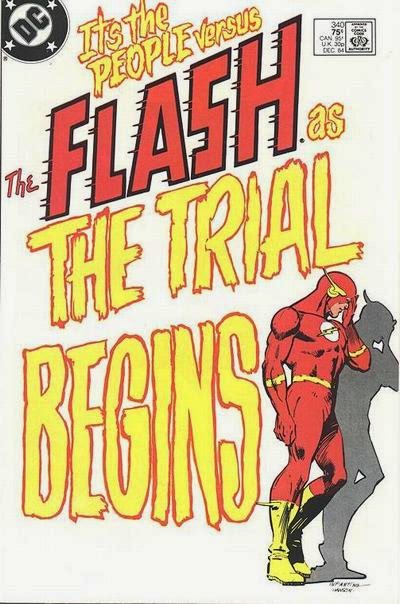
Within a year-and-a-half of discovering comic books, my favorite superhero, the Flash, was gone from the spinner racks.  Barry Allen had slogged through the lengthy “Trial of the Flash” storyline – by many accounts a story that was far too grim and went on for far too long – and sales were poor.  So, with the 350th issue, the powers that be axed the title.  The progenitor of the Silver Age of comics was now cast adrift.  A year later, the Flash was accorded a proper send-off with the eighth issue of Crisis on Infinite Earths, wherein Barry Allen gave the ultimate sacrifice for the good of humankind.  And with the final issue of that senses shattering maxi-series, the mantle was passed to the Flash’s sidekick, Wally West, who, as Kid Flash, had proved his mettle alongside his teammates in the Teen Titans.  But Wally had a huge legacy to live up to.


The new Flash series was launched out of the Legends mini-series, with Mike Baron and Jackson Guice as guiding hands.  Though uncommon, this passing of the torch was not unheard of.  In fact, Barry Allen, once imbued with the power of superspeed, patterned himself off the original Flash, Jay Garrick, whom Allen believed to be merely a comic book character from his own youth, until circumstances brought these two fleet heroes together – a newfound ability to traverse parallel dimensions through extreme speed the catalyst for this historic team-up.  The idea of heroic legacy is (or was) a linchpin in the DC universe, something that differentiated these heroes from Marvel’s, and it was this that spurred Wally to take up the gold and scarlet costume of his mentor, and uncle. 


Immediately, Baron & Guice worked to make this new Flash distinct from those who came before.  Wally was young, brash, and, at times, unthinking – decidedly different from Uncle Barry, who was a criminologist with the Central City police, a job necessitating meticulous care, a trait inherent in Barry.  Wally also had limitations to his speed, unable to slip between dimensions or circle the globe multiple times in the blink of an eye, unlike the seemingly limitless nature of his predecessor’s velocity.  Perhaps most importantly, Wally found himself weighed down by the example Barry set as the Flash.  It was a heroic standard that many would find daunting and unable to live up to.  Wally pushed himself, but always, in the back of his mind, he imagined Barry looking down on him with disappointment.  Though this yoke of responsibility spurred Wally to work harder as the Flash, it also was something he found unable to shake off. 


This weight of responsibility came to a head in Secret Origins Annual #2, in a story written by Baron’s successor on the title, William Messner-Loebs.  In this tale, Wally is speaking with his therapist, relating not only his origin but also many of the turning points in his life as a superspeedster.  Through the anecdotes, readers, and Wally’s therapist, learn about many of the heroic deeds he has accomplished during his young life.  It’s an amazing tale of an amazing life, one to be greatly admired.  However, Wally doesn’t see it in these terms.  His focus is on all of the lives he could not save, in spite of his extraordinary powers.  When the therapist asks Wally to write down how many people he’s saved in the past ten years – excepting intergalactic conflagrations or universe-shattering threats – and his patient treats the number, 172, as routine, he is left dumbfounded.  The therapist shares a thought – that maybe Wally isn’t able to achieve the speeds he once could (the reason Wally is seeing this therapist) because he has wrongly burdened himself with the belief that Barry would not be proud of him.  He tells Wally he needs to give himself a break and accept that 172 lives saved is an important achievement. 


As the series evolved, a family of speedsters, including Max Mercury, Johnny Quick, and others, grew around Wally to help him become a better hero and a better person.  And, in keeping with the youthful exuberance of Wally’s character, there was often a lighter tone to many of the stories.  It’s a fun series that sees a young hero grow into his own through experience and the natural process of maturing.  At its core, it is this personal struggle, and the evolution of the character of Wally West, that makes this run of books such a standout and the character of Wally West so great. 


With a string of extraordinary writers who each put their stamp on the character – from Baron and Messner-Loebs to Mark Waid, Grant Morrison, and Geoff Johns – and strong work from artists such as Guice, Greg Larocque, Mike Wieringo, and Scott Kolins, there are a number of highlights in the nearly 250 issues of this series.  Those highlights and the intriguing character dynamic of Wally West, along with the foundation created by the wholesome and unselfish character of Barry Allen, are the core of what made the Flash my favorite superhero.  Hands down.  And it is why I still have a great affinity for the scarlet speedster.  Go try out some of those back issues.  If you enjoy fun, energetic superhero comics, I don’t think you’ll be disappointed.

-chris


Wednesday, March 11, 2015

WHY THE FLASH [part 3.5] – The Rogues


Abra Kadabra

 
Weather Wizard

A hero is only as good as his or her greatest villain – Sherlock & Moriarty, Superman & Lex Luthor, Ripley & the Alien.  And for my money, with perhaps the exceptions of Batman and Spider-Man, the Flash has the best rogues gallery in superhero comics. 

Heat Wave

Captain Cold

I am more than willing to concede that my love of Flash’s cadre of villainy can easily be traced to my affinity for this heroic speedster, but that’s what this series of posts is about.  So, objection overruled.  What can’t be argued is that Flash’s classic rogues gallery is the one group of super-villains identified, collectively, as “The Rogues.”  Batman’s iconic rogues are not accorded that honorific, nor are Superman’s or Spidey’s, despite similarly well-known villains.  This is significant, because it puts them in a rarefied class of comic book supervillainy.

Captain Boomerang

 
Gorilla Grodd

Most, if not all, of the notable rogues are silver age creations.  This means they are colorful and flamboyant, with a hint of whimsy bubbling just under their villainous facades.  This is part of what I love about them – the pseudo-science involved, the Rube Goldbergian complexity of their plans, the flashy costumes (pun intended), and the inventive ways in which they would try to slow down their speedy nemesis.  Maybe they weren’t as deadly as other villains, though they sometimes tried to be, but they were always a challenge, a challenge that could captivate and engage the minds of the readership.

 
The Trickster

The Pied Piper

In the Wally West Flash series, writers Bill Messner-Loebs and Mark Waid appropriated and rehabilitated some of these classic rogues to battle, or aid, Barry’s nephew.  Later, Geoff Johns would take many of these characters and craft stories infusing them with a darker side intended to enhance their relevance, a feat he seems to have achieved – in the too few stories of his I’ve read –without losing what makes them cool. 


Mirror Master

Reverse Flash

It has been far too long since I’ve read a bunch of Flash comics, so going into much more detail than the pitifully thin bits I’ve scattered above is beyond me.  I would just say that you should seek out some of the classic Flash issues with these characters battling our crimson and gold hero – whether the Barry Allen run or the Wally West run – because they are some damn fun comics.  Then, I would argue, you’ll better understand the draw of these four-color villains.

-chris


Monday, March 9, 2015

WHY THE FLASH [part 3] – Carmine Infantino


I was already a fan of the Flash when I bought my first comic starring the Scarlet Speedster.  That was issue #336.  This comic threw me right into the middle of the “Trial of the Flash” storyline that encompassed the final two years of the Barry Allen series.  On the cover Flash worked desperately to clear a pile of rocks within which lay a bloodied hand – his dialogue revealing the tension visible in his eyes:   “What good is all my speed -- when I couldn’t save the one woman who could clear my name?”  I had no idea what this all meant, but I knew I had to find out.  Written by longtime Flash scribe Cary Bates, this comic was my introduction to the wonder that is the art of Carmine Infantino – specifically the wonder of his rendering of the Flash. 


Infantino began working in comics at its infancy, in the 1940s, and honed his style over decades – evolving into a distinct artist admired by readers and professionals alike.  His linework was very fluid, the figures almost rubbery in the way they moved across a page, angled dramatically as they fought or ran or toppled from rooftops.  Infantino’s characters were balletic and graceful in a way rarely portrayed by other artists, and as he refined this style, he continued to stretch that, making his figures flow in a smooth arc across the page.  The world within his comic panels felt like a distorted mirror universe.  And, when he returned to the series in 1981, with issue #296, his style was pitch-perfect for the Flash.


Carmine Infantino is, hands down, THE Flash artist – earned on the fact, alone, that he worked on the Golden Age Flash, designed the look of the “new” Silver Age Flash, and had two lengthy runs that bookend that same Silver Age series.  His fluidity of line translated especially well to drawing the mad dashes of superspeed Barry Allen utilized to defeat his foes and save the day.  Angling the Flash to a ridiculous degree, with wavy speedlines retreating from his speeding form, it was perfect.  Is perfect.  To my mind, Infantino is the only comic artist who’s ever been able to delineate superspeed convincingly on the page.  All else pale, even the work of my favorite superhero artist, George Pérez, who had plenty of practice drawing superspeed with Kid Flash when he worked on the New Teen Titans. Infantino, when it comes to drawing the Flash, is the man.


I was already a Flash fan when I picked up issue #336 of the series.  But the artwork of Carmine Infantino is what solidified the Flash as my all-time favorite superhero.     

-chris

Thursday, March 5, 2015

WHY THE FLASH [part 2] – Barry Allen


Barry Allen is, or was, one of the most wholesome characters in superhero comics.  He had a buzzcut, married his sweetheart, Iris Allen, was a criminologist with the Central City police department, and after witnessing his future nephew’s unexpected transformation into a speedster like him, agreed to take on the mentorship of Wally West, who would eventually (in a previous, better continuity) inherit the mantle of the Flash.  As a child with an overly romanticized view of the world, the character of Barry Allen really spoke to me.  He was a hero with a strong moral code, one who was easy to look up to. 


The first Flash comic I picked up was #336.  This issue fell smack in the middle of the overlong “Trial of the Flash” storyline – written by Cary Bates, with art by Carmine Infantino – and slightly more than a year out from the book’s cancellation.  I only had a little while to become acclimated to Barry Allen, in his own book, before he walked off into the sunset with Iris (who had died, but came back from the future to help absolve Barry of his murder conviction for allegedly killing the Reverse Flash, when the rogue threatened to kill Barry’s soon-to-be second wife, Fiona Webb, on their wedding day – yeah, it’s convoluted; it’s time travel in comic books; but it’s so damn fun). 


Those last fifteen issues were enough to solidify my appreciation of the Flash, as a character.  But the book that locked it down was Crisis on Infinite Earths #8.  When this series is discussed, the much-homaged cover and the sacrifice of Supergirl from issue #7 is a primary point of discussion.  It’s the one that really shocked readers.  But I find the following issue to be far more powerful.  Throughout the first seven issues of Crisis, readers, and heroes, caught fleeting glimpses of the Flash, ghostly images the even unnerved Batman.  It’s a mystery that does not get solved until the eighth issue. 


In issue #8, “A Flash of the Lightning!,” the anti-Monitor’s ultimate weapon, an anti-matter cannon that will destroy the five remaining positive matter universes, is revealed to the Flash, who has been kept incapacitated on the planet Qward by the Psycho Pirate’s mood-changing powers.  Barry understands the gravity of the situation and the fact that he is the only hero who can possibly stop this attack.  Using his strong force of will, the Flash builds up superspeed and escapes from the gelatinous shackles with which he’s been held.  Immediately, he drives for the Psycho Pirate, laying him out with one superspeed punch, and rushes the “pirate” from Thunderer to Thunderer, causing the guards to fear and hate their master.  When they attack the anti-Monitor, Barry rushes for the cannon to examine it (his scientific background coming in handy), recognizes its power source as concentrated anti-matter, and realizes he must run against the flow of that anti-matter to force the energies back into the cannon, in order to destroy it.


He also understands that he will most likely die, if he does this.  Without hesitation, the Flash jumps into the cannon.  And he starts to run. 


Racing against time, pushing beyond anything he’s ever experienced, Barry Allen’s life rushes across his vision.  But this is no hallucination or spiritual journey – Barry is running so fast that he is actually going back through time.  The images – the friends he sees for the last time – are paralleled by those earlier instances where Batman and others saw the “ghost” of the Flash.  It’s overwhelming and emotional for this man who only ever wanted to do good and come home to his one true love, Iris.  As he passes through his life, the Flash destroys the cannon, crushes the Anti-Monitor’s plan, and saves reality.  


And Barry Allen dies, alone and unmourned. 


This issue hit me so hard, as a kid.  And for a very long time, the death of the Flash was one of the handful of “deaths” in comics that was irrevocable.  Because of that, the character of Barry Allen’s Flash cast a long shadow over the heroes of the DC universe, none moreso than Wally West, who would take up the mantle soon after the “Crisis” passed. 

But that’s an entry for another day.

-chris


Tuesday, March 3, 2015

WHY THE FLASH [part 1] – an introduction


This is a topic I have pondered a lot, through the years.  Why did I gravitate to the Flash as my favorite superhero when, despite the longevity of the character, he seems to be off the radar of most superhero fans?  Even today, my son has a pair of Justice League pajamas, but the only heroes on his pjs are Superman, Batman, and Green Lantern, all of whom, it could be argued, have cooler powers (though your arguments would be baseless).  So why did I latch onto this hero whose only power is superspeed?   


I was introduced to DC’s superheroes through the classic Super Friends cartoons of the 1970s and 80s.  Watching some of these now, the animation is crude and the stories…juvenile.  But they’re still enjoyable through my nostalgic rose-tinted lenses, and these cartoons were some of, if not the, first pieces superheroic entertainment I had at my disposal.  At that point, I had no idea about comic books.  They weren’t even a thing for me.  (I believe my parents, both of whom were teachers, didn’t want me reading such trashy, throw-away fare).  Those would come later. 


I watched the Super Friends, in its myriad iterations, whenever the opportunity arose.  And I loved it.  In particular, I loved the Flash.  I think it might have been the super-bright colors of his costume – scarlet and gold – and the accompanying orange streak that revealed itself in his bursts of speed across the glass teat.  Comparatively, to my mind, Superman was too powerful, Batman wasn’t that cool, not in this cartoon anyway, Green Lantern had potential (odd that I gravitated to him, as well, since they became fast friends in the comic books), especially the crazy things he would craft with his power ring.  All cool superheroes, but the guy for me was definitely Barry Allen, the Flash.   


I think I also personally related to the character.  I was that kid who could outrun most of the others at school.  It was an identity, at a young age, which I latched onto with vigor, something at which I excelled.  And that made me feel good.  In my mind, I was the Flash!


Next: the comics and a better understanding of the character and his alter-ego.  Maybe.

-chris

STAR WARS -- a modern trailer

 This came across my feed, and it's pretty stellar, even if it utilizes some special edition cuts.