Two weeks have passed since I offered up one of these week-ending roundups. I'm not happy about missing the past two weekends, but I'm not going to beat myself up too much. I was still working on my writing through revising the novel and/or reading. So, without further ado, let's see what's what.

VISUAL MEDIA --
WRITTEN MATERIAL --
Nexus Archives, volume 1, by Mike Baron & Steve Rude ---

Sometimes you just need to read a stone-cold classic of the medium, and this book is one of those. Horatio Hellpop, known as Nexus, dreams of serial killers and mass murderers, many of them in some type of governmental or military position somewhere in the galaxy. With his near-limitless power, at least as far as we can tell from these early stories, he goes out and executes them, balancing the galactic scales and ridding himself of the nightmares.

The beauty of the character of Nexus isn't just the sense that he's doing what we all would like to do, meting out justice in a way that we don't experience in real life, i.e. even those with power and money get their come-uppance from Nexus, its beauty comes from the fact that here we have a Superman-level hero, whose power seems able to defeat any threat or obstacle, and yet, Baron, with Rude, makes him a compelling character. The problem with Superman, as many put it, is that he's too powerful. The same could be said of Nexus, but Baron & Rude don't necessarily focus on that, they focus on the inner turmoil he experiences, not only from these nightmares but from the responsibility he feels in doling out justice. By weighing Nexus down with this heavy responsibility of balancing the scales of justice on a galactic scale and making him the sole judge, we get an interesting character with interesting tales, and the "explodo" is merely the cherry on top of the sundae.

And the rest of that bowl of cherries would be the art from Steve Rude. His sleek linework is just incredible. He infuses the best of Jack Kirby and Alex Toth and Saturday morning cartoons (Surprise! Both Kirby & Toth worked in Saturday morning cartoons.), with a flair for inventive and thoughtful panel layouts, that makes this one of the best looking comics out there, even today. Very few artists can match Rude, even this early in his career. Just magnificent!
Hellboy: the Complete Short Stories, vol. 1, by Mike Mignola, et al. ---

I've also gone back to this classic, as well. The stories of Hellboy aren't as complex as those of Nexus, but they're just as enjoyable. Mignola throws ghost circuses and werewolves and luchadors and demons into these stories, among very many other things from mythologies across the globe, and there is a wonder and horror to them that I find magical. Hellboy is a character who continually moves forward, even in the face of impossible odds, and that is to be commended. Many times the stories end simply, in an almost banal manner, but that's okay, because the point of these stories isn't necessarily to tell tales with a surprising twist as much as they're intended to add to the mythology and the history of this strange creature who looks like the devil but is on the side of the angels.

The real star here, as with Nexus, above, is the artwork. Mignola is the master of drawing Hellboy, and his facility with spotting blacks coupled with the sharp, angular linework that epitomizes his style, is just wonderful to behold. But we also have Duncan Fegredo, whose work never looked as good as when he does Hellboy, Fábio Moon and Gabriel Bá, master illustrator Richard Corben, among a few others. If you're a fan of comics, and, particularly, a fan of comic art, then this is a book you will thoroughly enjoy. I can't wait to move onto the next volume.
Uncentering the Earth: Copernicus and the Revolutions of the Heavenly Spheres,
by William T. Vollman ---
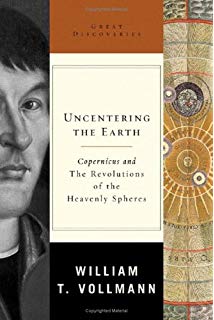
This was an intriguing book, and, if I'm being honest, one that got away from me, at times. Some of the arguments put forth by Vollman, including much of the mathematical representations he offered from Copernicus and Ptolemy and other ancient astronomers, was often above my head, which is not a bad thing. Indeed, I wish I could have absorbed it all in a fashion that I fully understood it, but, in the end, I was able to comprehend the major themes and insights of the book.
Ultimately, Vollman's case, which is supported within the book, is that Copernicus is a more nuanced cat than we've been led to believe (surprise!). Certainly, he put forth the idea of a heliocentric universe, though he was not the first to do so, and it was done at a time when the tools of the astronomic trade were primitive, to say the least (no telescopes!), but the way he got to many of his conclusions involved faulty calculations or faulty premises. And yet, he somehow managed to calculate many things, such as the distances of certain planets or the durations of certain orbits, to a relative precision that is astounding. And though he was more indebted to the ideas of Ptolemy than might be generally known, and despite the problems inherent in a world where scripture still won out over science, for fear of being persecute and prosecuted for heresy, Copernicus managed to hold fast to his conclusions. It's an interesting book for the broader understanding it gave, of Copernicus and of the time, and I would certainly recommend it if you have an affinity for the topic.
INSPIRATION(s) --
Alex Ross!

MUSIC TO WRITE BY --
Tori Amos, To Venus and Back ---

I love the swelling piano and the driving beat of Amos's songs on this double album, and, most importantly, I love the live songs on the second part of the album. Live music almost always trumps studio music, for me, and this is no exception. Amos has been part of my writing repertoire since very early on, back around 2000. It helps that my brain has trouble processing lyrics and focuses, mainly, on the musicality of an album. Having listened to this so many times, while writing, I've gleaned many of the lyrics, at this point, but I have now passed through that to a point where the lyrics fall into the back of my brain, and I'm able to focus on the music, only, once again. These songs infuse me with a vigor and excitement that helps propel me through whatever bit I may be writing, at the time, and it also achieves something else I've been feeling lately -- taking me back to an earlier point in my life and wrapping me in a warm blanket of nostalgia.
This is good music.
ON WRITING --
If you want to be a writer, habits are incredibly important -- specifically (maybe obviously) the habit of actually writing on a regular basis.
Writing, like many creative endeavors, is too often romanticized. Ideas of The Muse coming down from on high to bless the author with Divine Inspiration (TM), allowing her or him to pluck a beautiful string of words from thin air and put them to paper (digital or otherwise). Sometimes, quite rarely, this occurs -- or seems to occur, because there's still a lot of work that went into the apparent unconscious ease with which the words came out, on the page -- but for the most part, writing is work. And forming good habits can help that work move forward . . . with slightly more ease.
The best thing to do is to make a habit of your writing. When you sit to write, do it at the same time of day, in the same spot, with (as near as possible) the same circumstances. For example, Saturday and Sunday, when I don't have to worry about getting to work in the morning, I get up around 6:00, make the coffee, quickly check email and FB, pour my coffee, then get to work writing, and go for an hour and a half or so before wrapping it up. It may sound odd to set things up this way, but like practicing your jump shot or getting in the batting cages, setting up your writing time in this way will help it to become something like a muscle memory. After you've done it a few days or a week, it will become part of your daily routine, you'll feel natural sitting down to write, it will grow into something as familiar as brushing your teeth after waking or slipping on your silk pajamas before watching "This Is Us" (because we all have silk PJs, right?). Now, of course, your mileage may vary (YMMV) as to how long it takes to get into this habit, maybe it's longer than a week, but, realistically, it shouldn't be too long, and if it is, maybe it's not the thing for you.
Anyway, once you get this habit going, you'll find it much easier to get your daily writing in. It's just a natural part of your day. And, once it starts to feel comfortable within your schedule, you'll find that the words come more easily, that inspiration arrives more often and without as much struggle. "Chance (or inspiration) favors the prepared mind." It's kind of like good luck, it's not something dictated randomly by the universe or God, it's something that comes from all the work and experiences you've had prior, without all the time spent writing and researching and thinking (or throwing and working out and batting), you would never be able to achieve what you're hoping to.
And, conversely, as noted at the top of this post, it is quite easy to fall out of these habits. I did it the last few weeks, and unlike the few days it takes to get into one, it only takes a single missed day to fall out of your habits. For me, once it happened that first week it was far easier to skip the second week. But I made myself sit down again, at the laptop, and type away this weekend. So, we'll see if I'm back in the habit (of this weekly roundup, at least; I'm still pushing forward on the novel, fast approaching the halfway point) when there's either a post, or no post, next week. 'Til then . . .
chris

VISUAL MEDIA --
Avengers: Endgame –
Caught Endgame last week and really enjoyed it. Be aware, SPOILERS MAY FOLLOW.
Caught Endgame last week and really enjoyed it. Be aware, SPOILERS MAY FOLLOW.
I can't say it was a great film--cards on the table, I've found most of the Marvel films I've watched enjoyable, if forgettable. Read that as a criticism if you want, but I'm more than happy to be entertained for a couple hours by the MCU without needing to ruminate on it after I walk out of the theater. This was a similar experience, a good way to spend three hours with my youngest son.

There were moments, certainly, that stayed with me. I really enjoyed "Professor Hulk," and though I'm uncomfortable with the Thor fatsuit (they could have easily gotten across Thor's frame of mind without humor at the expense of overweight people), I appreciated his character arc. Captain America wielding Mjolnir--that was fun! I also appreciated the fact that the creators utilized Jim Starlin's idea of Thanos becoming a farmer, with a major swerve as Thor decapitated the Titan, in the opening of the film. That was a great move. And finally, I have to applaud the writers and directors for managing to juggle so many characters so well. For the most part, it felt natural, the way they managed to get most everyone a chance to shine, even if for only a quick moment.
Ultimately, though, I do have trouble with the finale of Steve Rogers's character arc, from a logical, character-driven standpoint. Steve would never stay on the sidelines. And, despite the Russo Brothers' arguments for that ending, their explanation that Steve went into a different timeline to live out his life is not evident in the film they made, so it just doesn't work for me. It betrays the character, as a number of people have noted online with far better werdz than me.


That said . . . I have to admit that, on possibly the most important level, the emotional level, it works. Allowing Steve to have lived the life he lost, to have been given a second chance, to have had that time with the woman he loved is incredibly cathartic for fans of Cap. And I felt that too, even without being too invested in the MCU. It's the Romantic ending that I love, and the one that I work hard to veer away from with my own writing. It's a fitting reminder that, if done well, emotion trumps logic, in writing, almost every time.
Columbo: By Dawn’s Early Light –


The Commandant of a military academy, Colonel Rumford (played by Patrick McGoohan), is unhappy with the school's chairman of the board, the grandson of its founder, who wants to make the school into a coed institution. The colonel manipulates the chairman into declaring he will fire the ceremonial cannon for the Founder's Day celebration, which has been loaded with a charge the colonel filled with gelignite, while also stuffing the barrel with a cleaning rag, which is intended to put suspicion onto one of the cadets with a poor disciplinary record. Everything would have gone as planned, if it weren't for the fact that Lt. Columbo is in charge of the investigation.
As Columbo digs into the case, he's bothered by the fact that the cadet who is implicated, because he was the one in charge of cleaning the cannon and who has such a poor disciplinary record, would have been given the job of cleaning the cannon, since it is considered as more of an honor and reward than a punishment. It doesn't sit well with the lieutenant. Asking more questions ("Ah, just one more thing, sir"), Columbo uncovers the fact that the school was going to be shifted to a coed facility. Now, he just needs to be able to tie the colonel to the crime, because he knew (as we all knew, watching) from very early on that it was murder rather than an accident, and that the colonel was involved.

In the end, it comes around to the fact of a separate investigation put forth by Colonel Rumford, into the fermenting of hard cider by the cadets--something he discovered the morning he stuffed the cleaning rag in the barrel of the cannon. Columbo does his own investigation of the hard cider, finds out the small window of time when the colonel could have seen it (because this is how he's aware of the infraction) and then determines the only spot form which he could have caught sight of the jug, as it hung in one of the dorm room windows . . . he could only have seen it BEFORE the time he says he awoke, and he could only have seen it from a spot beside the cannon. He was the killer, and his testimony unwittingly put him at the scene of the crime.

The biggest lesson to take from this is a reiteration of an important writing idea: all characters, even the villains, think they are the hero of their own story. This not only speaks to the selfishness and ego we all possess, thus making even a villain a little more human for that, but it also speaks to something more important. When writing, you want to try and craft complex characters. One way to do that is to give your characters, all your characters, motivations that are altruistic or laudable. In this example, the colonel worried about the military readiness of America and did not wish to see a decline in that respect, by making the academy coed. But, just because a character is doing something for what he or she contends are the "right reasons," does not mean their actions are necessarily laudable or good. The villainy comes in the form of misconstrued values or, more often than not, in bad deeds and bad actions done in the name of their personal good, which, when viewed from a wider lens, is obviously an act that can only lead to prosecution in a court of law, or some other, more dire, consequence.
As Columbo digs into the case, he's bothered by the fact that the cadet who is implicated, because he was the one in charge of cleaning the cannon and who has such a poor disciplinary record, would have been given the job of cleaning the cannon, since it is considered as more of an honor and reward than a punishment. It doesn't sit well with the lieutenant. Asking more questions ("Ah, just one more thing, sir"), Columbo uncovers the fact that the school was going to be shifted to a coed facility. Now, he just needs to be able to tie the colonel to the crime, because he knew (as we all knew, watching) from very early on that it was murder rather than an accident, and that the colonel was involved.

In the end, it comes around to the fact of a separate investigation put forth by Colonel Rumford, into the fermenting of hard cider by the cadets--something he discovered the morning he stuffed the cleaning rag in the barrel of the cannon. Columbo does his own investigation of the hard cider, finds out the small window of time when the colonel could have seen it (because this is how he's aware of the infraction) and then determines the only spot form which he could have caught sight of the jug, as it hung in one of the dorm room windows . . . he could only have seen it BEFORE the time he says he awoke, and he could only have seen it from a spot beside the cannon. He was the killer, and his testimony unwittingly put him at the scene of the crime.

The biggest lesson to take from this is a reiteration of an important writing idea: all characters, even the villains, think they are the hero of their own story. This not only speaks to the selfishness and ego we all possess, thus making even a villain a little more human for that, but it also speaks to something more important. When writing, you want to try and craft complex characters. One way to do that is to give your characters, all your characters, motivations that are altruistic or laudable. In this example, the colonel worried about the military readiness of America and did not wish to see a decline in that respect, by making the academy coed. But, just because a character is doing something for what he or she contends are the "right reasons," does not mean their actions are necessarily laudable or good. The villainy comes in the form of misconstrued values or, more often than not, in bad deeds and bad actions done in the name of their personal good, which, when viewed from a wider lens, is obviously an act that can only lead to prosecution in a court of law, or some other, more dire, consequence.
WRITTEN MATERIAL --
Nexus Archives, volume 1, by Mike Baron & Steve Rude ---

Sometimes you just need to read a stone-cold classic of the medium, and this book is one of those. Horatio Hellpop, known as Nexus, dreams of serial killers and mass murderers, many of them in some type of governmental or military position somewhere in the galaxy. With his near-limitless power, at least as far as we can tell from these early stories, he goes out and executes them, balancing the galactic scales and ridding himself of the nightmares.

The beauty of the character of Nexus isn't just the sense that he's doing what we all would like to do, meting out justice in a way that we don't experience in real life, i.e. even those with power and money get their come-uppance from Nexus, its beauty comes from the fact that here we have a Superman-level hero, whose power seems able to defeat any threat or obstacle, and yet, Baron, with Rude, makes him a compelling character. The problem with Superman, as many put it, is that he's too powerful. The same could be said of Nexus, but Baron & Rude don't necessarily focus on that, they focus on the inner turmoil he experiences, not only from these nightmares but from the responsibility he feels in doling out justice. By weighing Nexus down with this heavy responsibility of balancing the scales of justice on a galactic scale and making him the sole judge, we get an interesting character with interesting tales, and the "explodo" is merely the cherry on top of the sundae.

And the rest of that bowl of cherries would be the art from Steve Rude. His sleek linework is just incredible. He infuses the best of Jack Kirby and Alex Toth and Saturday morning cartoons (Surprise! Both Kirby & Toth worked in Saturday morning cartoons.), with a flair for inventive and thoughtful panel layouts, that makes this one of the best looking comics out there, even today. Very few artists can match Rude, even this early in his career. Just magnificent!
Hellboy: the Complete Short Stories, vol. 1, by Mike Mignola, et al. ---

I've also gone back to this classic, as well. The stories of Hellboy aren't as complex as those of Nexus, but they're just as enjoyable. Mignola throws ghost circuses and werewolves and luchadors and demons into these stories, among very many other things from mythologies across the globe, and there is a wonder and horror to them that I find magical. Hellboy is a character who continually moves forward, even in the face of impossible odds, and that is to be commended. Many times the stories end simply, in an almost banal manner, but that's okay, because the point of these stories isn't necessarily to tell tales with a surprising twist as much as they're intended to add to the mythology and the history of this strange creature who looks like the devil but is on the side of the angels.
The real star here, as with Nexus, above, is the artwork. Mignola is the master of drawing Hellboy, and his facility with spotting blacks coupled with the sharp, angular linework that epitomizes his style, is just wonderful to behold. But we also have Duncan Fegredo, whose work never looked as good as when he does Hellboy, Fábio Moon and Gabriel Bá, master illustrator Richard Corben, among a few others. If you're a fan of comics, and, particularly, a fan of comic art, then this is a book you will thoroughly enjoy. I can't wait to move onto the next volume.
Uncentering the Earth: Copernicus and the Revolutions of the Heavenly Spheres,
by William T. Vollman ---
This was an intriguing book, and, if I'm being honest, one that got away from me, at times. Some of the arguments put forth by Vollman, including much of the mathematical representations he offered from Copernicus and Ptolemy and other ancient astronomers, was often above my head, which is not a bad thing. Indeed, I wish I could have absorbed it all in a fashion that I fully understood it, but, in the end, I was able to comprehend the major themes and insights of the book.
Ultimately, Vollman's case, which is supported within the book, is that Copernicus is a more nuanced cat than we've been led to believe (surprise!). Certainly, he put forth the idea of a heliocentric universe, though he was not the first to do so, and it was done at a time when the tools of the astronomic trade were primitive, to say the least (no telescopes!), but the way he got to many of his conclusions involved faulty calculations or faulty premises. And yet, he somehow managed to calculate many things, such as the distances of certain planets or the durations of certain orbits, to a relative precision that is astounding. And though he was more indebted to the ideas of Ptolemy than might be generally known, and despite the problems inherent in a world where scripture still won out over science, for fear of being persecute and prosecuted for heresy, Copernicus managed to hold fast to his conclusions. It's an interesting book for the broader understanding it gave, of Copernicus and of the time, and I would certainly recommend it if you have an affinity for the topic.
INSPIRATION(s) --
Alex Ross!

MUSIC TO WRITE BY --
Tori Amos, To Venus and Back ---

I love the swelling piano and the driving beat of Amos's songs on this double album, and, most importantly, I love the live songs on the second part of the album. Live music almost always trumps studio music, for me, and this is no exception. Amos has been part of my writing repertoire since very early on, back around 2000. It helps that my brain has trouble processing lyrics and focuses, mainly, on the musicality of an album. Having listened to this so many times, while writing, I've gleaned many of the lyrics, at this point, but I have now passed through that to a point where the lyrics fall into the back of my brain, and I'm able to focus on the music, only, once again. These songs infuse me with a vigor and excitement that helps propel me through whatever bit I may be writing, at the time, and it also achieves something else I've been feeling lately -- taking me back to an earlier point in my life and wrapping me in a warm blanket of nostalgia.
This is good music.
ON WRITING --
If you want to be a writer, habits are incredibly important -- specifically (maybe obviously) the habit of actually writing on a regular basis.
Writing, like many creative endeavors, is too often romanticized. Ideas of The Muse coming down from on high to bless the author with Divine Inspiration (TM), allowing her or him to pluck a beautiful string of words from thin air and put them to paper (digital or otherwise). Sometimes, quite rarely, this occurs -- or seems to occur, because there's still a lot of work that went into the apparent unconscious ease with which the words came out, on the page -- but for the most part, writing is work. And forming good habits can help that work move forward . . . with slightly more ease.
The best thing to do is to make a habit of your writing. When you sit to write, do it at the same time of day, in the same spot, with (as near as possible) the same circumstances. For example, Saturday and Sunday, when I don't have to worry about getting to work in the morning, I get up around 6:00, make the coffee, quickly check email and FB, pour my coffee, then get to work writing, and go for an hour and a half or so before wrapping it up. It may sound odd to set things up this way, but like practicing your jump shot or getting in the batting cages, setting up your writing time in this way will help it to become something like a muscle memory. After you've done it a few days or a week, it will become part of your daily routine, you'll feel natural sitting down to write, it will grow into something as familiar as brushing your teeth after waking or slipping on your silk pajamas before watching "This Is Us" (because we all have silk PJs, right?). Now, of course, your mileage may vary (YMMV) as to how long it takes to get into this habit, maybe it's longer than a week, but, realistically, it shouldn't be too long, and if it is, maybe it's not the thing for you.
Anyway, once you get this habit going, you'll find it much easier to get your daily writing in. It's just a natural part of your day. And, once it starts to feel comfortable within your schedule, you'll find that the words come more easily, that inspiration arrives more often and without as much struggle. "Chance (or inspiration) favors the prepared mind." It's kind of like good luck, it's not something dictated randomly by the universe or God, it's something that comes from all the work and experiences you've had prior, without all the time spent writing and researching and thinking (or throwing and working out and batting), you would never be able to achieve what you're hoping to.
And, conversely, as noted at the top of this post, it is quite easy to fall out of these habits. I did it the last few weeks, and unlike the few days it takes to get into one, it only takes a single missed day to fall out of your habits. For me, once it happened that first week it was far easier to skip the second week. But I made myself sit down again, at the laptop, and type away this weekend. So, we'll see if I'm back in the habit (of this weekly roundup, at least; I'm still pushing forward on the novel, fast approaching the halfway point) when there's either a post, or no post, next week. 'Til then . . .
chris


