Showing posts with label Oni Press. Show all posts

Sunday, April 26, 2015

What It Is – week ending 26 April [2015]


With apologies to Dave the Thune (as well as Mike Baron & Steve Rude).


WRITING:
Every day.  1000 words.  That’s the goal.

Been working on my pitch for Oni, which shared the guidelines  for their upcoming open submission period.  They can be found here.  An interview with the editorial staff can be found here , full of good information for others looking to send in a comic proposal.  And they have been answering questions through their tumblr account, in order to clarify exactly what they are looking for. 


For me, this is pretty exciting.  It’s been years since Oni has allowed unsolicited submissions, and they have published a lot of amazing titles I’ve enjoyed, through the years, including Queen & Country, Oni Double Feature, Volcanic Revolver, and The Bunker.  So having the opportunity to share my work with them and know that it will get a proper assessment is stellar. 


This is also the point where I can try and “make my own luck.”  I admit, I didn’t fully understand this phrase when I first started writing and submitting stories to publications and editors.  To my mind, it made me think of those stories where people use a bit of subterfuge or “hutzpah” to get an in with a publisher, and having gotten their foot in that door are able to prove themselves worthy of the opportunity.  But now, having been working at my writing for a few years, I realize it’s far more than that.  I have a backlog of stories on my hard drive, in various stages of completion, as well as published stories to my name, which means when an opportunity of this nature comes about, I probably already have something that will fit – which I do.  At this point, I’m already ahead of the game because I’ve been working on this story for a while.  I just need to hammer it into a pitch that will engage the editors while making sure it fits with their guidelines.  If I were starting from scratch, I would be hard pressed to get anything in by the deadline.  Making my own luck, as best I’m able.


READING:
So, I’m reading The Adventures of Tom Sawyer for the first time, and I’m really enjoying it.  I love Mark Twain’s use of language – in the dialogue, in the descriptions, in the quiet moments – it’s all beautiful, almost elevated in its poetic nature, while still feeling authentic.  Not sure now why I have not read this book before. 


Xenozoic by Mark Schulz.  This was a favorite comic of mine, back in the day, that sadly did not come out often enough, for my taste.  Schulz may be one of the best illustrators ever to work in the medium, but it came at the price of anything resembling swiftness.  His pages, and the panels on those pages, are beautiful and he doesn’t short change readers at all, with a wealth of details all painstakingly delineated with a precision that is jaw-dropping.  This guy can draw.   And what he drew—dinosaurs in a future, five hundred years after the cataclysm that threatened to bring about the extinction of the human race.  But now we live alongside these giant beasts from the past, as one man, Jack Tenrec, works to keep the balance with nature that can ensure humankind’s survival, while a beautiful ambassador from a neighboring tribe comes to lay the groundwork for a peaceful coexistence that might also be mutually beneficial to both tribes.  Of course, the two become enamored of one another, but Schulz keeps that simmering within the subtext, for the most part, crafting a mature relationship between these two strong characters that is engaging and distinct, for these aspects of it.  I forgot how much I enjoyed this book.  It was great to re-read these stories again.  Well worth seeking out, if you’ve never read them before. 


WATCHING:
District 9 from director Neil Blomkamp, co-written by Blomkamp & Terri Tatchell.  This continues my foray into “recent” science fiction films I missed.  I enjoyed this.  I found the story engaging, even if the metaphor (though a worthy one) was a bit heavy-handed.  The effects were well done.  I appreciated the design of the aliens.  The villains were a bit one-dimensional, but what are you going to do?  Not great, but definitely worth watching.  Next up, some Val Lewton classics. 


MISCELLANY:
Something I managed to forget to include in the last “What It Is,” was the latest offering here at Warrio27:  A Fistful of Single Issues – Superhero Comics.  These are 6 (had to have an honorable mention) of my favorite single issue cape comics, the ones I go to when I have to read something exciting that will get my inner child all giddy.  Including work by Alan Moore, Grant Morrison, Todd McFarlane, Larry Hama, and a host of others, these are the comics I would bring with me to that theoretical desert isle.  And they would keep me pumped about comics for a long, long time. 
[interestingly, though unsurprisingly, three of these books were published in 1984, when I first began collecting comics, while the other three were published between 1988-89, which goes to prove the adage that a comic collector’s “Golden Age” is usually that period when they first began reading]


SIGN OFF:
As always, check out my friends – Brad& Matt, Darren Smith (with Bryan Young on accompaniment, when he’s available)  and Don McMillan, as well as Dan’s foray into podcastdom, the Potato League Podcast, for their own weekly recaps on things comic-y and geeky, and we'll see what's what in seven.  

-chris


Sunday, March 22, 2015

What It Is – week ending 22 March [2015]


With apologies to Dave the Thune (as well as Mike Baron & Steve Rude).


WRITING:
Every day.  1000 words.  That’s the goal.

Passed 100,000 words on draft one of the novel this week.  At this point, I can see the end fairly clearly.  I figure I might top out at around 120,000 words, which would be good.  I’d definitely be able to revise that down to under 100K, which is the point where most first novels come in.  Over that, and odds go down precipitously that they even get read – odds that are already pretty damn slim, at best. 

Oni Press will be opening up to submissions  from all in May, at Emerald City Comic Convention, as well as online.  I’ve got a pitch that’s been sitting on the hard drive for a little while now.  Time to work that into something worthwhile.  I’ll plan on the month of April for that, to make it really sharp, and then we’ll see what we see.


READING:
Finished up Bill McKibben’s Oil and Honey this week, the story of how he went from environmental advocate to environmental activist, with the advent of the Keystone XL pipeline debate.  McKibben interweaves that fight, centered around Barack Obama’s re-election campaign, with the work of a good friend of his in Vermont, Kirk Webster, who has managed to rediscover, on his own, how to sustainably raise bees in the wilds of Vermont without the use of chemicals or other “modern” techniques, such as wintering them in California or Florida or some similarly warmer clime.  It’s intriguing and depressing, at the same time, as the reality of climate change and what is happening to the planet colors the entire narrative.  Worth reading. 


Also completed the Grendel cycle, in comic form, this week, with Grendel: War Child and Grendel: Devil Quest.  Again, Wagner chose a new approach to the storytelling with each of these, in order to enhance the main narrative.  With War Child, he and artist Patrick McEown offer a sharp, quick story that, though it runs ten chapters, may be the quickest read of any Grendel tale.  It’s a flight narrative, as the heir to Orion Assante, the Grendel-Khan, is taken from his home by a Grendel warrior programmed to protect Jupiter Assante.  From there, Jupiter’s mother, and then her aide, work to get him back.  Through it all, readers get to see parts of the devastated world not seen before, which includes zombies and pirates.  It is told thorugh action, with many of the panels silent, and it moves quickly from place to place and scene to scene, ramping up the tension, while it hurtles toward its climax. 

In Devil Quest, it is farther on in the future, with the latest Assante a worthless leader.  But factions within the bureaucracy, and outside it, wish to find the Grendel-prime, the one who took the original Jupiter Assante in the last story, and utilize that as a symbol of their rightful claim to rulership.  It, again, is a fast-paced story, told in 8-page chapter, fully painted by Wagner.  It’s another interesting chapter in the story of Grendel, revealing a series of different perspectives, as a different, new character takes center stage in each chapter, and it all comes together in the end, once you’re able to ponder the entire narrative, as a whole.  It’s a nice capper to the comics.  Though I still have the novel, Past Prime, written by Greg Rucka, as well as some remaining Hunter Rose tales, and the Batman/Grendel crossovers.  Looking forward to those. 


WATCHING:
Finished season 2 of Downton Abbey.  The characters continue to be fleshed out, with new facets revealed that surprise and engage.  The family, and their servants, have come through the first World War, and they are all changed from that tumultuous time.  While some characters discover untapped worth within themselves, others are bowed down by indiscretion, disease, injuries from battle, and poor choices.  It’s fascinating to see how Julian Fellowes – I am fairly certain he wrote all the episodes for this season – juggles the multiple narratives, and to see how he manages to tease out the romantic tension between two of the leads, Matthew and Mary.  Engaging and frustrating all at once (when will Mary throw over the cad, Sir Richard?!?)


Feeling a bit nostalgic this week, I watched a couple of sports documentaries:  Stop at Nothing: the Lance Armstrong Story and 30 for 30: Requiem for the Big East.  If you are at all familiar with the Lance Armstrong story, you may have been disappointed in him, may have thought he was wrong to have used drugs to win those seven Tours de France, may even feel some ill will toward him.  After watching this, you would realize he’s a reprehensible human, whose ego and need to win blinded him to anything else, and who, as one lawyer puts it, is very probably a clinical sociopath, with the manner in which he continued to not only lie about his transgressions, but actively work to discredit and ruin the lives of those who spoke against him, including those he once called friends. 


And if you grew up in the 80s, like me, and were a fan of college basketball, like me, then you know about Big East basketball.  It was king.  The 30 for 30 documentary was intriguing.  It delved into the beginnings of the league, which started in 1979, its ties to ESPN, which began around the same time, and the way in which the meteoric rise of both intertwined one with the other.  Syracuse, Villanova, St. John’s, and Georgetown; Ed Pinckney, Chris Mullin, “Pearl” Washington, and Patrick Ewing.  This was a great league, with big names on the floor and big names coaching.  And just as quickly as it rose to prominence, it eventually succumbed to the reality that, for all the wonder of “March Madness,” football is what drives revenues in college sports.  And the Big East couldn’t survive that. 


SIGN OFF:
As always, check out my friends – Brad & Matt  and Don McMillan, as well as Dan’s foray into podcastdom, the Potato League Podcast, for their own weekly recaps on things comic-y and geeky, and we'll see what's what in seven.  

-chris


Friday, July 5, 2013

Finally - Queen & Country news

This is just a quick post, but I caught a tweet pointing to an interview Greg Rucka did with the New York Post's Parallel Worlds blog where Rucka divulged that Tara Chace would be returning next year, in comic form, from Oni Press


Queen & Country is one of my all-time favorite series - crossing over from comics into three novels, written by Rucka - and I cannot wait to see where Chace is at, emotionally, when the series returns.  Do yourself a favor, if you haven't already, and read these books now.  They are some of the best spy fiction you will ever read, regardless of medium. 

I plan on doing a big re-read, and will be writing about it here, as we draw closer to release of the new books.  Until then, go read some Rucka.

chris

Wednesday, March 16, 2011

FYC replay: Capote in Kansas

Another one from the archives, spotlighting the great Capote in Kansas from Oni Press, written by Ande Parks with art from Chris Samnee.

FOR YOUR CONSIDERATION: CAPOTE IN KANSAS
BY CHRIS BECKETT
The 411:
Capote in Kansas
Written by Ande Parks
Art by Chris Samnee
120 pages, b/w
$11.95
Oni Press


What It Is (with apologies to Dave the Thune):


In 1959, Truman Capote was atop the literary world. Having catapulted to fame with his first published novel, 1948’s Other Voices, Other Rooms, he followed that up with a variety of works that reached an apex with the much-revered novella Breakfast at Tiffany’s in 1958. His prose style was admired by many, including his childhood friend and author Harper Lee, Norman Mailer, and a young Andy Warhol. It was his delicate prose, coupled with the controversies surrounding his subject matter and his personal life, that helped propel him into the upper echelons of American celebrity during the 1950s.

But Capote was anxious to create something new, something he’d been contemplating for years – a non-fiction “novel.” Not only would it relay the facts of some true to life event, but readers would also be immersed within its world as completely as the best fiction. To that end, Capote went to Holcomb, Kansas where the Clutter family had been brutally murdered as they slept in their farmhouse. It was a horrific act lost on page nineteen of the New York Times, and the distance afforded Capote as he read about this tragedy in New York allowed him to believe he could easily write this book. Years later, Capote would famously state that “if [he] had known what waited for [him] in Garden City, [he] would have driven right through. [He] would never have stopped.”

Arriving in Kansas, Capote confronted a wall of silence. In mourning, and fearing what happened to the Clutters might happen again, the tiny populace had little time for this man from New York. Capote did little to help matters, walking through this small farming town clothed in cashmere scarves and silk turtlenecks. Unable to make inroads with these citizens, Capote found his research moving forward at a snail’s pace and worried it was all falling apart.


Harper Lee told him he needed to find a way to connect with this town or head home. Capote found this connection in the most unlikely of places, the Clutter farmhouse. There, the ghost of Nancy Mae Clutter, the murdered daughter, was waiting for him. Through this very human connection to the murder Capote reached an understanding of what he’d stumbled into. Dressed in a more casual manner, Capote washed off his air of entitlement and finally managed to make friends in this hurting town.

Months after the killing, Capote was also afforded the opportunity to speak with the suspects after they were finally apprehended. Unabashed in his desire to write this book, Capote spent many hours with these two killers. Not surprisingly, he formed a strong bond with the men imprisoned for this crime, most especially with Perry Smith. He drew out the humanity lurking deep within Smith and discovered, if not a kindred spirit, somebody with whom he could easily talk. Chilling, genuine, and all too sad, Capote eventually achieved the end for which he traveled to Kansas, the writing of a great book that has stood the test of time. But at what price did Truman Capote achieve this goal?

Ande Parks has crafted a taut drama that lays bare all too fully our human foibles. Although a piece of historical fiction, Capote in Kansas has been thoroughly researched and the results are obvious. Parks has created a story that is neither a glorification nor condemnation of the lengths to which Truman Capote went in order to create his masterpiece. Standing true to the characters, he reveals their desires and their failings in equal measure, providing readers with a very human drama that is a compelling read. The trials of Capote, and the strain it put on his relationships and his psyche in researching and writing this non-fiction novel will give any reader pause, but it is also these very real truths that urge Parks’s audience to turn the page and continue reading.

Known primarily as an artist for his work on such books as Superman, Daredevil, and Green Arrow, this is the second graphic novel Ande Parks has authored – the first being the fantastic Union Station – and he exhibits a facility far beyond what might be expected of someone writing their second book. Able to create genuine, well-rounded characters, the insights shared through Parks’s dialogue and the manner in which these characters react to difficult situations is inspired. Capote in Kansas rips away the façade that is all too often erected through memory’s rose-colored glasses and reveals the heartache and pain of a community in crisis and an author who gets too close to his subject matter. This is easily one of the best-written graphic novels on the shelves today.


Chris Samnee, Parks’s collaborator on Capote in Kansas does an amazing job of realizing this story. To look at the pages, one would be hard-pressed to believe that this was Samnee’s first major comic credit. His brush work is soft and reminds me of Bryan Hitch’s with a reserved execution befitting the narrative. Samnee helps draw readers into the story with a fully realized setting that is beautifully rendered. Utilizing negative space sparingly, he shows a level of expertise that one is not accustomed to seeing in an artist without a large body of work and it is hard to imagine anyone else bringing this story to such vivid life.

Complementing Parks’s writing masterfully, the collaboration between Parks and Samnee on Capote in Kansas is a perfect melding of writer and artist. Do yourself a favor, pick this book up, and after that, go read In Cold Blood by Truman Capote. A chilling work highlighted by some of the most brilliant prose ever put to paper, it is a book deserving of the description masterpiece, and its reading will only enhance that of Capote in Kansas.

An Interview with Ande Parks

CHRIS BECKETT: Why comics? What was it that attracted you to this storytelling medium?

ANDE PARKS:
Well, initially I went to comics because I like them and I had no idea what to do with my life. I just knew I didn’t want to spend my life doing something I hated. Now, I choose to continue telling stories in comics because it’s a versatile, unique, accessible art form. I think you can use the medium to tell any kind of story, and the freedom afforded creators in comics is stunning when compared to most other possibilities. If you’re doing Batman, you have to do what the folks who own Batman want, to some extent. On my creator-owned graphic novels, though, I am really given free reign. They are my stories.

BECKETT: You are primarily known for your artwork on books such as Green Arrow and Ultimate Team-Up. How challenging was it for you to don the writing hat with Capote in Kansas and previously, Union Station, and did your experience as a comic artist make it any easier for you?

ANDE PARKS:
I’ve always been a more natural writer than artist. I started my career as an inker because I had some talent for it and because it seemed like the fastest way to make a living in comics. Writing is harder than inking, but it’s also more rewarding. Writing scratches the creative itch that isn’t as strong for me as an inker, after doing that kind of work for a long time.

I do think that my experience as an artist has made me a more visual writer, which is a good thing. I’m very familiar with what does and doesn’t work visually in comics.

BECKETT: What was it that drew you to this particular story and made you want to create a comic dramatizing it?


ANDE PARKS:
I’ve been attracted to the story of Truman writing In Cold Blood ever since I first read the book… probably in Jr. High. I knew what Truman was like, having seen him on talk shows. I also knew what rural Kansas was like, having grown up in a suburban part of the state, and having grandparents in a small town much like where the Clutters lived. I think I immediately wondered how that odd little man had come to Kansas and convinced people to open up to him. That was the nugget that started the process.

BECKETT: What did Chris Samnee bring to this story that made him the artist for this project?

ANDE PARKS:
Chris draws real stuff in a very genuine, convincing, and interesting way. He nails all the period details, but doesn’t let that stuff get in the way of the drama. He is just remarkable… talented far beyond his years.

BECKETT: What other projects are you working on that you would like to tell readers about?

ANDE PARKS:
I just finished writing the upcoming Daredevil Annual, which will be out pretty soon. Ed Brubaker plotted it, and I did the script. I’m very excited about it. I’m also working on a new OGN for Oni Press. It’s called Blood Red, and I’m doing it with a great artist named Shawn Crystal. It’s a revenge story, set on Mars in the future… definitely not another historical fiction book! More stuff in the works, but too early to talk about.

Friday, February 11, 2011

FYC replay: Borrowed Time from Oni Press

Here's a look at a book that I profiled in my Pulse column that, to my knowledge, has yet to be finished. Borrowed Time by Neal Shaffer and Joe Infurnari has a great "what if" premise, and I hope that it finally gets finished some day.


For Your Consideration: Borrowed Time
By Chris Beckett
The 411:
Borrowed Time
Written by Neal Shaffer
Art by Joe Infurnari
Black & White
Vol. I, 80 pages, $6.95
Vol. II, 64 pages, $5.95
http://www.onipress.com


What It Is (with apologies to Dave the Thune):


Life could not get much better for Taylor Devlin. His career as a journalist affords him the luxury of traveling the globe in search of a story. It also allows him to live in a very nice apartment, which he shares with his girlfriend. With her, he has come to understand true love and plans on asking her to marry him. Things are about as perfect as they can get.

His latest assignment takes him to the Bermuda Triangle. Hitching a ride on a cargo liner, Taylor intends to get some first-hand experience, per his client’s request, in order to “liven up” the piece he is writing for them. As he boards the ship and meets the Captain, Taylor is reassured that things should generally be uneventful.

But that night, Mother Nature takes umbrage with all the forecasters predicting calm skies and attacks the cargo liner, buffeting the ship and its crew with high winds and rough seas. Devlin is warned off by one of the crewmembers but rushes up top to witness the fury of the storm. Admonished by the Captain, he is told to return to his cabin. The crew needs to fight the storm and Devlin would only be in the way. But as Taylor turns, he is confronted by a huge wave barreling over the side of the ship. It crashes into the dazed man, knocks him to the deck, and leaves Devlin unconscious until morning.


When he awakes, Devlin finds he is now alone on the ship, nothing to console him but the few remaining bottles of whiskey. The liner aimlessly wanders the Atlantic for six days before a chopper finds Devlin and brings him back to Norfolk. Happy to be back on land and only a phone call away from his girlfriend, Devlin wonders at the destruction surrounding him at the airfield. The chopper pilot hints at some explanation, but goes no further than some cryptic statements. He does, however, send Devlin to a man who can help, though the explanation awaiting him is one he is ill prepared to hear.

As astounding as it may be, Taylor Devlin is now one of the Lost. Caught in some quantum conundrum, he may still reside in the same geographic area, but temporally he now rests ten seconds out of sync with the world he has left. As it is explained to him, there are rifts, or seams, in the fabric of time. It is through one of these rifts that Taylor Devlin has passed. From this, the obvious question to ask is: what if somebody wants to go back to what they left behind? Devlin is told that’s not possible.

But is it?

The Bermuda Triangle has provoked speculation for over a century. The site of multiple unexplained disappearances by marine and air vessels, the aura surrounding this area of the Atlantic has spurred explorers and investigators to create elaborate hypotheses in order to explain these vanishings. Though most of these anomalies have been found to be exaggerated or, in some cases, inaccurately reported, many of the disappearances still remain unexplained, and this patch of water off the southern United States coast continues to provide fodder for authors and talkers around the world.

Most of the tales surrounding the Triangle involve extraterrestrials, a suspension of the laws of physics, or some other supernatural circumstance. Though these might make for good yarns around a campfire, they are forgettable studies in over-the-top storytelling for the most part. Luckily, Neal Shaffer and Joe Infurnari choose not to go the sensationalistic route and ground Borrowed Time squarely in this world of ours. The interests of these creators lay more with the relationships between people and what happens when they are overcome by unbelievable circumstances.

It’s the humanity found within Borrowed Time that makes this such an enjoyable book. Shaffer isn’t afraid to ask the tough questions. What would someone do if they lost all they had and loved? How would they react if the person for whom they cared the most was only seconds away, but those seconds were multiplied across time and space so that being able to touch them, to be with them, to love them would be an impossibility? Through Taylor Devlin, readers’ reactions to these questions are mirrored in his actions. He has trouble accepting this fanciful tale, and refuses to believe he will never return home. And yet, on the other side, Devlin discovers new friends – though acquaintances may be a better description – and works to survive as best he can in a world that is as similar, and as foreign, as anything he’s ever encountered.


Shaffer taps into that basic human fear of being uprooted and set down into an alien existence. It is one to which any reader will be able to relate, and Shaffer’s humanization of this fantastic premise more readily allows his audience to empathize with Taylor Devlin than if he had been stolen to some otherworldly planet. By eschewing the easy route, Shaffer imbues his narrative with a richness that can often be lacking in a science fiction milieu and keeps readers anxious for what will happen next. Couple this with the mysteries that Shaffer has set up – how did these people end up here and how is it that “Butch” is able to traverse the divide when everyone believes it impossible – and one has an exciting tale in their hands.

The artwork from Joe Infurnari, a winner of Oni’s 2005 talent search, perfectly complements the story set forth by Shaffer. His style hearkens back to masters of the medium like John Romita Sr. and Curt Swan – clean, delicate lines without the overworked cross-hatching that was such a staple in the late eighties and early nineties. His figures are very real and the settings in which they live resemble the world outside our windows – at least when we find ourselves on this side of the divide.

Infurnari also contrasts the two worlds very well, portraying the “other world” as a run-down cluttered place where there is very little in the way of social services or public works. The setting mirrors the fractured emotional state of all those people now residing there. But thankfully, Infurnari does not overdo it, preferring to subtly incorporate the clutter and disrepair into this strange place. This tactful impression of an alien existence by Infurnari allows readers to more easily relate to this predicament, complementing Shaffer’s script beautifully and pulling readers into this story with Devlin. It is a wonderful merging of creative minds that should hopefully prove to be another success for Oni.


An Interview with SHAFFER:

THE PULSE: Why comics? What was it that attracted you to this storytelling medium?


SHAFFER:
It wasn’t something that I originally set out to do. Rather, it grew out of my collaborations with Daniel Krall, who I worked with on our Oni Press series One Plus One. The more he and I worked together and talked, the more excited I got about comics. I just love the freedom of the medium. I love the fact that you can use quiet moments and give people a chance to linger on an emotion or a word and the story doesn’t keep marching like it would in a film. Nor does it leave everything up to the imagination like a novel. Comics are really a wonderfully unique way to tell a lot of different stories.

Kind of a rambling answer, I know, but it’s a good question. There’s not just one way to answer it.

THE PULSE: How many books will comprise Borrowed Time?

SHAFFER:
There will be a total of six parts, but they might not come out as six separate books. We’re talking about the release schedule with Oni right now.

THE PULSE: Do you have the entire series mapped out already or are you allowing some of it to write itself as you move through the script process?

SHAFFER:
I have much of the story mapped out, but I do leave a lot of room for discovery. Things constantly reveal themselves to me as I go. It’d be kind of silly to just ignore them, so I try to stay as loose as possible without completely losing my anchor.

THE PULSE: Pacing is an important talent when writing for comics and yet it’s something that really can’t be taught. That said, the pacing in these first two volumes of Borrowed Time has been masterfully handled. How are you approaching the pacing for these books, or are you even conscious of it?

SHAFFER:
Well, thanks first for the compliment. I really appreciate it.

To answer your question, I’m not really conscious of it. I mean I’m conscious of it in a very innate, visceral way, but I’m not precisely working on it. It’s one of those things, like a pitcher’s windup and delivery, that will start to fail if you get too conscious of it.


THE PULSE: What does Joe Infurnari bring to this series with his art and has he surprised you with anything – a panel, a page – that might have spurred you to take the story in a direction you may not have originally intended?

SHAFFER:
What doesn’t he bring? Joe’s an absolute monster and I’m terribly lucky to have him on the book. I don’t know that there’s been a specific instance where his art has pushed the story in one direction or another, but he does have all the leeway he wants to interpret the script as he sees it best. I couldn’t be happier with the results.

THE PULSE: What other projects are you working on that you would like to tell readers about?

SHAFFER:
Right now all of my other projects exist outside of comics. I’m working on a screenplay, some sports writing, a cookbook, and trying to get into advertising and copywriting. But I do have some comics stuff hopefully coming down the pike, and I’ll make sure to let you know if/when they become official.

Saturday, October 16, 2010

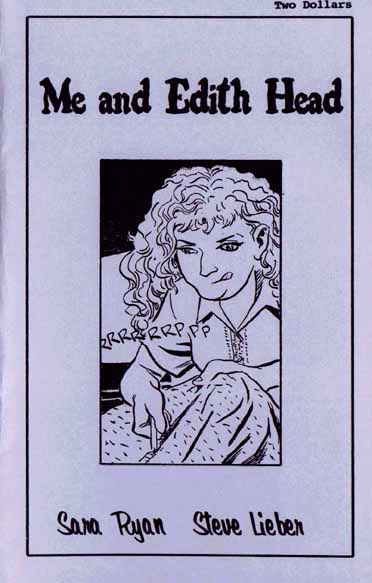
FYC Replay: Me & Edith Head with Sara Ryan and Steve Lieber

Here's another installment in the archiving of my Pulse columns, For Your Consideration. In this one, I had the opportunity to interview, by email, Sara Ryan and Steve Lieber. They were very gracious in taking the time to answer my questions, and when I had the opportunity to meet them in person at the Small Press Expo in 2009, they were just as gracious. The interview is a couple of years old, so the "upcoming projects" question includes work long since completed - except for Mr. Lieber's mention of Greg Rucka's scripts for the third Whiteout miniseries, "Thaw." That has yet to see publication, but I did see the original pages for that first issue - penciled, inked, and lettered - at SPX 2009. I'm not sure when it will find its way onto Oni Press's publication schedule, but when it does, you will not be disappointed. For now, though, enjoy this look at one of the best mini-comics you'll find out there.
Thanks,
chris


FRONT PAGE:
Warren Ellis put it best when he stated, “I’ve always been faintly disgusted by Steve Lieber's level of talent. Now it appears I have to have his wife killed too.” Me and Edith Head is a brilliant lesson in economy. With only fifteen pages, Ryan and Lieber manage to create a complete and fulfilling narrative that will resonate long after you put it down.

The 411:
Me and Edith Head
Written by Sara Ryan
Drawn by Steve Lieber
15pp. b/w
$2.00
Cold Water Press

What It Is (with apologies to Dave the Thune):

Wiser people than I have stated what many know to be true already, but it still bears repeating. Me and Edith Head is one of those gems all fans of the medium should seek out. Originally published in the September/October 2001 issue of Cicada magazine, it stars Katrina Lansdale, a character from Sara Ryan’s first novel Empress of the World. When that issue of Cicada went out of print, Ryan and Lieber decided to publish Edith Head as a 15-page chapbook in 2002 through their own publishing company Cold Water Press, and it was nominated for an Eisner award in the “Best Short Story” category that year.

Katrina is a character easily recognizable to many readers. A high school student dealing with the pressures inherent during that period of our lives, she must also contend with being one of those girls hovering just outside the cliques so ingrained within high school society. Compounding these difficulties, Katrina’s parents are quickly heading toward divorce, something that appears to have been a long time coming. She needs an outlet and auditions for the school play, a production of Shakespeare’s A Midsummer Night’s Dream. Hoping for the part of Titania, Katrina is instead delegated the task of costume designer.

Katrina is disappointed with the position and sees little hope of enjoying her time with the play. But something surprising happens. Katrina discovers a talent for the fashion needs of the company, and with the help of some books on Edith Head – an Oscar-winning costume designer – she discovers an inner confidence of which she was unaware. Growing up is difficult, but sometimes when one’s mind is diverted, it can happen without thinking.

This is an incredible little book. With only fifteen pages, Ryan and Lieber present a fully-fleshed out narrative in which the audience is witness to Katrina’s growth from a troubled teen to a confident young woman. This slim book packs more story into it than any collection from the “Big Two,” with very few exceptions. Ryan and Lieber hit all the high notes of the story, utilizing the comic page to its fullest, while eschewing the padded storytelling practice of decompression so common in many of today’s comics. This husband and wife team also exhibits an understanding of comics as a melding of words and pictures, allowing the images to tell the story in a way most creators never conceive.

One page in particular, in which the audience watches Katrina’s bedroom go from a typical teenage sty to a clean, well-ordered space as snippets of her parents’ dialogue illuminate their decaying relationship, is a prime example of how well thought out and well executed a comic this is. Throughout the story, Ryan’s dialogue is spot-on, and she expands much of the narrative with the unspoken statements lying beneath the characters’ words. And Lieber’s art is as superb as fans have come to expect. He is one of the best artists working in comics today with panels that are fully realized without being cluttered, allowing him to tell any type of story with a craft unmatched by many in the industry. Though not flashy, Lieber’s style is full of substance, and any book drawn by him is always a pleasure to read.

If you’re lucky enough to be attending a convention where Steve Lieber and Sara Ryan are in attendance, seek him out and buy this book. If not, go to Sara's website where you can order it through paypal. You’ll thank me.

An Interview with Sara Ryan and Steve Lieber:

Chris Beckett: What reaction have you gotten from fans at conventions regarding Edith Head and other mini comics you have available?

Steve: The responses have varied from wildly enthusiastic appreciation to indifference to an odd, condescending sort of -- I don't know-- pity, maybe? I'm glad to say that the good reactions have been the most common. The minis I've illustrated are all terrific stories. Edith was nominated for an Eisner; Sean Stewart's Family Reunion was reprinted in The Year's Best Graphic Novels, Comics & Manga. And Sara's first Flytrap story was wonderful. I'm hugely excited that she and Ron Chan are keeping the series going.

The few negative reactions I think just spring from people who haven't grasped that an artist might enjoy telling more than one kind of story. I'm just guessing here, but I get the feeling that the thinking is something like: "You drew Batman and Civil War: Frontline and Whiteout, and here you are with these little xeroxed booklet thingies about characters I've never heard of? What happened?” What happened is that I love drawing both big action stories about larger than life heroes, and smaller, more intimate stories about real people. Mini-comics are a great venue for the latter.

Beckett: With the experience you have in the comics medium, how much input into the story did you have?

Steve: Not much really. Sara's a natural visual storyteller. There might have been a few panels where I'd offer a suggestion to make things flow more easily, but she grasped the underlying mechanisms of comics from the start, and instantly knew how to make her points visually, manipulate time, play word against image -- all the things that a comic writer needs to know intuitively to make the medium work.

Beckett: Why did you choose to present Me and Edith Head as a comic?

Sara: There were a couple of things going on when I decided to write Edith. First, I just wanted to experiment with comics writing. Steve says that comics people are vampires, in that they turn everyone around them into comics people, too. That definitely happened to me. As I read and enjoyed more and more comics and graphic novels, I got increasingly intrigued about the possibility of writing comics myself. And at the same time, I'd just published my first novel, Empress of the World, and introduced some characters that I had -- and have -- a lot of affection for, including Katrina Lansdale. When we meet Katrina in Empress, she's very much a costume and fashion expert, but I knew she hadn't always been that way, and I wanted to tell the story of how she developed that interest and expertise. I also knew that by its nature the story would be very visual, so it just made sense to do it as a comic.

Beckett: Me and Edith Head is as fully realized a story as one could find. How challenging was it to fit it within the fifteen pages of the mini comic?

Sara: Thank you! I tend to write in a very compressed way, whether I'm writing prose or comics. More often than not, I find that I need to add or extend scenes in order for the story in my head to take coherent shape on the page.

Beckett: What was the collaborative process like for you two on Me and Edith Head, and how did it differ from other comics you have done, Steve?

Steve: We just talked about the story and she set to writing. It differed mainly in that I had the writer on-site to clarify matters where I had questions. The script said, "Katrina enters the thrift shop.” I asked how she was entering: tentatively, normally, forcefully? Sara went out of my studio, closed the door behind her and barged back in with squared shoulders and a face that was all business. So I drew that. And it's a story about a teen girl's relationship with clothing and how she dresses, so it was certainly handy for me to have her lean over my board now and then and say things like, "Ooh. She'd never wear that with a belt."

Sara: I would just add that when Steve and I collaborate, it's a little like Calvinball. We keep changing the rules, and sometimes someone has to sing the I'm Very Sorry song. But overall it's fun.

Beckett: What other current or forthcoming projects do each of you have that you might like to speak about?

Steve: I've been doing a ton of commercial and advertising art recently, so a lot of my recent work isn't available in comic’s stores. If you're in Japan, you can see an indoor parade I helped design for the Hello Kitty theme park Sanrio-Puroland. The Thunderbolts Annual I drew for Marvel comes out this month. My current comic projects are Underground - a graphic novel written by Jeff Parker, and a story for the Belgian publisher Dupuis. And of course Greg [Rucka]'s going to be writing the third and final Whiteout book, Thaw. I can't wait to get my hands on that.

Sara: My second novel, The Rules for Hearts, is just out, and I have not one, not two, but three more minicomics collaborations coming soon: "Click," with Dylan Meconis, "Einbahnstrasse Waltz" with Cat Ellis, and the third episode of Flytrap, "Over the Wall," with Ron Chan.

STAR WARS -- a modern trailer

 This came across my feed, and it's pretty stellar, even if it utilizes some special edition cuts.